






How to calculate total cost of ownership for wireless HVAC thermostats?
Authoritative guidance from an HVAC remote-control specialist with practical experience in smart thermostat deployments, energy management and system integration. This guide answers six long-tail, buyer-focused questions that commonly lack detailed, up-to-date answers online. Semantic terms such as smart thermostat, Wi‑Fi thermostat, Zigbee, Z‑Wave, BACnet, Modbus, remote sensors, occupancy analytics, OTA firmware and mesh network are used throughout.
1. How to calculate total cost of ownership for wireless HVAC thermostats, including subscription fees, firmware support and energy savings?
Begin by defining the analysis period (commonly 5–10 years) and listing every cost and benefit. Total cost of ownership (TCO) is not just the device price — include installation, integration, commissioning, recurring cloud/subscription fees, maintenance, battery replacement or power modules, expected firmware/support costs, and disposal or replacement at end-of-life. Subtract measured or estimated energy savings and productivity/comfort gains where monetizable.
Core formula (simple):
TCO = Upfront_Costs + Present_Value(Recurring_Costs_over_N_years) - Present_Value(Energy_Savings_over_N_years)
Breakdown (per thermostat):
- Upfront_Costs = device_price + installation_labor + additional_sensors + gateway/hardware_for_BMS_integration + commissioning
- Recurring_Costs = annual_subscription + annual_maintenance + battery_replacements (if applicable) + cloud_connectivity_charge (SIM/cellular)
- Energy_Savings = annual_kWh_savings * $/kWh + heating_fuel_savings where applicable
Discount future cash flows to present value using a discount rate (realistic commercial rate 3–7%). If you prefer a simpler metric, calculate simple payback = Upfront_Costs / (Annual_Energy_Savings - Annual_Recurring_Costs).
Example (sensitivity-friendly numbers):
- Device price: $250
- Installation & commissioning: $150
- Additional remote sensor: $60
- One-time gateway/BMS driver amortized to this unit: $300 (shared across few thermostats)
- Annual subscription: $50/yr
- Annual maintenance: $20/yr
- Estimated annual energy savings attributable: $300/yr (based on occupancy optimization & setback)
- Analysis period: 10 years; discount rate: 5%
Upfront = 250 + 150 + 60 + 300 = $760. Net annual benefit = 300 - (50 + 20) = $230. Simple payback = 760 / 230 ≈ 3.3 years. To get NPV: compute present value of 230/yr for 10 years at 5% = 230 * ≈ 1,776. NPV = PV_savings - Upfront = 1,776 - 760 = $1,016 (positive). This shows the device is cost-effective under these assumptions.
What to watch for (sensitivity):- If subscription fees are higher or energy savings lower, payback extends quickly.- For fleet deployments, gateway and integration costs are amortized and lower per-unit. Bulk device discounts can change the math substantially.- Use measured pre/post energy data to validate projected savings (A/B testing or short pilot deployments).
2. Which wireless protocol (Wi‑Fi, Zigbee, Z‑Wave, BLE, Thread, proprietary) minimizes latency and maximizes security for multi-zone HVAC remote control in commercial buildings?
Choice depends on scale, latency tolerance, security posture, and existing infrastructure. Key comparisons:
- Wi‑Fi thermostat: Best for direct cloud/remote access without a gateway. Advantages: high bandwidth, native internet access, easy remote control via cloud APIs. Drawbacks: higher energy use for battery-only devices, depends on facility Wi‑Fi security (WPA2/WPA3 required), potential interference on congested networks.
- Zigbee / Z‑Wave / Thread: Low-power mesh protocols ideal for battery sensors and many endpoints. Advantages: scalable mesh, lower power, local mesh resilience. Drawbacks: typically require a gateway to connect to the cloud/BMS, vendor-dependent security features (look for AES-128/256 and secure commissioning).
- BLE (Bluetooth Low Energy): Good for proximity/configuration and local sensor links; less ideal for wide multi-zone coverage without repeaters.
- Proprietary RF: May offer excellent range and battery life but risk vendor lock-in and unknown security implementations.
Security considerations (critical for remote control): use WPA3/WPA2-Enterprise where possible for Wi‑Fi; ensure TLS 1.2+/mutual TLS for cloud connections; verify OTA firmware is signed and delivered securely; require role-based access control and multi-factor authentication for cloud portals. For commercial BMS integration prefer protocols that support secure tunneling and encryption (BACnet/SC is emerging to replace insecure BACnet/IP).
Recommendation: For commercial multi-zone projects combining reliability and security, use a mix — local mesh sensors on Zigbee/Thread with a hardened gateway that bridges to BMS via secure BACnet/Modbus drivers and to the cloud using TLS with device identity management. This minimizes latency for local controls and centralizes secure remote access.
3. How to size and position remote sensors and repeaters for accurate temperature control and reliable remote access in large floorplans?
Sizing sensors and repeaters is driven by HVAC zoning strategy, occupancy patterns, and RF environment. Steps:
- Define control zones by thermal behavior (not just floor area). A 10,000 sq ft open office with uniform HVAC might be one zone; areas with different solar gain or occupancy need separate zones.
- Place at least one temperature sensor per zone near the thermostat’s control point and additional remote sensors at representative locations (near north-facing windows, high-occupancy desks, conference rooms). Use occupancy sensors where demand-controlled ventilation is employed.
- Aim remote sensor spacing so each sensor monitors no more than the area where conditions are expected to be homogeneous — typical rule: one sensor per 1,000–2,500 sq ft for open-plan offices, more for mixed-use spaces.
- Wireless repeaters (or mesh nodes): place repeaters where signal strength from sensors/gateway drops below -80 dBm or where walls/metal structures attenuate RF. In a mesh, arrange nodes to create robust multiple-hop paths. Use a wireless survey (walk-test) to confirm RSSI and packet loss targets: aim for > -70 dBm and <1% packet loss for reliable real-time telemetry.
Practical tips:- Avoid mounting sensors above HVAC diffusers, in direct sunlight, or next to heat sources.- Calibrate sensors and verify cross-sensor offsets; typical ±0.5°C accuracy is desirable.- For mission-critical installations, use redundant gateways and dual‑radio gateways (Wi‑Fi + Zigbee/Thread) to reduce single points of failure.
4. What are realistic energy savings and ROI for retrofitting wireless thermostats in a 50,000 sq ft office, accounting for occupancy patterns and HVAC inefficiencies?
Energy savings vary widely by baseline controls, HVAC efficiency, and occupancy. Government and industry studies (DOE, ENERGY STAR, vendor field studies) typically report smart thermostat savings in the range of:
- Heating: 8–15% savings (range depends on fuel type and baseline setbacks/thermostats)
- Cooling: 10–15% savings with optimized scheduling, demand-response and setback
Method to estimate ROI for a 50,000 sq ft office:
- Establish baseline HVAC energy cost. Example baseline: HVAC energy + cooling & heating roughly equals 30–50% of total building energy. If total energy cost is $2.00/ft2·yr (example), total = $100,000/yr; HVAC share ~ $40,000/yr.
- Apply conservative savings estimate, e.g., 10% of HVAC energy = $4,000/yr saved.
- Estimate retrofit cost: device count depends on number of zones. If 50 thermostats are required (typical for medium zoning), per-thermostat TCO (upfront incl. installation and sensors) might be $600–$1,200 commercial, plus integration costs. Using $800/unit upfront = $40,000 total.
- Simple payback = 40,000 / 4,000 = 10 years. If you target deeper control (occupancy analytics, VAV integration) energy savings could rise to 20–30% of HVAC energy, shortening payback to 3–5 years.
Key levers to improve ROI:- Increase measured savings via occupancy-based control and sensor fusion (CO2, PIR, remote sensors).- Reduce integration costs through vendor support and standardized drivers (BACnet/Modbus).- Seek utility rebates and demand response incentives — these can materially reduce upfront expense.
Given the variability, we strongly recommend a short pilot (5–10% of zones) to measure real energy and comfort impacts before full roll-out.
5. How to evaluate long-term cybersecurity and firmware update policies from thermostat vendors to ensure safe remote control?
Evaluating cybersecurity should be a procurement gate, not an afterthought. Checklist:
- Firmware updates: vendor provides signed OTA updates, documented frequency (critical patches within 30–90 days), and a clear change log.
- Vulnerability management: public or private vulnerability disclosure program, evidence of third-party security testing (pen tests, code audits), and CVE handling where applicable.
- Data in transit & at rest: TLS 1.2+ with strong cipher suites for communications; AES-256 for stored sensitive data; no default shared passwords; support for certificate-based device identity.
- Authentication & access control: role-based access, MFA for admin access, granular API keys and revocation procedures.
- Local-control mode: the ability to operate locally without cloud dependency for critical HVAC control during outages.
- Supply chain & hardware security: secure boot, signed firmware, hardware-backed key storage where feasible.
- Logging & monitoring: vendor provides logs, SIEM-friendly integration, and incident response SLA.
Ask vendors for a security datasheet and evidence of certifications or audits (e.g., SOC 2 for cloud services). For enterprise/BMS integration, insist on BACnet/SC or secure tunneling rather than open BACnet/IP with no encryption.
6. What are hidden installation and integration costs when connecting wireless thermostats to an existing BMS (BACnet/Modbus) and how to estimate them?
Hidden costs often exceed the device price. Common items:
- Gateway hardware and licensing for protocol translation (e.g., Zigbee-to-BACnet gateway, cloud-to-BMS adaptor).
- Engineering time to design control logic, map points and create custom drivers (driver development or building custom BACnet objects).
- Commissioning and point-to-point testing — typically measured in engineer-hours or days.
- Downtime scheduling or after-hours labor to avoid business disruption.
- Control contractor/third-party integration fees and additional BMS licenses for new devices.
- Training for facilities staff and documentation updates.
Estimating approach:1) Count endpoints that require mapping. 2) Estimate per-endpoint engineering time (simple mapping: 0.25–0.5 hours each; custom control logic: 1–4 hours each). 3) Add gateway & license costs (one-time). 4) Add commissioning time (usually 1–3 days of on-site work for medium projects). Multiply engineering hours by your hourly rate or vendor quote.
Example ballpark: for 50 thermostats, simple mapping might take 50 * 0.5 = 25 engineering hours. Custom logic and testing may add 40 hours. At a blended rate of $120/hr, labor = $7,800. Gateway and licenses $2,000–$8,000 depending on vendor. Commissioning & travel another $2,000. These ranges illustrate why integration can be $10k–$20k on top of device costs for moderate deployments.
Mitigation: choose thermostats with native BACnet/Modbus support or robust, documented APIs to lower driver development time; amortize gateway and engineering across more devices to reduce per-unit integration cost.
Concluding summary of advantages of wireless HVAC thermostats and remote control
Wireless HVAC thermostats with properly designed remote-control architecture offer improved occupant comfort, faster fault detection, energy savings and flexible zoning without heavy wiring costs. When chosen and implemented with the right wireless protocol mix, strong cybersecurity, correctly sized remote sensors, and rigorous integration planning, they deliver measurable ROI and operational benefits including reduced maintenance time, remote commissioning and data-driven energy management. Pilot deployments, accurate TCO calculations and attention to firmware/security policies turn potential vendor risk into a strategic operational asset.
For precise, site-specific TCO modeling, wireless protocol selection, or a detailed quote for sensors, gateways and integration services, contact us for a quote.
Company: SystoRemote (www.systoremote.com) | Email: [email protected]
CRC014V LITE
Does it work with smart TVs?
Yes, it works with most IR-compatible smart TVs from major brands.
KS-PN03V
Is this model available for other brands?
Only for Panasonic. But we offer a full range of universal remotes for different A/C brands. Please contact us for details.
CRC2303V
Are batteries included?
No, batteries are not included. Please use 2×AAA batteries.
Does this remote need any setup or pairing?
No need. Simply insert two AAA batteries to start using.
G10S
Can I use it with a Smart TV?
Yes, it supports most Android Smart TVs, TV boxes, and PCs.
Recommended For You
Infrared LED light remote for Panasonic Japan market. No setup required. Supports dimming, color adjustment, timer, and 3-channel switching.
Do solar remote controls still use lithium batteries? Learn how modern solar-powered remotes now adopt supercapacitors with USB Type-C fast charging for improved safety, durability, and long lifespan.
Learn how to check whether a garage door remote control bought online is compatible with your opener. Frequency, learning type, and easy tips explained.
Having trouble setting up a universal remote even though your TV brand is listed in the manual? Learn the real reason, common mistakes, and how to improve success by using precise TV codes.
Learn how to set up and program the CRC1130V universal remote control for your TV. This step-by-step guide covers direct brand buttons, code input, and auto search methods for quick and easy pairing.
You May Also Like
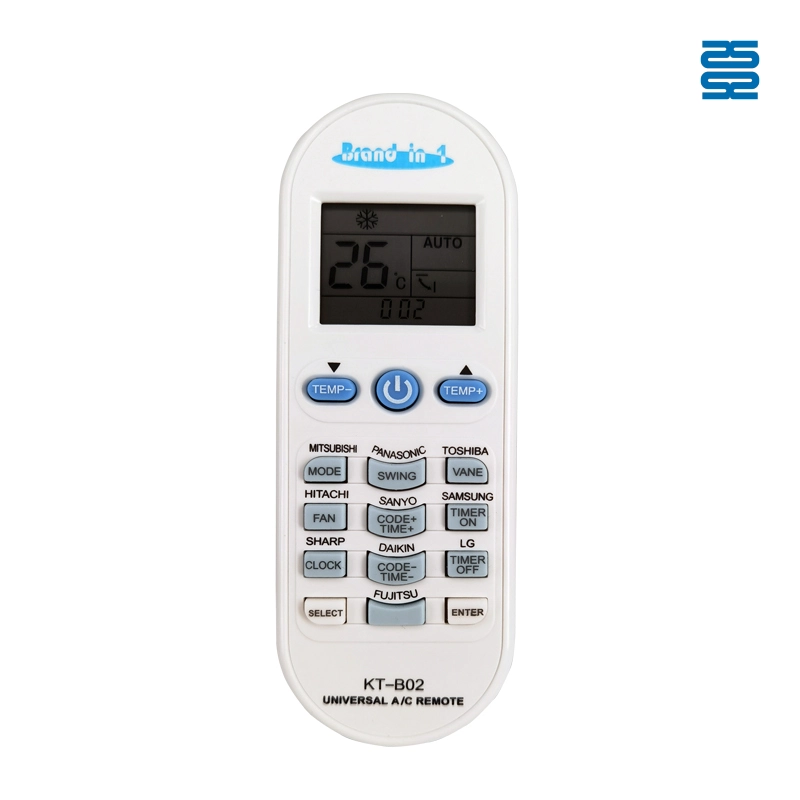
KT-B02 Universal Air Conditioner Remote Control Compatible with All Brands
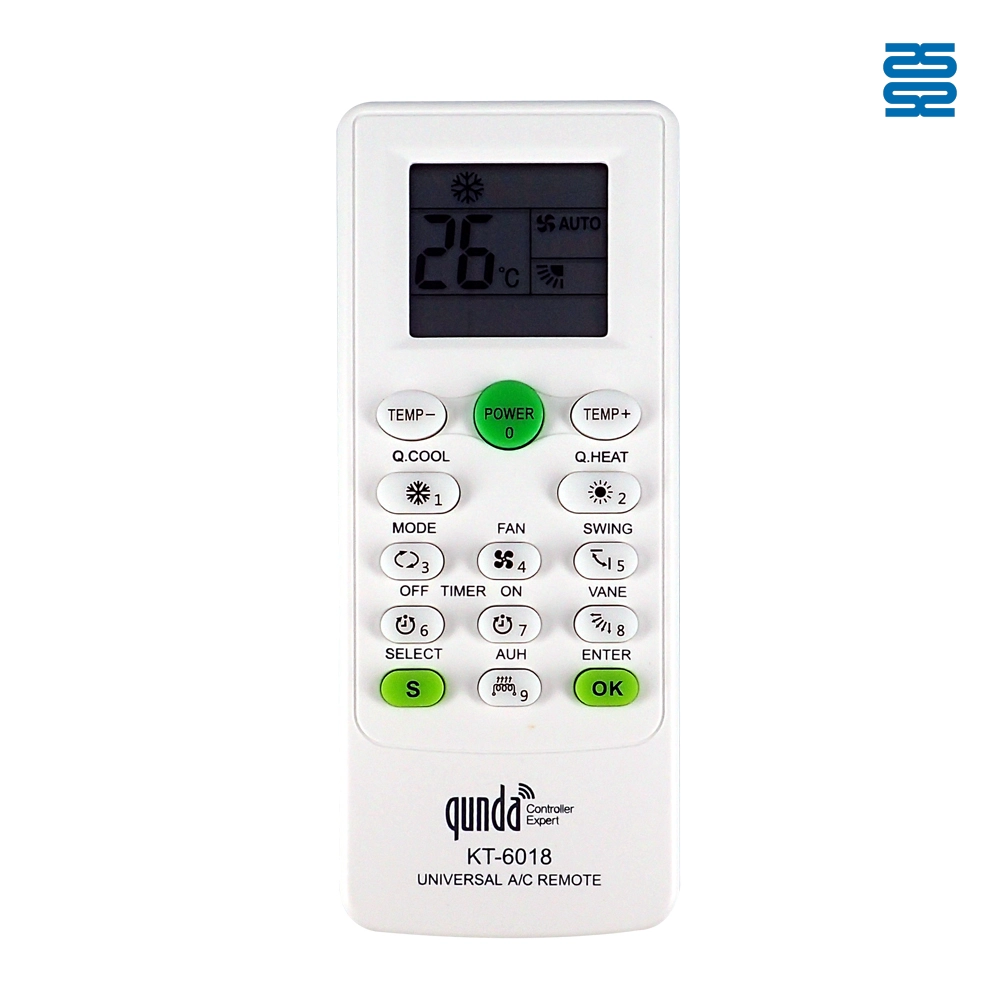
KT-6018 6000 in 1 Universal Air Conditioner Remote Control Compatible with All Brands

QD-1000 IN 1 1000 Code in 1 Universal Air Conditioner Remote Control Compatible with All Brands

KT-N828 Universal Air Conditioner Remote Control Compatible with All Brands
◼ Let’s Build Together
Get in Touch with SYSTO
If you have any comments or good suggestions, please leave us a message, later our professional staff will contact you as soon as possible.


Contact
Email us
Text or Call us
Address
Room 1606, No. 65, Zhongshan Seven Road, Liwan District, Guangzhou, Guangdong, China.

Facebook
Instagram
YouTube
Tik Tok
VK