






What are OEM vs aftermarket window air conditioner remotes?
1. How can I confirm an exact OEM replacement remote when the original model number is missing?
Beginners often face lost remotes and no model sticker. To confirm an exact OEM replacement, follow these steps:
- Locate the appliance model number on the window air conditioner chassis (usually on a label behind the filter or on the side panel). Write it down — manufacturers map remote part numbers to unit model numbers.
- Inspect the original remote: many remotes have a small label or molded part number inside the battery compartment. If you have photos of the remote, they help vendors verify button layout and LCD icons.
- Cross-reference with the manufacturer. OEM remotes are listed in technical/service manuals or parts catalogs on manufacturer websites. If the brand provides an online parts lookup, enter the AC model number to find the exact remote part number.
- When unsure, request the remote's P/N from an authorized parts dealer. OEM part numbers are definitive; buy only if the seller guarantees a one-to-one match to your AC model.
Why this matters: OEM remotes often include hardware features such as a built-in temperature sensor, backlit LCD, or specific button functions (sleep, eco, ionizer) mapped to the unit’s firmware. A visual match alone does not guarantee identical behavior.
2. Will a universal or aftermarket window AC remote control support advanced features like sleep, eco, ionizer, or auto-swing?
Short answer: sometimes, but often not fully. Many universal and low-cost aftermarket remotes cover basic commands (power, temperature, fan speed, mode) but omit or only superficially emulate advanced proprietary features.
Details:
- Proprietary functions: Features such as built-in ionizers, HEPA/filter reminders, humidity control, or specific sleep/eco algorithms may be implemented on the AC’s control board and require remote commands with proprietary codes. If the aftermarket remote does not have those exact codes, the unit won’t enable the behavior or will default to a closest-match function.
- Buttons vs. signals: Some aftermarket remotes include physical buttons like 'sleep' but send a generic command the unit’s firmware doesn’t interpret as the manufacturer intended. That produces unpredictable results.
- Display-driven modes: If the OEM remote has an LCD that sends compound settings (schedules, timers), a simple universal remote cannot replicate the multi-step signals unless it explicitly supports your model’s protocol.
Recommendation: If you rely on advanced features for comfort or energy savings, prioritize OEM replacements or high-quality aftermarket remotes that list explicit compatibility with your AC model and confirm support for each advanced feature you need.
3. My replacement remote’s LED blinks but the window AC doesn’t respond — how do I diagnose IR vs RF and protocol mismatch?
Start with basic checks, then move to protocol-level diagnostics:
- Battery and LED check: Confirm fresh batteries and that the remote’s IR LED blinks when pressing buttons (visible through a digital camera or phone camera — IR appears as a flashing violet/white light on most CMOS cameras).
- Line-of-sight and range: IR requires clear line-of-sight. Test at 1–3 meters directly in front of the receiver. RF remotes don’t need direct line-of-sight but must be paired or use the correct frequency.
- Receiver condition: Inspect and clean the AC IR receiver lens. Dirt, direct sunlight, or decals can block IR signals.
- Protocol/carrier mismatch: Consumer IR commonly uses ~38 kHz carrier modulation, but protocols (NEC, RC5, proprietary) differ in pulse coding. If your replacement remote uses a different carrier or protocol, the unit will not decode it. For RF remotes, common ISM frequencies are 315 MHz or 433 MHz; a mismatch prevents communication.
- How to establish the mismatch: If you have the original remote, compare behavior. If not, try a known-compatible universal remote configured for your AC codes. Professional tools (IR analyzers or logic scopes) can confirm carrier frequency and code format, but most consumers will rely on cross-referenced part numbers or vendor compatibility lists.
If basic checks fail, return the remote under the seller’s warranty and ask for an explicit compatibility confirmation or an OEM unit.
4. Will using an aftermarket remote void my window air conditioner warranty or cause regulatory issues?
Warranty and regulatory impacts depend on what you replace and how:
- Warranty: Replacing a remote with a third-party remote is typically considered a user replacement and rarely voids the appliance’s main warranty, since the remote is an external accessory. However, if a seller or manufacturer explicitly states that third-party accessories void certain service guarantees, you should get that in writing. Opening the unit or modifying internal electronics can void warranty.
- Regulatory compliance (RF): If the remote uses RF, it must comply with national radio regulations (e.g., FCC rules in the USA, CE/RED in Europe). Reputable aftermarket RF remotes are FCC-certified — check the listing or label. Using a non-compliant RF device could technically violate regulations and cause interference.
- Safety and electrical risk: Remote controls are low-voltage battery-powered devices; replacing them rarely poses an electrical safety hazard. The main risks are poor build quality, corrosion in battery compartments, or use of wrong battery types that can leak. Buy remotes with UL/ETL/CE markings from reputable vendors when possible.
Bottom line: Confirm warranty terms with the manufacturer and choose FCC/CE-certified RF remotes. Keep purchase receipts and test early so you can return nonfunctional units within the seller’s return window.
5. Can I reprogram or 'teach' a universal remote to match a proprietary window AC protocol, and what tools or procedures are needed?
There are two general approaches:
- Learning remotes: Some high-end universal remotes can learn IR codes from the original remote. To use this, you need the original remote to be functional. Place the remotes face-to-face and follow the learning procedure; the learning remote records the IR pulses and replays them. Limitations: learning remotes capture the raw signal but may not replicate special timing or repeated multi-packet transactions perfectly.
- Code libraries and manual programming: Most universal remotes include a database of manufacturer codes you program by entering a model code or cycling through codes until the AC responds. This requires that the universal’s library includes your AC’s protocol.
Tools for advanced users or technicians:
- IR detector or smartphone camera for basic verification of emission.
- IR analyzer or logic analyzer to inspect carrier frequency and pulse timing for protocol cloning.
- Service manual or schematic that documents remote-to-board signaling (this is rare for consumer units but available to authorized technicians).
Practical advice: If you don’t have the original remote and the universal’s library lacks your model, teaching is not possible. For proprietary encrypted RF systems, cloning is generally infeasible without specialized equipment and manufacturer cooperation.
6. How do I choose a replacement remote that matches IR carrier frequency, provides reliable range, and preserves battery life?
Key technical specifications to check when buying a replacement:
- Carrier frequency and protocol: Look for remotes that explicitly list compatibility with your model. Most IR consumer remotes use a 38 kHz carrier; some use 36 or 56 kHz. The protocol matters more than carrier alone. If seller specs don’t list the protocol, request confirmation.
- IR LED quality and range: Higher-quality remotes use multiple IR diodes or driven LEDs to reach longer ranges. Read product specs for operating range (typical 5–10 meters for consumer remotes). If you need long-range operation, choose remotes advertised for extended range.
- Built-in temperature sensor: Some OEM remotes include a remote-mounted thermistor that the AC uses for local temperature feedback. If the OEM remote had a temperature sensor, ensure the replacement includes one; otherwise the unit may behave differently, running longer or shorter cycles.
- Battery type and life: Check battery type (AA, AAA, or coin cell) and the typical battery life rating. Consider remotes with low-power microcontrollers and auto-sleep to extend battery life. Also check battery compartment quality to avoid corrosion.
- Physical fit and control mapping: Confirm button layout and labeling, because frequent use functions should be easy to access. A remote with identical mapping reduces user error.
Test immediately: Within the return period, test all modes, timer functions, and advanced features. Keep packaging for returns if the remote does not fully match functional behavior.
Concluding summary of advantages:
OEM remotes: guaranteed protocol and feature parity, correct temperature sensor and full access to proprietary modes, higher initial cost but lower risk of lost functionality; ideal when advanced features, warranty clarity, and exact compatibility matter. Aftermarket/universal remotes: lower cost and broad availability, suitable for basic control (power, temp, fan), but may lack full support for proprietary features, sensors, or encrypted RF pairing; choose high-quality, certified aftermarket units that explicitly list model compatibility to minimize issues.
If you need a verified OEM replacement, a high-quality universal remote with documented compatibility, or a professional quote for bulk orders, contact us for a quote at www.systoremote.com or email [email protected].
CRC014V LITE
How can I set up the remote?
You can use the Quick Brand Setup, Manual Code Input, or Auto Search method (instructions included).
CRC2303V
Which original LG models can it replace?
Compatible with numerous LG remotes including AKB72915210, AKB73975757, AKB74475490, MKJ42519604, AKB73975761, AKB74915324, MKJ42519605, AKB74475472, and many more.
Does this remote need any setup or pairing?
No need. Simply insert two AAA batteries to start using.
BN59-01432A
Does this replacement remote work the same as the original Samsung BN59-01432A?
Yes, it has the same features, layout, and functions — including voice recognition, Bluetooth, and solar charging.
AN-MR25GA
Does it work with all LG TVs?
It is compatible with LG 2025 TV models including OLED G5/C5/B5 and QNED 92A/85A/80A/UA77 series.
Recommended For You
Infrared LED light remote for Panasonic Japan market. No setup required. Supports dimming, color adjustment, timer, and 3-channel switching.
Do solar remote controls still use lithium batteries? Learn how modern solar-powered remotes now adopt supercapacitors with USB Type-C fast charging for improved safety, durability, and long lifespan.
Learn how to check whether a garage door remote control bought online is compatible with your opener. Frequency, learning type, and easy tips explained.
Having trouble setting up a universal remote even though your TV brand is listed in the manual? Learn the real reason, common mistakes, and how to improve success by using precise TV codes.
Learn how to set up and program the CRC1130V universal remote control for your TV. This step-by-step guide covers direct brand buttons, code input, and auto search methods for quick and easy pairing.
You May Also Like
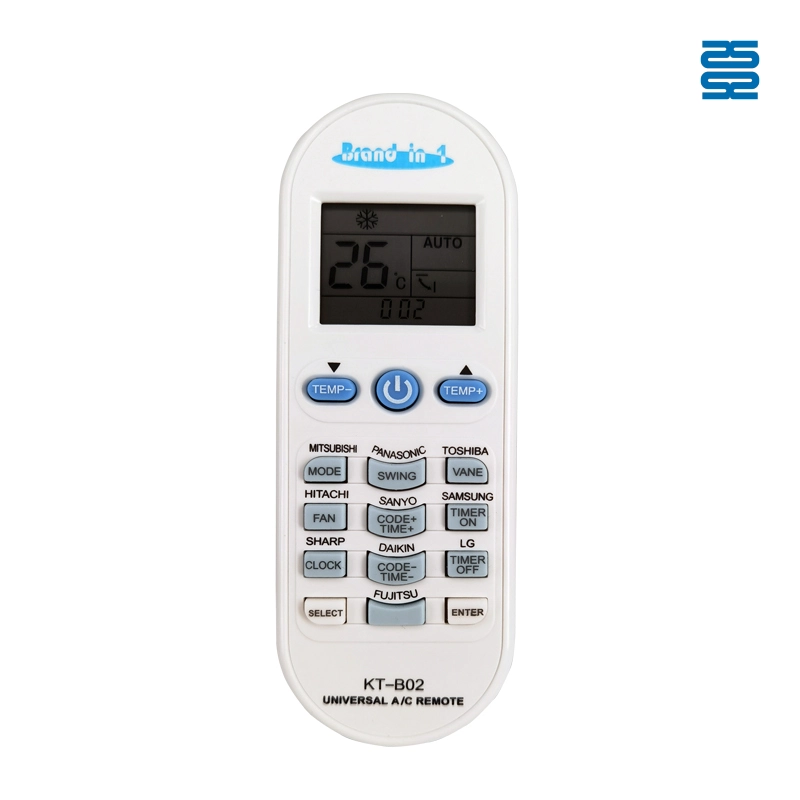
KT-B02 Universal Air Conditioner Remote Control Compatible with All Brands
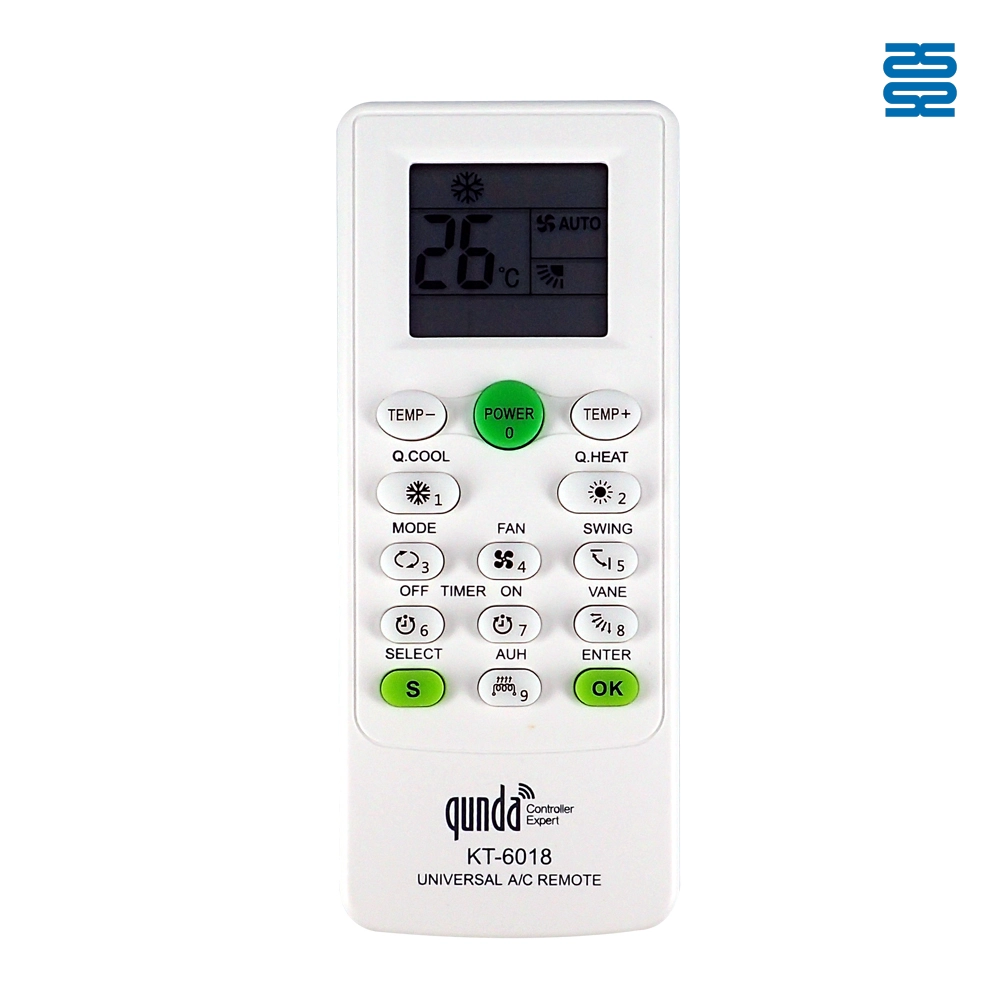
KT-6018 6000 in 1 Universal Air Conditioner Remote Control Compatible with All Brands

QD-1000 IN 1 1000 Code in 1 Universal Air Conditioner Remote Control Compatible with All Brands

KT-N828 Universal Air Conditioner Remote Control Compatible with All Brands
◼ Let’s Build Together
Get in Touch with SYSTO
If you have any comments or good suggestions, please leave us a message, later our professional staff will contact you as soon as possible.


Contact
Email us
Text or Call us
Address
Room 1606, No. 65, Zhongshan Seven Road, Liwan District, Guangzhou, Guangdong, China.

Facebook
Instagram
YouTube
Tik Tok
VK