






universal remote for sanyo tv | Insights by SYSTO
How can I program a modern learning universal remote to control an old Sanyo CRT TV when no code exists?
Most older Sanyo CRT sets use standard IR carriers (commonly 38 kHz) and legacy protocols (NEC, RC5, Sony variants), but many code lists don’t include extremely old or region-specific models. If the remote database lacks your Sanyo model, use a learning universal remote or IR learning device. Steps:
1) Prepare: get a learning-capable remote (Inteset 4-in-1, SofaBaton, or any remote with an explicit IR-learning function) or an IR blaster/hub with learning (BroadLink RM4 Pro, FLIRC + IR emitter array). Ensure both remotes have fresh batteries and are 6–12 inches apart facing each other.
2) Enter learning mode: follow the universal remote’s manual to start the IR-learn routine (usually hold a button until a LED blinks). On many remotes you assign the target device (TV) before learning.
3) Align and capture: press and hold the original Sanyo button (power, volume, input) while the learning remote receives and stores the IR bursts. For intermittent or noisy IR you may need to transmit each button several times; use the remote’s ‘repeat’ or ‘timing adjust’ option if available.
4) Verify and repeat for all essential keys: test power, volume, input/source, and channel keys. Older sets sometimes use toggle or long-press vs. repeated pulses—capture both behaviors if the learning remote allows macro timing.
5) Save and label: store the learned set under a device slot labeled “Sanyo CRT” so you can restore it later.
Practical tips: if learning fails, try positioning the remotes at different angles, increase the capture time, or use a known-working donor remote that shares the same protocol (for example other Japanese/Asian-brand remotes). If the TV uses very low- or high-frequency carriers, a specialized IR receiver (spectrum tester) may be necessary; many pros use a cheap IR receiver on a smartphone camera to visualize pulses before learning.
This approach avoids needing manufacturer codes and preserves original button behavior for legacy Sanyo sets.
Why does my universal remote control Sanyo TV power and volume but not Input/Source or Smart TV functions?
Universal remotes communicate via discrete IR code sets for basic TV functions (power, volume) and sometimes by only a limited subset of commands for input/source or smart keys. Reasons and solutions:
Limited code mapping: mass-market remotes map only common IR commands. Input/source and app-launch keys are often device-specific and not always part of generic datasets. Solution: use an IR-learning remote to capture the TV’s original Input/Source key or program a macro to simulate the input sequence (e.g., Send 'Menu' then navigate to input).
Smart functions use Bluetooth or proprietary RF: many modern smart Sanyo TVs (or TVs using external smart dongles) use Bluetooth or proprietary RF for app buttons (Netflix, voice) which IR-only universal remotes cannot replicate. Solution: use the TV’s mobile app, an official replacement remote with Bluetooth, or an advanced hub (Wi‑Fi/Hub-based systems like BroadLink or legacy Harmony Hub) that can emulate multiple protocols.
HDMI-CEC vs. discrete input: Input selection can be handled by HDMI-CEC from source devices rather than the TV remote. If your universal remote controls input by sending an IR code that the TV no longer prioritizes, try sending a CEC command from the source device or configure the remote to control the source (DVD/Box) rather than the TV.
For installers: verify whether the missing functions are IR-addressable on your specific Sanyo model (consult the service manual or original remote). If not, the correct fix is an RF/Bluetooth replacement or a hub that bridges Wi‑Fi/RF to IR.
Which universal remotes reliably support Sanyo TV IR learning and 50+ device macros for home theater setups?
When selecting a programmable remote for a Sanyo-based home theater, prioritize these features: robust IR database plus learning mode, macro/sequence programming, hub support (IR/ RF/ Wi‑Fi bridge), and device grouping for activities.
Recommended feature checklist (vendor-agnostic):
- IR learning and adjustable pulse timing (essential for older Sanyo sets).
- Hub-based option (IR blaster + Wi‑Fi or RF) to place emitters near concealed devices.
- Macro or activity sequences with delays and nested commands (e.g., Power On TV → Set Input HDMI1 → Power On AVR).
- Device slot capacity > 10 and macro storage > 50 steps or cloud-syncable macros.
Practical picks: mid-tier programmable remotes (Inteset 4-in-1, SofaBaton line) provide IR learning and macros at low cost; hub-based ecosystems (BroadLink RM4 Pro as an IR/RF hub, or legacy Logitech Harmony hubs while available) offer the most flexible integration for multi-device macros. For enterprise or integrators, look for remotes with RS‑232, IP control, or open APIs so you can automate functions and integrate with control systems.
Before buying: confirm the remote supports IR learning for your Sanyo model and has the physical IR emitter arrangement you need (individual emitters vs. single blaster). Ask the vendor about firmware updates and device database refresh policies to maintain compatibility with new devices.
How do I fix volume control lag, step issues, or double-stepping when using a universal remote with a Sanyo TV and AV receiver?
Symptoms (lag, double-volume increments, or unresponsive volume) usually come from these causes: conflicting control targets (TV vs AVR), differing IR repeat behaviors, or HDMI-CEC interfering with commands. Fixes:
1) Decide where volume should be handled: set the universal remote to control the AVR (recommended) if the AVR is your primary audio device. Controlling the TV’s volume while the receiver is active often causes duplication (TV receiving volume commands through both IR and CEC/ARC).
2) Use discrete volume codes: many remotes offer discrete volume up/down codes vs. toggle or long-press. Use discrete single-step commands to avoid double increments. Learning remotes can capture the exact pulse width used by your Sanyo or AVR.
3) Adjust repeat rate and key repeat delay: high repeat rates produce rapid volume jumps. Set the remote’s repeat delay to longer or disable auto-repeat; set a slower repeat rate on the universal remote if possible.
4) Eliminate CEC conflicts: if HDMI-CEC is enabled, your receiver and TV might both react to a single command. Test by disabling HDMI-CEC temporarily and checking volume behavior. If CEC is required, configure the remote to send volume commands to the AVR and leave power to the TV.
5) For RF hubs: confirm the RF-to-IR bridge has low latency and doesn’t throttle repeated volume commands. Some low-end IR repeaters aggregate pulses and cause double events. Use a hub with per-command passthrough and configurable debounce.
When diagnosing, log which device receives the IR code (use an IR detector or smartphone camera) and test single-step vs. long-press behaviors. That isolates whether the problem is from the remote, the hub, or the TV/AVR configuration.
Can I use a universal RF remote or an RF-to-IR bridge with a Sanyo TV placed inside cabinetry or another room?
Yes. Because Sanyo TVs (like most consumer TVs) use IR receivers with line-of-sight requirements, an RF remote (or RF-to-IR bridge) is a standard solution for hidden installations. Key options and best practices:
RF remote + IR blaster/hub: RF remotes send commands to a hub that retransmits IR via emitters placed near the TV/boxes (BroadLink RM4 Pro, some SofaBaton models with hubs). This overcomes line-of-sight and allows control through walls.
Dedicated IR repeater systems: commercial IR repeater systems place emitters directly on the IR windows of devices and a receiver outside the cabinet. Choose one with low latency and per-device emitters to prevent cross-talk.
Placement and cable management: put the IR emitter within 2–6 cm of the TV’s IR receiver, avoid metal obstructions, and route cable runs to minimize interference. For rooms separated by drywall, RF range is typically adequate; concrete or metal studs reduce range.
Latency and reliability: RF-to-IR bridges add slight latency (tens to low hundreds of milliseconds). For simple commands this is acceptable; for high-frequency step commands (rapid volume changes) choose a high‑quality hub with fast packet handling.
Security and interference: if using 433/868 MHz RF systems, verify local band regulations. Wi‑Fi-based hubs rely on your network—ensure a reliable 2.4 GHz signal near the hub.
This setup allows you to hide a Sanyo TV or AV gear while retaining full functionality, including macros and activities when combined with a programmable remote and hub.
How can I ensure a replacement universal remote will handle Sanyo smart TV firmware updates and dedicated app buttons like Netflix or voice control?
Universal remotes historically map static IR commands. Modern smart features (app launches, voice, Bluetooth pairing) often require more than IR and are tied to firmware or proprietary Bluetooth profiles. To ensure ongoing compatibility:
Identify how the smart buttons operate: if app buttons use IR scan codes, a universal remote with a wide device database or learning can replicate them. If those buttons use Bluetooth, RF, or are hard-coded in the TV’s BLE profile, a universal IR remote cannot emulate them.
Use a hub-based solution: Wi‑Fi/Hub systems (IR + IP control) can send API or network commands to smart TVs if the TV exposes an open API (some Android TVs expose ADB/IP control). That lets you trigger app launches independent of IR codes.
Consider mobile-app control: many modern Sanyo smart TVs (or rebranded Android-based panels) support official mobile apps that remain compatible through firmware updates. Pairing a universal remote with mobile app control (via hub or direct pairing) delivers the best longevity.
Check for firmware/update policy: ask the remote vendor about firmware updates and database refresh options. Vendors that offer cloud-updated device libraries or user-shared code repositories maintain relevance as TV firmware changes.
Voice and BLE: if voice or Bluetooth pairing is a requirement, look for remotes that include a Bluetooth HID/LE profile or a hub that can bridge Bluetooth voice (rare and usually platform-specific). Otherwise rely on the TV’s app or a manufacturer remote that supports the TV’s BLE profile.
In short: for durable smart-function support, choose a solution that combines IR learning, hub-based IP control, and vendor firmware updates rather than an IR-only universal remote.
Concluding summary: Advantages of using a universal remote for Sanyo TV
Using a well-chosen universal remote (learning-capable and hub-compatible) gives Sanyo TV users reliable replacement control for legacy and modern sets, consolidates multiple devices into activity macros, solves line-of-sight issues with RF/IR bridges, and provides future-proofing when paired with hub/IP control and firmware-updatable device databases. For concealed setups or AV racks, a hub with individual IR emitters and repeatable macros eliminates most integration pain points.
Contact us for a quote at www.systoremote.com or email [email protected].
CRC2605V
Can I customize my own app keys?
Yes, CRC2605V have 7 keys can set the learning function allows custom programming for other apps.
What’s the estimated delivery time?
In-stock items ship immediately; non-stock within 15–25 working days.
About Products
Do you sell both universal and dedicated remote models?
Yes, we offer universal, brand-specific, single-code remotes to fit different user needs.
CRC2303V
What streaming apps can it control directly?
Netflix, Prime Video, Disney+, FPT Play, LG Channels, IVI, WatchA, and Rakuten TV.
PU01
Does it include an overflow alarm?
Yes, an integrated alarm system triggers when the water level exceeds safety limits.
Recommended For You
The CRC2621V AI Universal Air Conditioner Remote is designed for the Southeast Asian market. With an AI search function and compatibility with 99% of air conditioner brands, it provides faster setup and a better user experience.
Infrared LED light remote for Panasonic Japan market. No setup required. Supports dimming, color adjustment, timer, and 3-channel switching.
Do solar remote controls still use lithium batteries? Learn how modern solar-powered remotes now adopt supercapacitors with USB Type-C fast charging for improved safety, durability, and long lifespan.
Learn how to check whether a garage door remote control bought online is compatible with your opener. Frequency, learning type, and easy tips explained.
Having trouble setting up a universal remote even though your TV brand is listed in the manual? Learn the real reason, common mistakes, and how to improve success by using precise TV codes.
You May Also Like

QD-HVAC23 Qunda Touch-Screen Thermostat for Air Conditioner

QD-HVAC06E Qunda Digital Thermostat for Central Air Conditioner
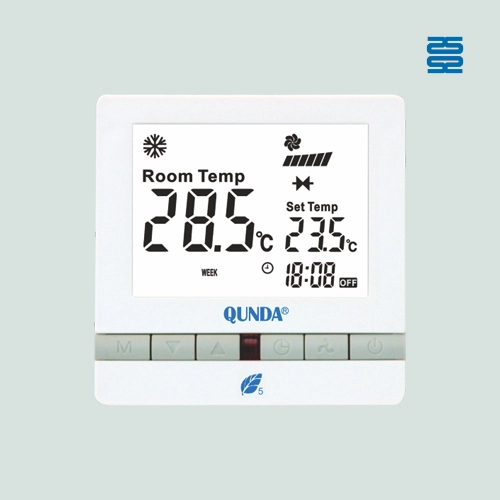
QD-HVAC05E Qunda Digital Thermostat for Central Air Conditioner

QD-HVAC03E Qunda Digital Thermostat for Central Air Conditioner
◼ Let’s Build Together
Get in Touch with SYSTO
If you have any comments or good suggestions, please leave us a message, later our professional staff will contact you as soon as possible.


Contact
Email us
Text or Call us
Address
Room 1606, No. 65, Zhongshan Seven Road, Liwan District, Guangzhou, Guangdong, China.

Facebook
Instagram
YouTube
Tik Tok
VK