






Can smart thermostats manage AC via remote control protocols?
Choosing the right smart thermostat for air conditioner control requires understanding remote control protocols (IR, RF, Wi‑Fi, Zigbee/Z‑Wave) and real-world installation limits. Below are six specific beginner questions that often have incomplete or outdated answers online, followed by in‑depth, field‑tested guidance to help purchasing, retrofit and integration decisions.
1) How do I reliably tell if my split AC remote uses IR or RF (and what frequency), so I can pick a compatible smart controller?
Why it matters: IR and RF require different bridges. Selecting the wrong type wastes time and money.
Step‑by‑step identification:
- Line‑of‑sight test: Stand 3–5m from the indoor unit and point the remote. If the unit only responds when you point directly at it, it’s almost certainly IR (infrared).
- Camera test for IR: Aim the remote at a smartphone camera or a digital camera and press a button. Many IR remotes show a purple/white LED on camera viewfinder when transmitting. This test detects IR transmitters but not RF.
- Obstruction test for RF: Try operating the AC from another room or with the unit out of sight. If it works reliably through walls, it’s RF (radio frequency).
- Label and documentation: Inspect the remote and indoor unit for model numbers and FCC/CE labels. Searches of the remote model will often show whether it’s 433 MHz or 315 MHz RF, or IR.
- Spectrum sniffing: For advanced buyers/installers, low‑cost SDR (software defined radio) dongles or RF sniffers can detect 315/433 MHz transmissions and capture modulation. This is useful when manufacturer info isn’t available, but requires technical skill.
- Common frequencies: Many generic RF AC remotes use 433 MHz (EM‑type) or 315 MHz in some regions. Proprietary RF (or encrypted sub‑GHz) is also used by OEMs—these often won’t be replicated by universal RF bridges.
Practical tip: If you confirm IR, a wide range of smart IR controllers (Sensibo, Tado, BroadLink, Cielo) will work. For RF, check device specs (e.g., BroadLink RM4 Pro supports many 433 MHz protocols) or consult the manufacturer to confirm the exact RF modulation and codes.
2) Can a smart thermostat designed for 24VAC central HVAC control a wall‑mounted inverter mini‑split that uses a proprietary RF remote?
Short answer: Not directly. Most smart thermostats for central HVAC (Nest, Ecobee, Honeywell Home Wi‑Fi) expect 24VAC control signals and cannot emit IR/RF remote codes used by many mini‑splits.
Options when facing a mini‑split with a proprietary RF remote:
- Use an IR/RF bridge: Devices like Sensibo Air (IR), Tado Smart AC Controller (IR), or BroadLink/RM4 Pro (IR + some RF) act as an intermediary and translate cloud or local commands into remote codes. This preserves full mode/fan/swing control when supported.
- Manufacturer network modules: Many OEMs sell official Wi‑Fi or cloud modules (e.g., Mitsubishi Kumo Cloud, Fujitsu Wi‑Fi kit) that integrate with the indoor unit’s PCB—these are the most reliable but may be limited to the OEM app and cloud.
- Replace the indoor unit’s control board (only in special cases): Some technicians install third‑party controllers that wire directly into the unit electronics—this is invasive and voids warranty unless performed or approved by the manufacturer.
- Smart plug as last resort: If you only need simple on/off scheduling for a wall/window unit (not recommended for compressor health or precise comfort), a smart plug can cut power—but this risks hard starts and does not preserve fan/mode/state, and is not a recommended method for long‑term use.
Recommendation: For mini‑splits, choose a proven IR/RF bridge or the OEM Wi‑Fi module. If you already have a 24VAC thermostat and want full mini‑split control, use a bridge that integrates with your home automation platform rather than rewiring to emulate 24VAC signals.
3) What are the exact steps to integrate an IR‑controlled AC with Home Assistant while preserving thermostat features like setpoint hysteresis, multi‑speed fan and swing control?
Goal: Convert raw IR commands into a proper climate entity with safe control logic.
Implementation roadmap (tested pattern used by installers):
- Choose hardware that supports local integration: BroadLink (local API caveats), Sensibo (official cloud API + community integrations), or an IR emitter + Raspberry Pi (LIRC) are common choices.
- Import IR codes: Use the device’s learning tool or a remote database (irdb) to capture all commands — power, modes (cool/heat/auto), target temps (if incremental), fan speeds, swing positions, turbo/economy and presets.
- Create a Home Assistant climate entity: Map the captured commands to the climate platform using the climate: generic_thermostat or mqtt_climate approach. Ensure mode mappings exactly reflect the AC modes and fan speeds.
- Example: HA climate mode 'cool' -> IR command 'MODE_COOL'; fan speeds 'low/med/high' -> corresponding IR commands.
- Add accurate temperature sensing: Relying on the indoor unit’s temperature readout is often inaccurate. Add a local temperature/humidity sensor (Zigbee/Z‑Wave/BLE/MQTT) mounted where occupants actually are, and use that sensor as the control sensor for the climate entity.
- Implement hysteresis and compressor protection: Use automation to enforce minimum off/on times and hysteresis. For example, only issue an HVAC On command if temp is > setpoint + 0.5°C, and keep the compressor off for at least 3–5 minutes after shutdown to protect the compressor and avoid short‑cycling.
- Test and refine: Validate that each automation produces the expected sequence of IR commands and that fan/swing transitions occur in the right order to avoid mode conflicts.
- Logging and fallback: Log commands and set fallback automations in case the bridge loses cloud connectivity (e.g., expose a direct IR macro in HA that can be triggered locally).
Notes on limitations: IR bridges do not read the indoor unit’s internal state (e.g., current fan speed reported by the unit). Your climate entity should treat the AC as 'stateless' and rely on sensors and timed checks rather than reported unit feedback. Where possible, prefer bridges or OEM modules that expose stateful feedback via API.
4) My property uses an air handler on 24VAC for central cooling, but my retrofit is a ductless mini‑split. What wiring or adapter options let me use a standard smart thermostat?
Key point: Standard smart thermostats expect 24VAC control circuits (R, C, Y, G, W). Mini‑splits usually use communications between indoor and outdoor units and remote control lines, not 24VAC thermostat wires.
Retrofit paths:
- Central HVAC (24VAC) to mini‑split conversion: You cannot directly repurpose a 24VAC thermostat to drive a mini‑split without an electronic adapter. Two typical approaches:
- Install an interface module that converts thermostat outputs to IR/RF/serial commands—these are rare and often custom.
- Use a smart AC controller (IR/RF bridge) that receives Wi‑Fi commands derived from thermostat schedules via an automation layer (Home Assistant/Hub). This effectively translates the thermostat’s desired state to the mini‑split via the bridge.
- Line‑voltage systems: If you have line‑voltage baseboard or window ACs (120/240V), you need approved line‑voltage smart thermostats or relay modules (e.g., Mysa, Stelpro) designed for those voltages. Do not connect a low‑voltage thermostat directly to line voltage.
- Manufacturer control modules: Many mini‑split OEMs provide a Wi‑Fi adapter that offers direct integration with third‑party home automation or at least with cloud control—this is typically the simplest and safest route for full function control.
Safety and warranty: Any changes to indoor unit wiring or PCB should be done by certified technicians. Replacing control electronics can void warranties and must meet local electrical code.
5) What are the security and latency risks when converting IR/RF remotes to IP via cloud hubs, and how do I mitigate them?
Risks:
- Cloud dependency: Many consumer bridges use cloud APIs, introducing latency and the risk of service outage if the vendor’s cloud is down.
- Data exposure: Commands and device metadata may pass through third‑party servers. Weak or reused vendor credentials increase breach risk.
- Local network attack surface: IR/RF bridges on your LAN can be pivot points if their firmware is vulnerable.
- Unauthorized control: Poor authentication or exposed APIs can allow outsiders to send commands (turn on AC remotely, change setpoint).
Mitigation strategies (industry best practices):
- Choose hardware with a local control API: Prioritize devices that support local HTTP/MQTT control or can be fully integrated into Home Assistant without cloud dependence.
- Network segmentation: Place IoT devices on a separate VLAN or guest network to reduce lateral movement risk. Block unnecessary outbound traffic from the IoT subnet to the internet where possible.
- Strong credentials and MFA: Use unique strong passwords and enable MFA on vendor portals. Rotate API keys if exposed.
- Firmware updates: Select vendors with an established security update policy and apply firmware updates promptly.
- Use secure protocols: Where available, prefer TLS/HTTPS and MQTT with TLS over plaintext protocols.
- Local fallbacks: Build local automations or expose IR macros to local controllers so basic functions remain during cloud outages.
Latency considerations: Expect added latency with cloud bridges (0.5–3+ seconds) vs. local control (<200 ms). For HVAC that's acceptable for scheduling and remote access but not for real‑time control in tight control loops; design automations accordingly using local sensors and conservative hysteresis.
6) When buying a smart thermostat for an air conditioner in a multi‑zone or VRF building, what remote‑control capabilities should I prioritize to ensure real energy savings and system reliability?
Priorities checklist for multi‑zone/VRF projects:
- Per‑zone temperature and humidity sensors: Accurate local sensing prevents overcooling and ensures occupant comfort. Built‑in single sensors rarely optimize multi‑zone performance.
- Support for native protocols or proven gateways: For VRF, prefer controllers that either integrate natively with the OEM or have validated gateways supporting the manufacturer’s protocol. Avoid reverse-engineered solutions for mission‑critical installations.
- Minimum on/off/dwell protection: Compressor anti‑short cycle timers and minimum run times are essential to prevent equipment damage and maintain efficiency.
- Fan control granularity: Ability to set variable fan speeds and fan mode mapping to avoid coarse fan toggling that reduces perceived comfort and may waste energy.
- Humidity and enthalpy control: For cooling efficiency and comfort, prioritise controls that can act on humidity or enthalpy (especially in humid climates) rather than temperature alone.
- Scheduling, geofencing and occupancy integration: Combine schedules with reliable occupancy detection (PIR/motion sensors, door contacts, or reliable geofencing) to avoid heating/cooling unoccupied zones.
- Open APIs and BMS integration: For commercial multi‑zone systems, ensure the controller offers BACnet/MQTT/REST API or certified BMS integration for analytics and demand response.
- Scalability and maintainability: Choose vendor solutions with centralized management for dozens of zones, remote firmware updates, and role‑based access control for service providers.
Energy impact: Real energy savings come from matched controls, accurate sensors and avoiding short cycling. For properly implemented multi‑zone control, industry reports and case studies commonly show HVAC energy reductions in the 10–20% range depending on baseline operations and control strategy. Savings depend on climate, usage patterns and correct commissioning.
Concluding summary: Advantages of using smart thermostats and smart AC controllers with remote‑control protocol support
Adopting a smart thermostat or smart AC controller that understands IR/RF/Wi‑Fi protocols delivers precise zone comfort, remote scheduling, and integration with home automation and energy management platforms. The main advantages are:
- Flexibility: Bridge legacy IR/RF remotes to modern Wi‑Fi and home automation systems without rewiring.
- Energy optimization: Schedules, geofencing and adaptive algorithms reduce wasted runtime when combined with correct sensors and anti‑short cycling rules.
- Scalability: Cloud or local management supports centralized control for multi‑zone buildings, provided you select equipment with open APIs or BMS compatibility.
- Improved reliability: Choosing local‑control capable bridges and enforcing compressor protections increases equipment life and reduces service calls.
- Security and resilience: Proper device selection, network segmentation and local fallback automations reduce cloud exposure and downtime risk.
If you need a quote or tailored system recommendation for integrating IR/RF controlled ACs, mini‑splits or multi‑zone VRF with smart thermostats and automation platforms, contact us for a quote at www.systoremote.com or email [email protected].
CRC2503V
Which air conditioner brands are supported by CRC2503V?
It supports all A/C brands including GREE, MIDEA, HAIER, AUX, LG, SAMSUNG, DAIKIN, and many others.
KS-PN03V
How do I perform the auto-search setup?
Long-press the power button until “00” flashes on the display. Wait until your A/C unit beeps, then release the button — setup is complete.
Does the KS-PN03V work with all Panasonic air conditioners?
It’s compatible with most Panasonic models. If not working directly, you can use the auto-search setup mode to pair it easily.
QD85U
Does it include sensors?
Yes, it features dual sensors for ambient and coil temperature detection.
FAN-2989W
How do I set up the remote for my fan?
You can use Auto Search or Manual Setup following the included user manual.
Recommended For You
The CRC2621V AI Universal Air Conditioner Remote is designed for the Southeast Asian market. With an AI search function and compatibility with 99% of air conditioner brands, it provides faster setup and a better user experience.
Infrared LED light remote for Panasonic Japan market. No setup required. Supports dimming, color adjustment, timer, and 3-channel switching.
Do solar remote controls still use lithium batteries? Learn how modern solar-powered remotes now adopt supercapacitors with USB Type-C fast charging for improved safety, durability, and long lifespan.
Learn how to check whether a garage door remote control bought online is compatible with your opener. Frequency, learning type, and easy tips explained.
Having trouble setting up a universal remote even though your TV brand is listed in the manual? Learn the real reason, common mistakes, and how to improve success by using precise TV codes.
You May Also Like

QD-HVAC23 Qunda Touch-Screen Thermostat for Air Conditioner

QD-HVAC06E Qunda Digital Thermostat for Central Air Conditioner
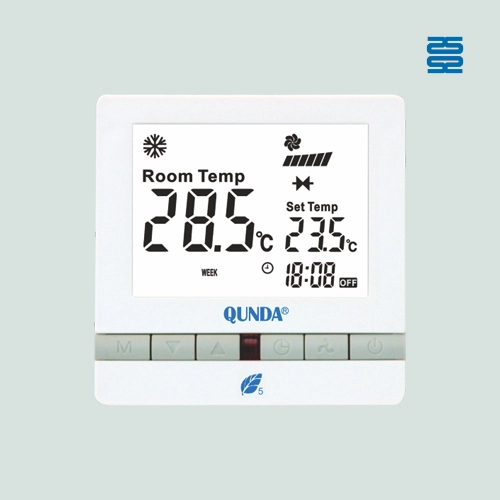
QD-HVAC05E Qunda Digital Thermostat for Central Air Conditioner

QD-HVAC03E Qunda Digital Thermostat for Central Air Conditioner
◼ Let’s Build Together
Get in Touch with SYSTO
If you have any comments or good suggestions, please leave us a message, later our professional staff will contact you as soon as possible.


Contact
Email us
Text or Call us
Address
Room 1606, No. 65, Zhongshan Seven Road, Liwan District, Guangzhou, Guangdong, China.

Facebook
Instagram
YouTube
Tik Tok
VK