






RF vs IR: which wireless remote is best for industrial buyers?
1. How do I calculate the RF link budget for a wireless remote control in a noisy industrial plant so the system won't drop commands?
Why it matters: Failures caused by marginal RF links create safety risks and downtime. Many vendor answers gloss over link-budget math and fade margins for metal-rich factories.
Answer (practical steps):- Gather component specs: transmitter power (Pt, dBm), transmitter antenna gain (Gt, dBi), receiver sensitivity (Smin, dBm), receiver antenna gain (Gr, dBi), and estimated cable/connector losses (Lc, dB).- Compute path loss allowance: Link Margin = Pt + Gt + Gr - Lc - Smin.- Account for expected propagation loss. Use the Free-Space Path Loss (FSPL) as a baseline: FSPL(dB) = 20·log10(d_km) + 20·log10(f_MHz) + 32.44. Example: at 433 MHz over 100 m (0.1 km) FSPL ≈ 65 dB. Industrial environments add diffraction/obstruction losses; add an empirical clutter loss (10–30 dB typical depending on dense steel structures).- Set fade margin: For robust industrial use, target 20–30 dB of additional margin beyond calculated multipath/clutter loss. If your Link Margin after FSPL and clutter is < 20 dB, increase transmitter power, use higher-gain antennas, add diversity or repeaters, or change band/modulation.- Validate with on-site RF testing: measure RSSI and PER (packet error rate) at intended mounting points and operator locations during busy plant operations (shift hours) to capture real interference.Tools & tips: Use a calibrated spectrum analyzer or a field-strength meter and run a walk-test. Where packet loss matters for safety, design for redundancy (dual receivers or independent command confirmation) rather than relying solely on margin numbers.
2. Which modulation and frequency band (433MHz vs 868/915MHz vs 2.4GHz) gives the best reliability and battery life for a push-button industrial remote?
Why it matters: Buyers must balance range, penetration through obstacles, regulatory constraints, interference environment, and battery life. Generic advice online often favors one band without context.
Answer (band-by-band tradeoffs):- Sub-GHz bands (315/433/868/915 MHz): Better propagation through metal racks, around obstacles, and longer range for a given power. Narrowband FSK/GFSK or LoRa-style modulation conserves energy and extends range with low duty cycles. These bands are usually less congested than 2.4 GHz in industrial settings and provide better link margin—preferred for long-range, low-data push-button remotes.- 2.4 GHz (BLE, Zigbee, proprietary): Higher data rates; global availability; lots of existing infrastructure (Wi‑Fi, Bluetooth) which can cause co-channel interference. Shorter range and greater attenuation by people and water. Good for telemetry-rich remotes that require higher throughput or integration with IT networks, but expect somewhat higher transmitter power and shorter battery life unless using BLE Low Energy optimizations.- Modulation: FSK/GFSK (narrowband) provides reliable links with low power. FHSS (frequency-hopping) or DSSS offer strong interference resilience. LoRa (chirp spread spectrum) gives very long range at low data rate and excellent sensitivity but is not appropriate for extremely low-latency control unless protocol permits.Recommendation: For a simple, low-duty-cycle push-button remote in a noisy factory, a sub-GHz FSK design (433/868/915 MHz) or LoRa for very long-range, combined with a low-power MCU and sleep strategy, usually gives the best battery life and reliability. If you need IT integration or mesh networking, consider 2.4 GHz BLE/Zigbee but plan for more interference mitigation.
3. How can I design wireless remote controls to meet safety integrity requirements (SIL/PL) for emergency stop or safety-critical functions?
Why it matters: Using wireless for E‑stop or safety functions is sensitive — outdated web answers either forbid wireless or provide vague statements without actionable design patterns.
Answer (practical compliance approach):- Know the standard: Functional safety standards such as IEC 61508 and ISO 13849 define Safety Integrity Levels (SIL) and Performance Levels (PL). Wireless can be part of a safety function if the entire safety concept achieves the required integrity.- Avoid single-point wireless E‑stop unless certified: Use redundancy. Typical industrial practice uses dual-channel architectures—two independent receivers or two different wireless channels—and requires both to confirm a safe state unless a single channel is designated as safety-rated after independent validation.- Implement failsafe logic: Watchdogs, heartbeat monitoring (periodic status frames), sequence counters, CRCs, and timeouts ensure stale or replayed packets are rejected. Combine with hardware interlocks or safety relays that default to safe state on loss of communication.- Certified modules and SIL-rated subsystems: Seek vendors offering modules or systems with documented safety analyses and third-party certification for specific SIL/PL targets. If a vendor claims SIL capability, request the safety manual, failure rates, FMEDA results, and certificate references.- Practical mitigation: For emergency stop, many integrators choose wired or certified safety-rated wireless systems. If wireless is used for non-stop critical commands, ensure the safety architecture treats wireless as advisory unless fully certified.
4. What real-world steps reduce EMI and co-channel interference when hundreds of wireless remotes and industrial radios operate together?
Why it matters: In plants with PLC radios, VHF/UHF equipment, and Wi‑Fi, buyers face unpredictable interference; generic answers suggest use a different frequency without practical mitigations.
Answer (multi-layer strategy):- Frequency planning: Use less congested sub-GHz bands and regionally appropriate channels (433/868/915 MHz). If using 2.4 GHz, select channels away from main Wi‑Fi; implement DFS or dynamic channel selection where supported.- Modulation & MAC strategies: Choose FHSS or adaptive frequency hopping to avoid narrowband interferers; use acknowledgments and retransmission with smart backoff to avoid collisions.- Antenna & placement: Elevate antennas, keep clear line-of-sight where possible, and avoid mounting near large motors or power converters. Use directional or higher-gain antennas to improve SNR and reduce susceptibility to local noise.- Filtering & shielding: On fixed receivers, add band-pass filtering and proper grounding. Metal enclosures and grounded cable glands, with well-designed feed-through filters, reduce conducted and radiated interference.- Diversity & redundancy: Use antenna diversity (spatial or polarization), multiple receivers, or repeaters to mitigate multipath and localized interferers. Maintain a link margin target of 20–30 dB.- Certification & vendor selection: Use radio modules with robust coexistence features (FHSS, LBT, CCA), industrial-grade RF front ends, and proven performance in plants similar to yours. Insist on lab and field test reports.Operational tip: During commissioning, perform spectrum monitoring during peak operational hours and tune configuration (channels, transmit power, antenna orientation) based on measured noise-floor and interferer signatures.
5. What are realistic battery-life expectations and maintenance strategies for fleets of industrial wireless remotes?
Why it matters: Buyers managing hundreds of remotes need predictable maintenance windows. Many online resources give optimistic single-device battery life without fleet maintenance planning.
Answer (how to estimate and manage):- Realistic expectations: Consumer IR remotes (CR2032 coin cell, passive IR LED bursts) often last 1–2 years with occasional use. Industrial RF remotes depend on topology: a low-duty sub-GHz remote in deep sleep between short transmit bursts can last many months to multiple years on a coin cell. Remotes with telemetry, backlit displays, or continuous connectivity typically last from weeks to several months on rechargeable packs.- Estimation method: Identify sleep current, active transmit current, transmit duration per operation, and average operations/day. Battery life (hours) ≈ Battery capacity (mAh) / average current (mA). Remember that small periodic wakeups (RTC, BLE advertisements) and self-discharge dominate over infrequent short bursts.- Fleet maintenance strategies: 1. Telemetry: Use remotes that report battery voltage in telemetry frames so the receiver/SCADA logs remaining capacity and issues alerts. 2. Predictive replacements: Trigger replacements at a conservative threshold (e.g., 20–30% remaining) and batch replacements by location to reduce downtime. 3. Standardized power modules: Use swappable coin-cell holders or standardized rechargeable packs to simplify logistics. 4. Asset tracking: Tag remotes in CMMS with installation date, battery type, and expected replacement interval. 5. Environmental protection: High temperatures drastically reduce battery life—choose industrial-grade cells and IP-rated enclosures (IP65–IP67) to minimize premature failures.Operational example: If a remote sleeps at 5 µA, wakes to transmit 100 ms at 20 mA per press, and is pressed 50 times/day, the average current is dominated by sleep. The battery could last many months. However, if backlight/tactile feedback runs for several seconds per operation, active current grows and life becomes weeks. Always confirm with vendor-provided usage profiles or perform a small field test before large deployments.
6. For crane and hoist controls in outdoor or sunlit environments, when is RF the clear choice over IR — and what certifications should buyers require?
Why it matters: Hoist/crane control operators demand reliable command delivery across distances and in sunlight/reflection-rich environments. Many generic guides still list IR as an option without noting practical limitations.
Answer (why RF is preferred and compliance checklist):- Why RF wins for cranes/hoists: IR requires line-of-sight and is easily disrupted by sunlight (broad-spectrum IR) and reflections from metal surfaces. RF (sub-GHz) penetrates obstructions, tolerates non-perfect LOS, and supports longer operational range—essential for moving loads in complex yards.- Environmental and safety certifications to require: 1. EMC and radio compliance: FCC Part 15 (US), ETSI EN 300 220 / EN 301 489 (EU), and local regulatory approvals (RCM, IC) for allowed bands and power. 2. Environmental/IP rating: IP65–IP67 or higher for water and dust protection; UV-stable housings for outdoor exposure. 3. Explosion-hazard locations: ATEX (EU) or IECEx certificates where the hoist operates in explosive atmospheres; these impose design constraints on battery compartments and transmit power. 4. Functional safety: If the remote performs safety-related functions (e.g., speed limit, approach-to-stop), request documentation of safety analysis and relevant SIL/PL evidence. 5. Mechanical durability: Drop and ingress-tested housings, temperature range ratings, and ergonomic designs for gloved use.Implementation notes: Choose remotes with robust mechanical switches, redundancy in critical controls (two-step actuator sequences or dual-channel signalling), and proven field deployments in similar crane/hoist applications. For sites with many cranes, plan channel management and use dedicated receivers per crane with secure pairing to prevent accidental cross-control.
Concluding summary — Advantages of choosing the right wireless remote control technology for industrial buyers
Choosing the correct wireless remote control solution (RF vs IR and the right band/modulation) delivers measurable advantages: higher command reliability under metal-rich and sunlit conditions, predictable battery life and maintenance workflows, better immunity to interference with FHSS or narrowband modulation, and the ability to meet functional-safety and environmental certifications. Sub-GHz RF typically provides superior range and penetration for hoists, cranes, and factory floor remotes; 2.4 GHz is suitable when IT integration and higher data rates are required. A disciplined design process—link-budget engineering, field testing, EMI hardening, safety architecture, and fleet battery telemetry—lets you deploy remote-transmitter and receiver-module systems that reduce downtime and increase operator safety.
For tailored RF/IR selection, safety integration, or a quote for industrial wireless remote control systems, contact us: www.systoremote.com or [email protected].
CRC2201V
What is the maximum operating distance?
The infrared signal works up to approximately 7 meters in a straight line. Walls or obstacles may reduce effective range.
CRC2303V
What’s the MOQ for bulk purchase?
Regular stock supports small quantities. Custom orders depend on requirements.
AN-MR25GA
Can I order small quantities or OEM bulk?
Yes. We support small MOQ for standard order.
Is this remote identical in function to the original LG AN-MR25GA?
Yes. It supports the same voice control, pointer, and wheel functions as the original model.
About Products
Are your remote controls compatible with my device?
Yes, our remotes are compatible with most major TV, air conditioner, and set-top box brands. You can check the compatibility list on each product page.
Recommended For You
The CRC2621V AI Universal Air Conditioner Remote is designed for the Southeast Asian market. With an AI search function and compatibility with 99% of air conditioner brands, it provides faster setup and a better user experience.
Infrared LED light remote for Panasonic Japan market. No setup required. Supports dimming, color adjustment, timer, and 3-channel switching.
Do solar remote controls still use lithium batteries? Learn how modern solar-powered remotes now adopt supercapacitors with USB Type-C fast charging for improved safety, durability, and long lifespan.
Learn how to check whether a garage door remote control bought online is compatible with your opener. Frequency, learning type, and easy tips explained.
Having trouble setting up a universal remote even though your TV brand is listed in the manual? Learn the real reason, common mistakes, and how to improve success by using precise TV codes.
You May Also Like

QD-HVAC23 Qunda Touch-Screen Thermostat for Air Conditioner

QD-HVAC06E Qunda Digital Thermostat for Central Air Conditioner
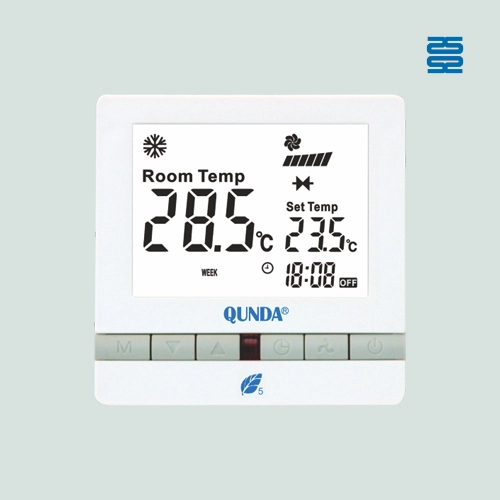
QD-HVAC05E Qunda Digital Thermostat for Central Air Conditioner

QD-HVAC03E Qunda Digital Thermostat for Central Air Conditioner
◼ Let’s Build Together
Get in Touch with SYSTO
If you have any comments or good suggestions, please leave us a message, later our professional staff will contact you as soon as possible.


Contact
Email us
Text or Call us
Address
Room 1606, No. 65, Zhongshan Seven Road, Liwan District, Guangzhou, Guangdong, China.

Facebook
Instagram
YouTube
Tik Tok
VK