





What are the application scenarios of universal tv remote for hitachi?
- Why universal remotes matter
- Consolidation and convenience
- Cost-effective replacements and upgrades
- Support for mixed-technology environments
- Common application scenarios and recommended remote types
- 1) Home replacement and multi-device control
- 2) Smart TV setups and voice control
- 3) Hospitality, education, and commercial displays
- Technical considerations: compatibility, protocols, and learning features
- IR codes and protocols
- RF, Bluetooth and Wi‑Fi control
- Learning remotes and macro programming
- Practical examples and deployment checklist
- Residential deployment example
- Hotel deployment example
- Commercial signage and conference rooms
- Choosing the right supplier and ensuring reliability
- Quality, compliance and supply chain
- Customization and engineering support
- After-sales and documentation
- Setup tips and troubleshooting for Hitachi TVs
- Quick setup checklist
- Troubleshooting common issues
- When to consult a professional
- Conclusion
- Frequently Asked Questions (FAQ)
- Q: Will a universal remote always work with my Hitachi TV?
- Q: Can I customize a universal remote with my brand for hotel use?
- Q: Are universal remotes reliable for bulk deployments?
- Q: Where can I find standard documentation about remote control protocols?
This article explains where and how a universal tv remote for hitachi is most effectively used—covering home use, multisource media setups, hospitality/POI installations, accessibility solutions, and OEM/ODM deployments—so search engines and local intent match user needs for purchasing, configuring, or customizing remotes for Hitachi televisions.
Practical Application Scenarios for a Universal TV Remote for Hitachi
Universal remotes for Hitachi TVs solve a broad set of real-world needs: replacing lost remotes, consolidating multiple devices into one controller, enabling voice or Bluetooth control for newer smart TVs, and providing branded OEM remotes for commercial and hospitality deployments. This guide helps engineers, buyers, installers, and end users understand when to choose an infrared (IR) universal remote, a learning remote, or a smart RF/Bluetooth/voice remote, and how to apply each solution to Hitachi TVs across residential and commercial environments.
Why universal remotes matter
Consolidation and convenience
Households today often have multiple device remotes—TV, set-top box, soundbar, Blu-ray, and streaming dongles. A universal tv remote for hitachi reduces clutter by combining control codes into a single device. Modern universal remotes can store thousands of IR codes (including Hitachi code sets) or learn commands directly from an existing remote to replicate functions exactly.
Cost-effective replacements and upgrades
Replacing a lost or broken Hitachi remote with a compatible universal remote is usually faster and cheaper than sourcing an original equipment manufacturer (OEM) replacement, especially for legacy models. For businesses replacing remotes across many units (hotels, conference centers), bulk universal remotes reduce procurement complexity.
Support for mixed-technology environments
Some Hitachi TVs (especially Android-based smart models) support Bluetooth or Wi‑Fi control in addition to IR. Universal remotes come in IR-only, RF/433 MHz, Bluetooth, and Wi‑Fi/voice types. Choosing the right technology ensures coverage whether the TV is located inside cabinets (where IR may not reach) or in public venues requiring remote concealment.
Common application scenarios and recommended remote types
1) Home replacement and multi-device control
Scenario: A family has a Hitachi TV, a cable/satellite STB, a soundbar, and a streaming stick. They want a single remote to control power, volume, input switching, and navigation.
Recommended remote: 4–8 device IR universal remote or a Bluetooth/IR hybrid that supports macro functions (one-button sequences). Learning functionality is useful to capture any proprietary commands from original remotes.
2) Smart TV setups and voice control
Scenario: Newer Hitachi smart TVs with Android TV or proprietary smart platforms benefit from voice search and wireless pairing.
Recommended remote: Bluetooth/voice universal remote (with mic and IR fallback). These remotes use RF or Bluetooth profiles to pair directly, enabling hands-free voice search and navigation when IR is insufficient.
3) Hospitality, education, and commercial displays
Scenario: Hotels, hospitals, schools, and conference rooms deploy many Hitachi TVs and need consistent, lockable control (preventing guests from changing inputs or settings) and easy mass replacement.
Recommended remote: Customized OEM universal remotes with locked-button profiles, infrared with restricted macros, or RF remotes if line-of-sight must be avoided. SYSTO supports OEM/ODM customization to add branding and tailored keymaps for hospitality needs.
Technical considerations: compatibility, protocols, and learning features
IR codes and protocols
Most Hitachi TVs—especially non-smart and legacy models—use infrared (IR) remote codes, often following common consumer protocols such as NEC or RC5 variations. The NEC protocol is widely used in TV remotes and is documented on reference sites such as NEC protocol (IR remote control). Universal remotes typically ship with large code databases that include Hitachi code sets and can match codes by brand or auto-search.
RF, Bluetooth and Wi‑Fi control
RF and Bluetooth remotes bypass line-of-sight limitations. For direct device pairing, Bluetooth profiles and proprietary RF pairings are common in modern remotes. For broader interoperability and standard communication layers, pages like IrDA and communications literature describe the constraints and capabilities of wireless command protocols.
Learning remotes and macro programming
Learning remotes capture IR sequences from an original Hitachi remote to reproduce exact functions where pre-programmed codes are missing. Macro programming allows multiple commands (power on, set input, set volume) to run with a single button. For installers and hospitality providers, macros simplify user experience and reduce support calls.
Practical examples and deployment checklist
Residential deployment example
Example: A homeowner with a Hitachi 55 LED TV (non-smart) and a soundbar wants simplified control. A basic 4-device IR universal remote with learning function is set up to control TV power/volume/input and soundbar volume. The remote's database contains Hitachi brand codes; when those do not match, the learning function captures signals from the original remotes.
Hotel deployment example
Example: A 120-room hotel outfitting all rooms with Hitachi TVs chooses a customized IR universal remote with volume and channel lockout, single-button “Guest Mode” macro, and hotel logo. Bulk procurement and on-site labeling reduce confusion. SYSTO's OEM/ODM service can supply remotes with preloaded keymaps and FCC/CE compliance documentation for each region.
Commercial signage and conference rooms
Example: Conference rooms with Hitachi commercial displays often require concealed remote operations to prevent tampering. RF or Bluetooth universal remotes are used alongside IR repeaters and control systems (Crestron/AMX) for centralized automation.
| Scenario | Hitachi TV type | Recommended remote type | Key benefits |
|---|---|---|---|
| Home replacement | Legacy IR TV / basic LED | IR universal / learning remote | Cost-effective, simple setup, supports Hitachi codes |
| Smart TV with voice | Android TV / Smart models | Bluetooth/voice hybrid remote | Voice search, wireless pairing, better navigation |
| Hospitality / hotels | Guest-room Hitachi TVs | Customized OEM universal remote (IR or RF) | Branding, locked functions, bulk provisioning |
| Commercial signage | Large-format displays | RF/Bluetooth / Central control integration | Remote hiding, centralized management, automation |
Choosing the right supplier and ensuring reliability
Quality, compliance and supply chain
When buying universal remotes at scale, verify supplier credentials, quality control, and compliance with regional regulations (CE, FCC, RoHS). Founded in 1998, Guangzhou SYSTO Trading Co., Ltd. has over two decades in remote control R&D, manufacturing and global distribution, serving more than 30 countries—making it a proven partner for OEM/ODM projects and bulk procurement.
Customization and engineering support
SYSTO offers custom keymaps, logos, packaging, and firmware adjustments. For hospitality or commercial projects, ask for preloaded macros, locked-button firmware, and on-site testing to ensure the universal tv remote for hitachi works reliably across your deployed models.
After-sales and documentation
Prioritize suppliers that provide clear programming guides, IR code lists, and firmware update paths. For technical background on IR control standards, see general references such as the Remote control (Wikipedia) overview.
Setup tips and troubleshooting for Hitachi TVs
Quick setup checklist
- Identify your Hitachi TV type (legacy IR vs. smart Bluetooth/Wi‑Fi).
- Try brand code search in the universal remote’s database (select Hitachi or auto-search).
- If codes fail, use the learning function by pointing the original remote to the universal remote during capture.
- Program macros for common multi-step tasks (power on & set input).
Troubleshooting common issues
Symptom: Remote commands work inconsistently. Actions: Replace batteries, ensure line-of-sight for IR, check for nearby IR noise (sunlight, fluorescent lights), and try alternative Hitachi codes. For RF/Bluetooth remotes, verify pairing and battery level.
When to consult a professional
If multiple TVs exhibit inconsistent behavior after deploying a universal remote (e.g., interference, non-responsive inputs), consider an RF solution, an IR repeater system, or professional integration with an AV control system. For large deployments, work with the supplier to pre-test remotes with representative TV models.
Conclusion
A universal tv remote for hitachi can be the ideal solution across many scenarios: simple home replacements, consolidated multi-device control, voice-enabled smart TV navigation, hospitality lock-downs, and enterprise signage control. The correct choice depends on your Hitachi TV's technology (IR vs. Bluetooth), the environment (residential vs. commercial), and functional needs (learning, macros, voice).
As an experienced remote control manufacturer with global reach and OEM/ODM capabilities, SYSTO can help you select or customize the right universal remote solution—whether you need a lightweight IR learning remote for retail sale or a branded, locked-down remote for thousands of hotel rooms.
Frequently Asked Questions (FAQ)
Q: Will a universal remote always work with my Hitachi TV?
A: Most universal remotes include Hitachi code sets and can learn commands from an original remote. However, compatibility depends on whether the TV uses standard IR codes or proprietary RF/Bluetooth protocols. For smart Hitachi TVs using Bluetooth/wireless pairing, choose a hybrid or Bluetooth-compatible remote.
Q: Can I customize a universal remote with my brand for hotel use?
A: Yes. Suppliers like SYSTO offer OEM/ODM services—custom key legends, logos, packaging, and firmware features (e.g., locked buttons, macros) to fit hospitality requirements and regulatory compliance for target markets.
Q: Are universal remotes reliable for bulk deployments?
A: When sourced from reputable manufacturers with strict quality control and supply chains, universal remotes are reliable. Validate certifications (CE/FCC), request sample testing with your Hitachi TV models, and ensure warranty/after-sales support for large-volume orders.
Q: Where can I find standard documentation about remote control protocols?
A: Useful references include the Remote control overview and specific protocol pages such as the NEC protocol, which explain common IR signaling formats. For wireless communication specifics, see resources on Bluetooth or IrDA.
Contact us to discuss customized universal remote solutions for Hitachi TVs and bulk procurement options.
Best universal remote for home theater buyers
Compare Panasonic TV Remote Replacements: Features & Price
Universal vs Original: Best Remotes for Panasonic TVs
Wireless HVAC Thermostats: Compatibility with Existing Systems
About Products
Are batteries included with your products?
Our remote controls are sold without batteries due to international shipping safety regulations. Please prepare batteries locally before use. But little models of air mice or smart remotes include rechargeable batteries.
CRC2303V
Can I customize the logo or packaging?
Yes, OEM/ODM customization is available, including logo, key layout, and packaging.
AN-MR25GA
Does it support AI Voice commands?
Yes. It fully supports LG AI Voice Recognition and Google Assistant (if available in your TV).
About Company
When was your company established?
Founded in 1998, we have over 27 years of manufacturing experience.
CRC2201V
Can I buy in small quantities?
Yes. We support small MOQ for regular models; OEM MOQ depends on customization needs.
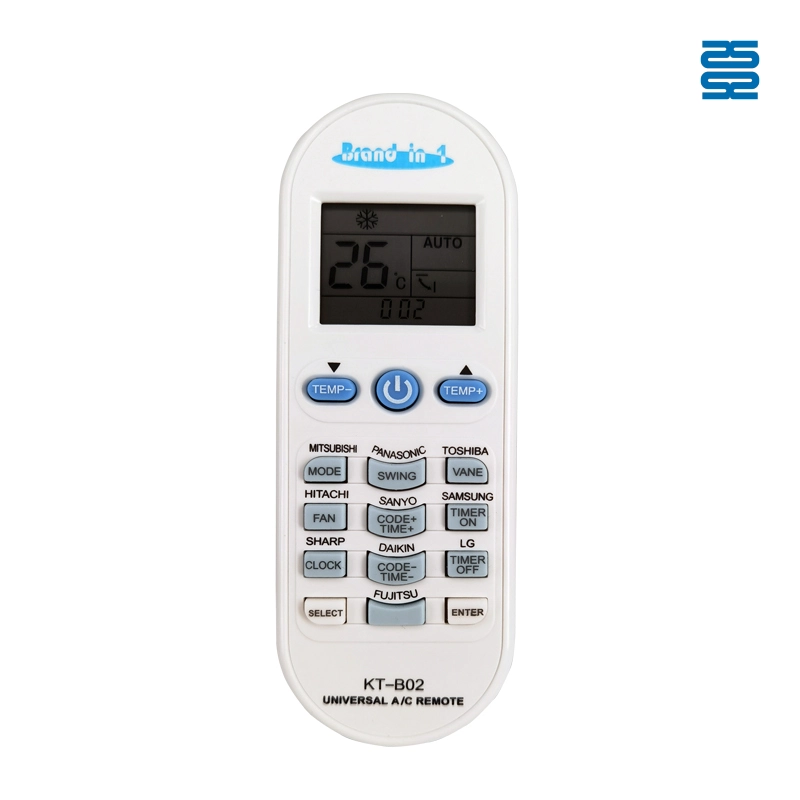
KT-B02 Universal Air Conditioner Remote Control Compatible with All Brands
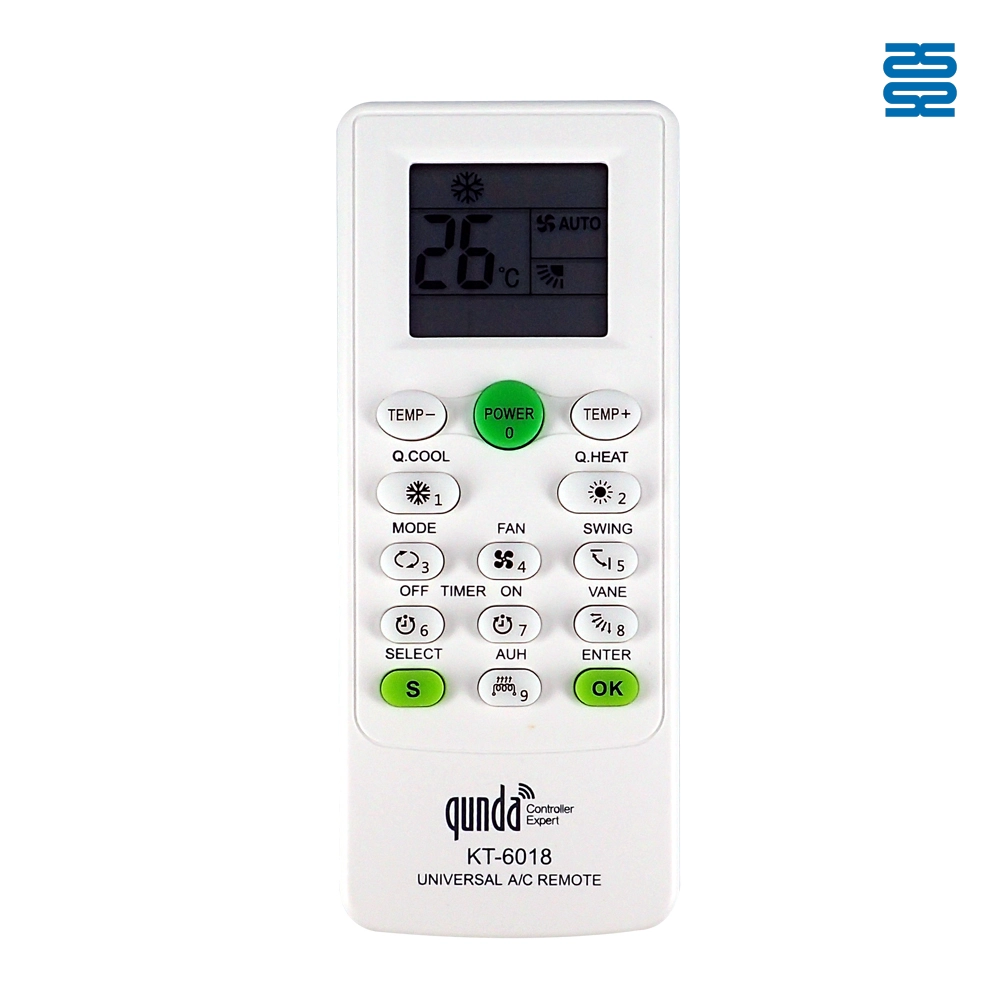
KT-6018 6000 in 1 Universal Air Conditioner Remote Control Compatible with All Brands

QD-1000 IN 1 1000 Code in 1 Universal Air Conditioner Remote Control Compatible with All Brands

KT-N828 Universal Air Conditioner Remote Control Compatible with All Brands
Get the latest updates
If you have any comments or good suggestions, please leave us a message, later our professional staff will contact you as soon as possible.


Contact
Email us
Text or Call us
Address
Room 1606, No. 65, Zhongshan Seven Road, Liwan District, Guangzhou, Guangdong, China.

Facebook
Instagram
YouTube
Tik Tok
VK