






What are the application scenarios of universal remote for philips tv?
- Why universal remotes matter for modern TV environments
- Key technical touchpoints
- Who benefits the most
- Common application scenarios for a universal remote for Philips TV
- 1. Home theater and living-room consolidation
- 2. Smart TV and streaming integration
- 3. Accessibility and assisted living
- Commercial, hospitality and professional AV deployments
- 1. Hotels and short-stay accommodation
- 2. Conference rooms and corporate AV
- 3. Retail and public-facing displays
- Technical design choices and compatibility considerations
- IR, RF, Bluetooth and HDMI-CEC: feature comparison
- Learning vs. code-based vs. app programming
- Security, firmware updates and long-term support
- Practical setup tips and troubleshooting for Philips TVs
- Pairing and basic setup steps
- Common troubleshooting
- When to choose professional/custom solutions
- Cost-benefit and deployment checklist
- Cost factors
- Deployment checklist
- Conclusion
- Frequently Asked Questions
- Q1: Will any universal remote work with my Philips TV?
- Q2: Can a universal remote control multiple Philips TVs at once?
- Q3: Are there industry standards to refer to for interoperability?
- Q4: How can SYSTO help with customized remote requirements?
Universal remote solutions for Philips TV cover broad application scenarios—home entertainment, hospitality, assisted living, corporate AV and smart-home integration—by unifying IR, RF, Bluetooth and HDMI-CEC controls to simplify user experience, reduce costs, and enable OEM/ODM customization. This article analyzes technical compatibility, feature trade-offs, and deployment best practices to help consumers, installers and product managers choose or design the right universal remote for philips tv solution.
Why universal remotes matter for modern TV environments
Universal remote controls solve a practical problem: one user often must manage multiple devices—TVs, set-top boxes, soundbars, streaming sticks and media players—each with its own remote. A universal remote for Philips TV centralizes control, reducing user friction and improving accessibility. As TVs evolve (with smart platforms, HDMI-CEC, Bluetooth remotes and voice assistants), a modern universal remote must support multiple protocols and offer flexible programming or learning capabilities.
Key technical touchpoints
Modern Philips TVs may accept control via traditional infrared (IR), Bluetooth (for some Android TV/Google TV models), and HDMI-CEC. HDMI-CEC lets connected devices control one another through the HDMI cable and is standardized by the HDMI Forum; details are available from the HDMI organization: HDMI CEC (HDMI.org). The classical overview of remote control technology is summarized on Wikipedia, which outlines IR encoding, RF and learning remotes.
Who benefits the most
Primary beneficiaries include home users wanting a single control for multi-device setups, hospitality operators seeking simplified guest interfaces, installers and AV integrators standardizing controls across rooms, and manufacturers/resellers needing OEM/ODM remote solutions. Organizations like the Consumer Technology Association provide industry context for device interoperability: CTA.
Common application scenarios for a universal remote for Philips TV
1. Home theater and living-room consolidation
Scenario: A household uses a Philips TV, a soundbar, a Blu-ray player and a streaming stick. Each device has a separate remote—confusion and lost remotes become frequent. A universal remote can be programmed to control TV power/volume, switch inputs, control playback on other devices, and toggle soundbar modes.
Benefits: fewer lost remotes, single-point device automation, simplified learning curve for family members, and harmony with voice assistants if the remote supports voice.
2. Smart TV and streaming integration
Scenario: Many Philips smart TVs run Android TV/Google TV or other smart platforms. Some Philips models support Bluetooth remotes and voice input. A universal remote that supports IR for legacy devices and Bluetooth for compatible Philips models (or that triggers HDMI-CEC commands) ensures consistent behavior across old and new devices.
Reference: Google’s Android TV documentation describes common TV control integrations and compatibility considerations: Android TV Support.
3. Accessibility and assisted living
Scenario: Users with limited mobility or cognitive impairments need simplified controls. Universal remotes can be configured with large buttons, dedicated macros (e.g., “Watch TV” turns on TV, switches to set-top box input and sets volume), and learning features to replicate legacy Philips remote functions. Some designs include voice control and backlit keys to improve usability.
Benefits: increased independence, fewer support calls, and improved satisfaction for elderly residents or users in assisted-living facilities.
Commercial, hospitality and professional AV deployments
1. Hotels and short-stay accommodation
Scenario: Hospitality operators need a uniform guest experience across multiple rooms and TV models. A universal remote for Philips TV can be locked to prevent configuration changes, include housekeeping commands (picture mode defaults, volume caps), and be branded or customized through OEM/ODM programs.
Benefits: consistent guest experience, fewer lost or incompatible remotes, reduced guest complaints, and branded control devices that align with property standards.
2. Conference rooms and corporate AV
Scenario: Meeting rooms contain Philips commercial displays alongside presentation devices, video-conferencing codecs and audio systems. A universal remote reduces complexity for end-users by combining input switching, source control and basic conferencing functions (camera mute/unmute, volume control) into one device. For advanced control, universals can interface with room control systems via IR extenders or programmable relays.
3. Retail and public-facing displays
Scenario: Retail stores, quick-service restaurants and information kiosks run Philips displays that require limited local control. A universal remote allows staff to change inputs, power cycle displays remotely or switch to promotional content without complex menus. Remotes can be hardened (durable casing, limited buttons) for frequent handling.
Technical design choices and compatibility considerations
IR, RF, Bluetooth and HDMI-CEC: feature comparison
When selecting or designing a universal remote for Philips TV, you must weigh protocol trade-offs. Below is a comparison table to help choose the right remote type for your scenario:
| Protocol | Range & Line-of-Sight | Compatibility with Philips TV | Strengths | Limitations |
|---|---|---|---|---|
| Infrared (IR) | Short, needs line-of-sight | Works with nearly all Philips TVs that have IR receivers | Simple, low cost, widely supported | Requires pointing at TV; can be blocked by obstacles |
| Radio Frequency (RF) | Longer, no line-of-sight required | Works via RF-to-IR base or dedicated RF-compatible receivers | Good for hidden-AV setups or enclosed cabinetry | Requires base station or receiver integration |
| Bluetooth | Short-medium, no strict line-of-sight | Supported by some Philips smart TVs (esp. Android TV models) | Bidirectional, supports voice, pairing security | Not universal; requires TV Bluetooth support and pairing |
| HDMI-CEC | Wired over HDMI cable | Supported by most modern Philips TVs and HDMI devices | Device-to-device control, reduces need for extra remotes | CEC implementation varies across brands; not all commands standardized |
Learning vs. code-based vs. app programming
Universal remotes use three main programming approaches: code-based (pre-programmed IR library), learning (copies signals from an original remote), and app-based/programmable (mobile apps or desktop utilities allow flexible mapping and macros). For Philips TV owners, code-based remotes may include dedicated Philips codes, while learning and app-based universals offer better support for uncommon or legacy Philips models.
Security, firmware updates and long-term support
For commercial and hospitality deployments, consider remote firmware update paths and remote management. Some universals allow OTA updates or management through a central server—important for large-scale rollouts. OEM/ODM partners like SYSTO can implement customized update and security features to meet enterprise needs. SYSTO has over two decades of remote control experience and offers OEM/ODM services to tailor products for regional markets and certifications.
Practical setup tips and troubleshooting for Philips TVs
Pairing and basic setup steps
1) Determine the control pathway: IR, Bluetooth or HDMI-CEC. 2) If IR, find the Philips TV code in the universal remote’s library or use the learning function with the original Philips remote. 3) For Bluetooth, follow the TV’s pairing procedure (Settings > Remotes & Accessories on many smart TVs). 4) For HDMI-CEC, enable CEC on both TV and connected devices—note some vendors use proprietary names (e.g., “EasyLink”, “Bravia Sync”); check the Philips TV manual to confirm the CEC label and enable it.
Common troubleshooting
- IR not working: check batteries, clean the remote’s IR LED, ensure line-of-sight, and confirm the TV’s IR receiver isn’t blocked. - HDMI-CEC inconsistent: CEC commands vary by device; try power-cycle of devices and use direct HDMI connections. - Bluetooth pairing fails: ensure the TV is in pairing mode, remove prior paired devices, and confirm compatibility (Bluetooth LE vs Classic may differ).
When to choose professional/custom solutions
Large properties, AV integrators and product resellers often require customization: branded housings, locked button layouts, RF range adjustments, or integration with property management systems (PMS). SYSTO provides OEM/ODM services—including R&D, design and manufacturing—to implement these features, with shipping to over 30 countries and strict quality standards to support enterprise deployments.
Cost-benefit and deployment checklist
Cost factors
Costs depend on complexity: simple IR universals are low-cost; RF or Bluetooth remotes with voice and backlit keys are mid-tier; fully managed RF systems, custom housings, and OTA management increase price. Consider total cost of ownership: fewer replacement remotes, less staff time supporting users, and improved guest/customer satisfaction can offset upfront costs.
Deployment checklist
- Audit TV models and control interfaces (IR, Bluetooth, CEC).
- Decide on remote type (IR-only, hybrid IR/Bluetooth, RF base station).
- Plan for programming method (bulk code programming, learning, or app-based).
- Test macros and default settings (volume caps, default input, power behavior).
- Consider branding, packaging and spare stock for replacements.
- Arrange firmware update and QA procedures with your OEM/ODM partner.
Conclusion
A universal remote for Philips TV is a practical, often essential tool across residential, hospitality, and professional AV environments. By supporting IR, Bluetooth and HDMI-CEC where needed—and offering learning, app-programming and OEM/ODM customization—universal remotes can simplify user experience, improve accessibility and reduce operating costs. For large-scale or brand-specific needs, partnering with an experienced remote control manufacturer that offers flexible OEM/ODM services and robust QA—such as SYSTO, founded in 1998 with products exported globally—ensures reliable outcomes and smooth deployments.
Frequently Asked Questions
Q1: Will any universal remote work with my Philips TV?
Most universal remotes that support IR will work with Philips TVs because IR command sets are widely documented. For smart Philips TVs that use Bluetooth remotes or rely on HDMI-CEC, ensure the universal supports those protocols or use a hybrid remote. If in doubt, check the universal’s code library or use the learning function.
Q2: Can a universal remote control multiple Philips TVs at once?
Yes—universals can be configured per-room, or an RF-based universal with base stations can be set to control multiple displays remotely. In multi-room deployments, assign distinct device IDs or use separate base stations to avoid cross-control.
Q3: Are there industry standards to refer to for interoperability?
Yes. HDMI-CEC is standardized via the HDMI Forum and is documented at HDMI.org. General remote control technology and IR encoding are covered in academic and technical references such as the Wikipedia summary on remote controls: Remote control (Wikipedia). For industry guidance and interoperability trends see the Consumer Technology Association: CTA.
Q4: How can SYSTO help with customized remote requirements?
SYSTO (founded in 1998) provides R&D, design, manufacturing and global sales of remote solutions. For branded, hospitality or enterprise needs, SYSTO offers OEM/ODM services including custom housings, tailored button maps, macros, RF range adjustments and bulk programming to meet deployment requirements.
Ready to discuss a customized universal remote for Philips TV deployments? Contact us to explore OEM/ODM options and bulk pricing.
IR vs RF vs Bluetooth: Choosing a Home Theater Remote Type
Top Wi-Fi Smart Thermostats Compatible with AC Units
Top 10 Wireless Thermostats for Smart Building Integration
Wired vs Wireless Lighting Remote Controls: Buyer Comparison
BN59-01432A
Does this replacement remote work the same as the original Samsung BN59-01432A?
Yes, it has the same features, layout, and functions — including voice recognition, Bluetooth, and solar charging.
CRC2304V
Can I customize the logo or packaging?
Yes, OEM/ODM customization is available, including logo, key layout, and packaging.
AN-MR25GA
Does it work with all LG TVs?
It is compatible with LG 2025 TV models including OLED G5/C5/B5 and QNED 92A/85A/80A/UA77 series.
FAN-2989W
Can this replace my original KDK or Panasonic fan remote?
Yes, if your fan uses infrared control (please check before purchase).
About Products
Do you sell both universal and dedicated remote models?
Yes, we offer universal, brand-specific, single-code remotes to fit different user needs.
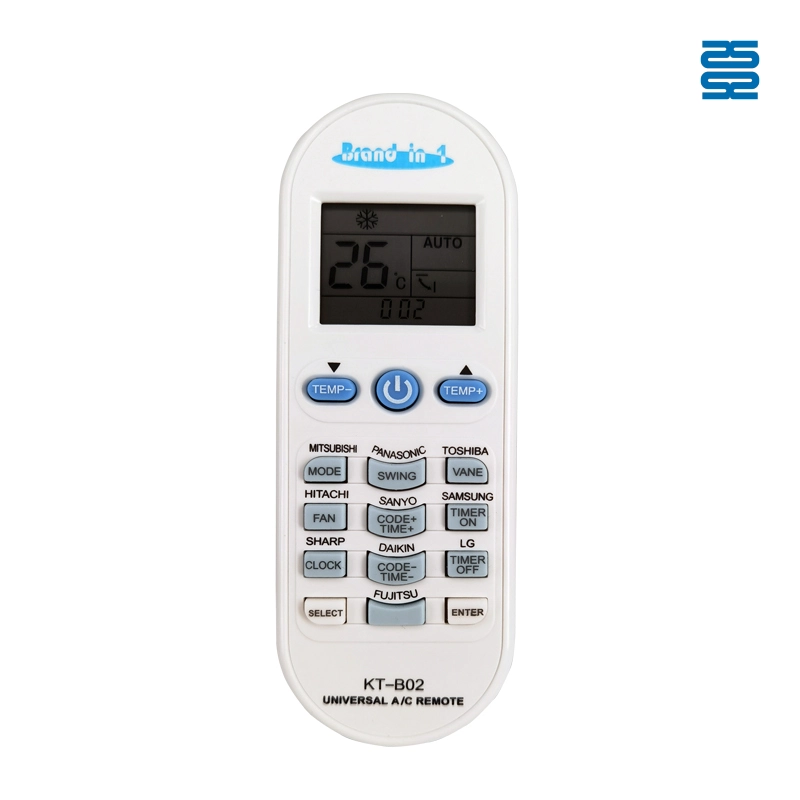
KT-B02 Universal Air Conditioner Remote Control Compatible with All Brands
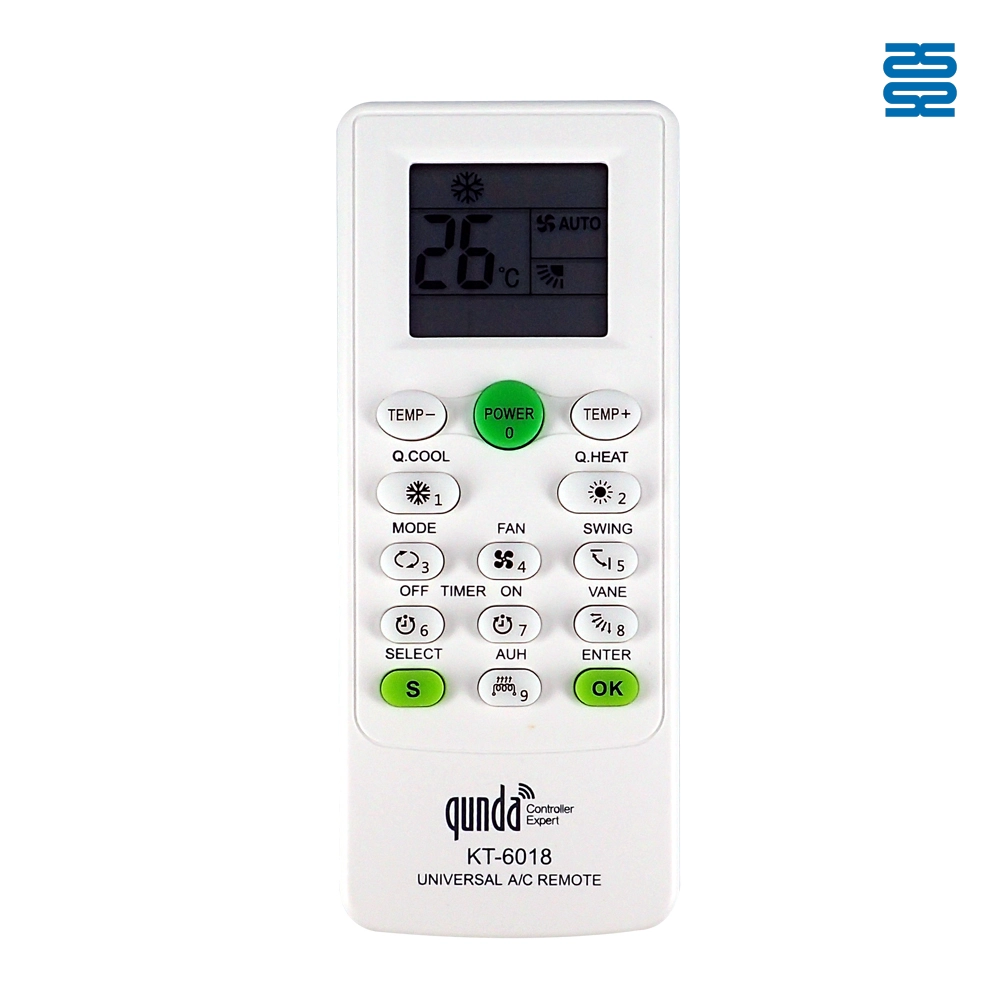
KT-6018 6000 in 1 Universal Air Conditioner Remote Control Compatible with All Brands

QD-1000 IN 1 1000 Code in 1 Universal Air Conditioner Remote Control Compatible with All Brands

KT-N828 Universal Air Conditioner Remote Control Compatible with All Brands
Get the latest updates
If you have any comments or good suggestions, please leave us a message, later our professional staff will contact you as soon as possible.


Contact
Email us
Text or Call us
Address
Room 1606, No. 65, Zhongshan Seven Road, Liwan District, Guangzhou, Guangdong, China.

Facebook
Instagram
YouTube
Tik Tok
VK