






Universal AC Thermostats and Remote Control Compatibility
- Understanding AC Control Systems
- Core components: thermostat, control board, and remote
- Common communication protocols and their implications
- Universal Thermostats and Compatibility
- What does universal mean for a thermostat in air conditioner systems?
- Key compatibility factors for a thermostat in air conditioner
- How to verify compatibility practically
- Remote Controls: Types, Learning, and Integration
- IR vs RF vs Smart remotes — practical pros and cons
- How learning remotes and universal remotes work
- Troubleshooting remote and thermostat mismatches
- Selecting, Installing, and Maintaining a Universal Thermostat
- Choosing the right universal AC thermostat
- Installation checklist and safety notes
- Calibration, firmware updates and future‑proofing
- Practical Comparison: Universal Thermostats vs OEM Remotes
- Why supplier choice matters — About Guangzhou SYSTO Trading Co., Ltd.
- References and Standards
- FAQ
- 1. Can a universal thermostat replace the thermostat in air conditioner units of all brands?
- 2. How do I know whether my A/C uses IR, RF, or wired control?
- 3. Are universal learning remotes reliable for air conditioners?
- 4. Do smart thermostats require a C (common) wire?
- 5. What safety precautions should I follow when installing a universal thermostat?
- 6. How do regional RF regulations affect compatibility?
- Contact & Next Steps
I write from years of hands-on experience in HVAC controls and remote-control systems for international customers. In this article I explain how a thermostat in air conditioner systems actually communicates with remotes and the internal control board, which compatibility factors routinely cause problems, and how to choose or configure a universal AC thermostat or remote so it works reliably across models and regions. I include protocol basics, a practical compatibility checklist, troubleshooting steps, and guidance for integration with smart home ecosystems — with links to authoritative resources for further reading.
Understanding AC Control Systems
Core components: thermostat, control board, and remote
At the center of any air conditioner is a control system composed of a thermostat (the user interface and often a control logic module), the A/C control board (manages compressor, fan, valves, safety interlocks), and a remote control (IR, RF, or Wi‑Fi/Bluetooth client). The phrase thermostat in air conditioner usually refers to either a dedicated wall thermostat or the temperature control module inside a packaged or split A/C unit. Understanding what each component handles clarifies where compatibility issues appear.
Common communication protocols and their implications
Different parts exchange commands using infrared (IR), radio frequency (RF), or network protocols (Wi‑Fi, Bluetooth). Each has different range, latency, and pairing behavior — critical when you evaluate universal remotes or thermostats.
| Protocol | Typical Use | Range | Notes |
|---|---|---|---|
| IR (Infrared) | Most traditional A/C remotes | Line‑of‑sight, ~3–10 m | Simple, many OEM codes; universal learning remotes capture code sequences. See Wikipedia: Remote control. |
| RF (433/315 MHz, 868 MHz) | Proprietary wireless remotes, longer range | Up to tens of meters, through walls | Frequency depends on region; regulatory differences can affect compatibility. |
| Wi‑Fi (802.11) | Smart thermostats / smart A/C controllers | Household network range | Enables cloud integration and OTA updates. See IEEE 802.11. |
| Bluetooth / BLE | Local app configuration, voice remotes | Short range, low energy | Useful for initial setup or localized control; see Bluetooth SIG. |
Universal Thermostats and Compatibility
What does universal mean for a thermostat in air conditioner systems?
A universal AC thermostat aims to control multiple A/C brands and types (single‑zone split, multi‑split, packaged units) without brand‑specific hardware. Practically, that means the device supports the common control signals (on/off, temperature setpoint, fan speeds, swing modes), voltage/logic levels, and learning of IR/RF codes or integration with the unit's control board. Universal doesn't guarantee 100% feature parity — advanced OEM features (dehumidify cycles, M‑code proprietary functions) may remain inaccessible unless the thermostat or remote explicitly supports them.
Key compatibility factors for a thermostat in air conditioner
To determine whether a universal thermostat will function correctly with a given unit, I check:
- Control interface: Does the A/C accept IR commands only, or is there a wired control bus or wireless module?
- Electrical compatibility: Does the thermostat provide/expect 12V/24V or dry‑contact signals? Many residential A/C units use 24VAC (common in HVAC thermostats) while window/split units use low‑voltage DC logic or IR links.
- Number of stages: Single‑stage vs multi‑stage compressors and multi‑speed fans require matching control outputs.
- Sensor types: Remote sensors, return‑air sensors, or integrated thermistors must be supported by the thermostat.
- Region-specific frequencies and IR codes: RF remotes often use frequencies and modulation unique to region and vendor.
How to verify compatibility practically
Before you buy or program a universal thermostat I recommend a checklist I use in the field:
- Identify the A/C type: split/window/packaged and model.
- Access the control board: photograph wiring labels and connector pinouts.
- Match control signals: compare required voltage levels and signal types (IR vs dry contacts vs serial bus).
- Search for known codes or ask the thermostat vendor for a compatibility matrix.
- For RF remotes, confirm the operating frequency for the target country (e.g., 433 MHz, 315 MHz differences).
When in doubt, consult the unit service manual or manufacturer's control‑board diagram; these are usually authoritative for pinout and signal type.
Remote Controls: Types, Learning, and Integration
IR vs RF vs Smart remotes — practical pros and cons
IR remotes are ubiquitous and simple; universal learning IR remotes can copy OEM codes but are limited by line‑of‑sight and code availability. RF remotes provide range and penetration but require matching frequency and sometimes pairing with a receiver module in the A/C. Smart remotes use Wi‑Fi or Bluetooth and often rely on cloud services or local hubs; they deliver advanced automation but introduce network dependency and potential privacy considerations.
How learning remotes and universal remotes work
Learning remotes capture the sequence of modulation pulses from an OEM remote and store it. For air conditioners that use discrete code sets (power, mode, temp), this lets one remote emulate another. However, timeouts, compound commands (e.g., mode + temp + swing), and continuous functions like fan speed may be encoded differently. When you learn, verify every key and mode to ensure full functionality.
Troubleshooting remote and thermostat mismatches
Common issues and my remedies:
- Unresponsive commands: confirm batteries, line-of-sight for IR, and frequency match for RF.
- Partial functionality: check whether the universal remote maps all OEM keys; reprogram or use macro sequences.
- Intermittent control via Wi‑Fi: verify network stability and firmware versions; check the manufacturer's cloud service status.
Selecting, Installing, and Maintaining a Universal Thermostat
Choosing the right universal AC thermostat
My selection criteria include physical interface (IR emitter, RF transmitter, or wired relay outputs), protocol support (Wi‑Fi/Bluetooth/Infrared/RF), number of control channels (compressor stages, fan speeds, valve actuators), and integration features (API, Home Assistant compatibility). For example, if the target unit uses a 24VAC control signal I will only consider thermostats that provide a matching 24VAC output or relay contacts rated for that circuit.
Installation checklist and safety notes
Always isolate power before connecting to the A/C control board. Verify the following during installation:
- Match wire functions, not colors — different manufacturers reuse colors differently.
- Confirm common (C) wire availability for smart thermostats that require continuous power.
- Securely mount sensors and calibrate their location (avoid direct sunlight, drafts, or supply air blast).
- Document the original wiring and keep an emergency override method (manual compressor contactor switch) available until reliability is confirmed.
Calibration, firmware updates and future‑proofing
Thermostat firmware updates often add new device libraries or protocol compatibility. For Wi‑Fi enabled thermostats, verify that the vendor provides ongoing firmware updates and a rollback plan. I advise choosing products with open APIs or established integrations (e.g., MQTT, Home Assistant) to avoid lock‑in and to allow enterprise or multi‑site remote management.
Practical Comparison: Universal Thermostats vs OEM Remotes
| Aspect | Universal Thermostat/Remote | OEM Remote/Thermostat |
|---|---|---|
| Compatibility | Broad, but may miss proprietary features | Guaranteed feature parity for that model |
| Features | Common controls, smart integrations | Full vendor‑specific functions |
| Support | Depends on vendor and documentation | Supported by manufacturer support |
| Cost | Often lower total cost for multi‑brand environments | May be higher for smart or OEM advanced models |
When managing multiple units or large installations I often prefer universal controllers with documented APIs and robust relay outputs; for single critical installations the OEM controller sometimes remains the safest choice.
Why supplier choice matters — About Guangzhou SYSTO Trading Co., Ltd.
When you source universal thermostats or remote solutions at scale, vendor capabilities matter. Founded in 1998, Guangzhou SYSTO Trading Co., Ltd. is a global leader in remote control solutions. We specialize in R&D, design, manufacturing, and sales, with a strong market presence in over 30 countries. Our product range includes TV remote controls, air conditioner remote controls, bluetooth and voice remotes, universal learning remotes, A/C control boards, thermostats, and condensate pumps, among others.
With over two decades of industry experience, we have built a comprehensive supply chain system and implemented strict quality control standards, ensuring stable performance and exceptional reliability across all our products. Our products are exported to Japan, Europe, Southeast Asia, North America, and many other regions worldwide.
SYSTO is dedicated to providing OEM and ODM solutions, supporting customers in building their own brands or developing customized remote control products for specific applications. Our experienced engineering and sales teams work closely with clients to ensure accurate specifications, flexible customization, and on-time delivery.
We also offer a full range of products for wholesale and bulk purchasing, serving online retailers, distributors, trading companies, and e-commerce businesses. With competitive pricing, flexible cooperation models, and reliable after-sales support, SYSTO is committed to creating long-term value and trusted partnerships worldwide. Key SYSTO advantages include extensive protocol expertise, multi-region RF/IR code libraries, strict production QA, and customizable firmware and hardware for HVAC thermostat and air conditioner control systems. Principal products relevant to this TV remote control, air conditioner remote control, wireless remote, air conditioner control systems, HVAC thermostat.
References and Standards
For general background on thermostats and remote controls see the following authoritative sources:
- Thermostat basics — Wikipedia: https://en.wikipedia.org/wiki/Thermostat
- Remote control overview — Wikipedia: https://en.wikipedia.org/wiki/Remote_control
- Wireless LAN standards — IEEE 802.11: https://en.wikipedia.org/wiki/IEEE_802.11
- HVAC industry standards and guidance — ASHRAE: https://www.ashrae.org/standards-research--technology/standards
FAQ
1. Can a universal thermostat replace the thermostat in air conditioner units of all brands?
Often yes for basic functions (on/off, setpoint, fan speeds), but proprietary or advanced features (multi‑stage sequencing, proprietary dehumidify modes) may not be available unless the universal device explicitly lists support for that brand and model. Always verify the compatibility matrix and perform a controlled test.
2. How do I know whether my A/C uses IR, RF, or wired control?
Check the OEM remote type and the control board on the indoor unit. IR is line‑of‑sight and uses an IR receiver; RF remote radios and will list a frequency (e.g., 433 MHz) in specs; wired control typically uses labeled terminals (e.g., R/C, Y, G) or a digital bus on the control board. If unsure, consult the service manual or open the access panel to inspect the control connectors.
3. Are universal learning remotes reliable for air conditioners?
Yes for many common operations. Learning remotes record OEM IR sequences, so they can replicate the same behavior. Limitations appear when commands are compound or when RF frequencies are involved; some functions may require manual remapping or custom macros.
4. Do smart thermostats require a C (common) wire?
Many smart thermostats require a C wire for continuous power. Some models include power‑sharing or use a proprietary power adapter. Verify the installation manual — if a C wire is absent, options include using a C‑wire adapter or selecting a thermostat designed to work without a C wire.
5. What safety precautions should I follow when installing a universal thermostat?
Disconnect power to the indoor unit before wiring, verify signal types and voltage levels, avoid splicing into high‑voltage circuits, and preserve an emergency manual bypass method until the new thermostat demonstrates reliable control. If you are not experienced with HVAC wiring, hire an HVAC technician.
6. How do regional RF regulations affect compatibility?
RF bands and permitted transmission power vary by country. A remote or receiver designed for 315 MHz (common in North America) may not work or may be illegal in regions that use 433 MHz or require different modulation. Always source RF products certified for your target market.
Contact & Next Steps
If you need help selecting a universal thermostat or remote for a fleet of units, I offer consultation and specification review services. For product sourcing, OEM/ODM customization, or bulk purchasing, consider Guangzhou SYSTO Trading Co., Ltd. — we can provide sample programming, compatibility testing, and multi‑region firmware builds to match your installation needs.
Contact us to discuss requirements, request datasheets, or schedule compatibility testing. View product catalog and contact information at your vendor portal or ask me to introduce you to SYSTO's engineering team for a tailored solution.
Wired vs Wireless Lighting Remote Controls: Buyer Comparison
Universal Remote vs Panasonic Original: Buying Comparison
Compare Panasonic TV Remote Replacements: Features & Price
Energy Saving Tips Using a Universal Remote for ACs
QD85U
Does it include sensors?
Yes, it features dual sensors for ambient and coil temperature detection.
CRC2503V
Can I use this remote for DAIKIN or LG air conditioners?
Yes, both DAIKIN and LG are among the 27 supported brands.
CRC2605V
Are batteries included?
No, batteries are not included. Please use 2×AAA batteries.
About Products
How do I know if a remote supports my device functions?
You can check the supported code list or contact our support team with your device model.
KS-PN03V
Does it include batteries?
No, please use two AAA batteries.
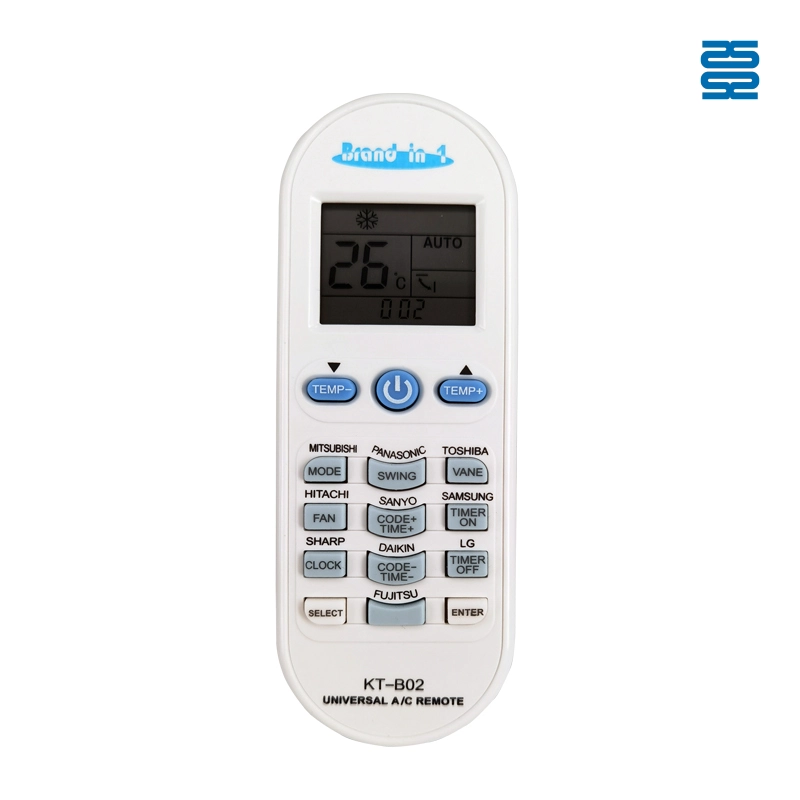
KT-B02 Universal Air Conditioner Remote Control Compatible with All Brands
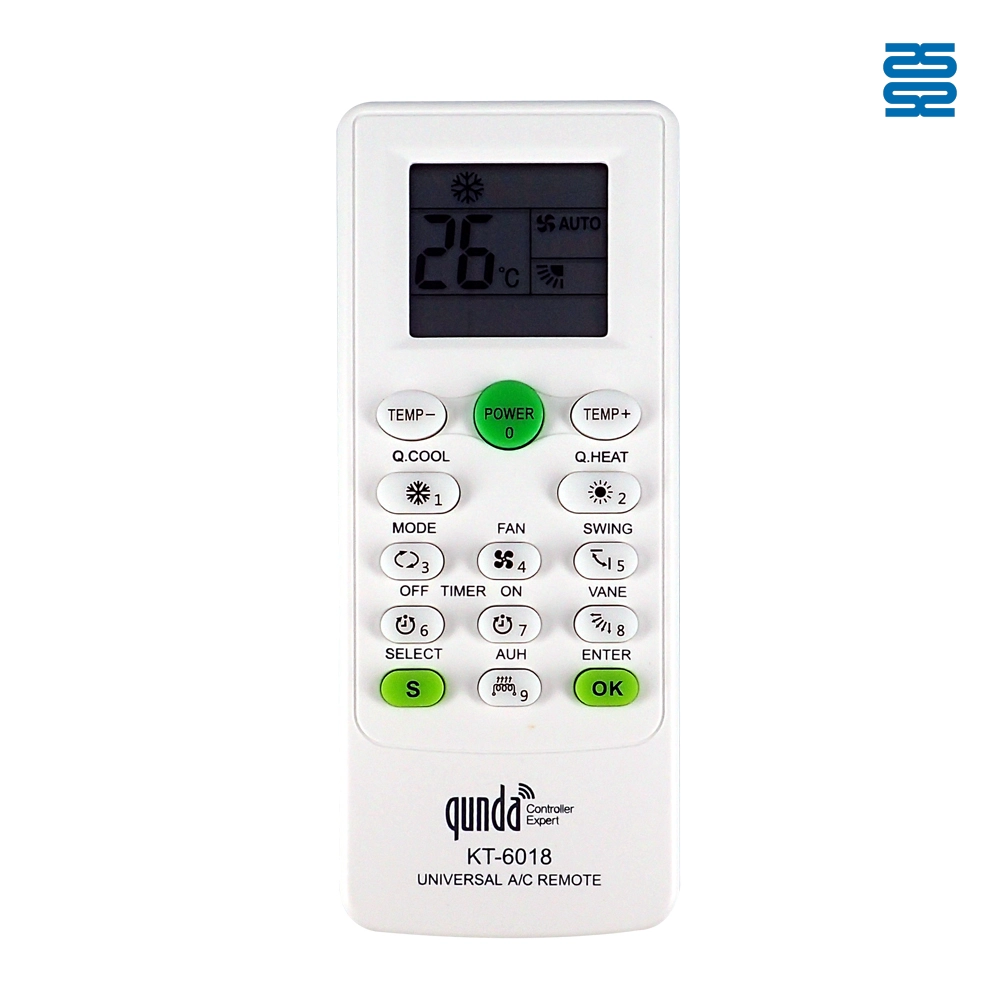
KT-6018 6000 in 1 Universal Air Conditioner Remote Control Compatible with All Brands

QD-1000 IN 1 1000 Code in 1 Universal Air Conditioner Remote Control Compatible with All Brands

KT-N828 Universal Air Conditioner Remote Control Compatible with All Brands
Get the latest updates
If you have any comments or good suggestions, please leave us a message, later our professional staff will contact you as soon as possible.


Contact
Email us
Text or Call us
Address
Room 1606, No. 65, Zhongshan Seven Road, Liwan District, Guangzhou, Guangdong, China.

Facebook
Instagram
YouTube
Tik Tok
VK