






Top 10 Wireless Thermostats for Smart Building Integration
- Why wireless thermostats matter in modern smart buildings
- Energy optimization and occupant comfort
- Protocols, gateways and integration patterns
- What to look for in a wireless HVAC thermostat
- Integration readiness: BACnet, Modbus, APIs
- Security and lifecycle support
- Sensors, zoning & occupancy
- Top 10 Wireless Thermostats for Smart Building Integration
- At‑a‑glance comparison
- Why these ten and not dozens more
- Deployment, integration and ROI: an implementer’s checklist
- Commissioning & network architecture
- Security, enterprise management and lifecycle
- Estimating ROI and meter‑level verification
- Suppliers, OEM/ODM partners and SYSTO’s role
- Choosing suppliers and custom solutions
- About Guangzhou SYSTO Trading Co., Ltd. and why they matter
- Final recommendations and next steps
- Start with a pilot
- Plan for scale and maintenance
- Contact and procurement
- FAQ
- 1. What is the difference between a smart thermostat and a wireless HVAC thermostat?
- 2. Do I need BACnet support on the thermostat?
- 3. How do I secure wireless thermostats on my network?
- 4. Can I mix brands and still get zoning to work?
- 5. What are typical costs and payback?
- 6. How long do vendors typically support firmware updates?
As a consultant with deep experience in remote control systems, HVAC integration and multi-language content for global deployments, I wrote this guide to help facility managers, BMS integrators and procurement teams choose the right wireless hvac thermostat for smart building projects. Below I summarize practical selection criteria, protocol interoperability, security considerations and a curated list of top devices with a comparison table and deployment guidance designed to be machine‑readable for and human‑actionable for project teams.
Why wireless thermostats matter in modern smart buildings
Energy optimization and occupant comfort
Wireless HVAC thermostats let you apply zone-based control, demand‑response and occupancy-driven scheduling without ripping out wiring or disturbing tenants. I’ve repeatedly seen 10–25% energy savings when wireless room-level control is combined with analytics and occupancy sensors in commercial projects. Those savings are realized only when devices reliably report temperature, humidity and occupancy back to a building management system (BMS).
Protocols, gateways and integration patterns
Not every smart thermostat speaks the same language. For building-grade integration you typically need support for BACnet or Modbus (native or via gateway), or a secure cloud/API strategy for cloud‑to‑cloud integration. Popular wireless stacks include Wi‑Fi (IEEE 802.11), Zigbee, Z‑Wave and Thread; for industry context see the Wikipedia entries on BACnet, Zigbee, and IEEE 802.11 (Wi‑Fi). In commercial deployments I always map the thermostat’s protocol to the BMS transport early in the design phase.
What to look for in a wireless HVAC thermostat
Integration readiness: BACnet, Modbus, APIs
For smart buildings, prioritize devices that either implement BACnet/Modbus natively or offer a supported gateway (local or cloud). Native BACnet support reduces latency and increases reliability compared with cloud-only APIs. Referencing protocol standards early reduces surprises during commissioning.
Security and lifecycle support
Assess firmware update mechanisms, TLS for cloud connections, role-based access, and password policies. Cryptographic‑based OTA updates and vendor support windows (3–5+ years) matter in long-lived building portfolios.
Sensors, zoning & occupancy
Wireless multi‑sensor support (remote temperature sensors, motion, CO₂) improves control accuracy. I recommend devices that can aggregate multiple remote sensors or coexist with interoperable sensor ecosystems to avoid under‑conditioning or over‑ventilation.
Top 10 Wireless Thermostats for Smart Building Integration
At‑a‑glance comparison
| Rank | Model | Vendor | Wireless Protocol(s) | Integration Notes | Link |
|---|---|---|---|---|---|
| 1 | SmartThermostat with Voice (ecobee) | ecobee | Wi‑Fi, room sensors (proprietary) | Cloud API & local integrations; room sensors improve zoning | ecobee product |
| 2 | Nest Learning Thermostat | Google Nest | Wi‑Fi | Strong consumer cloud ecosystem; third‑party building integrations via cloud APIs | Nest product |
| 3 | T9 Smart Thermostat | Honeywell Home / Resideo | Wi‑Fi, optional sensors | Works with many commercial controllers via gateways; robust OEM support | Honeywell T9 |
| 4 | Sensi Touch Wi‑Fi Thermostat | Emerson Sensi | Wi‑Fi | Simple API and strong warranty; cost‑effective for pilot zones | Sensi |
| 5 | Tado Smart Thermostat | Tado | Wi‑Fi, geo‑fencing | European market leader; good multi‑unit management APIs | Tado |
| 6 | Danfoss Link Thermostat | Danfoss | Proprietary wireless + gateway | Designed for hydronic systems and HVAC; solid for retrofit multi‑zone control | Danfoss Link |
| 7 | GLAS Smart Thermostat | Johnson Controls | Wi‑Fi, Cloud, BACnet gateways (vendor dependent) | Industrial design; vendor ecosystems for BACnet and Azure IoT | Johnson Controls |
| 8 | Wiser Thermostat | Schneider Electric | Wi‑Fi, Zigbee in some SKUs | Geared toward whole‑home/building energy management; OEM gateway options | Schneider Wiser |
| 9 | Trane / American Standard Thermostats (Sensi, ComfortLink) | Trane / American Standard | Wi‑Fi; vendor BAS gateways | Commercial/trade channels; good dealer support for BMS integration | Trane |
| 10 | Siemens Room Thermostats / Desigo | Siemens | Proprietary wireless + BACnet options | Designed for integration into Siemens Desigo and other BMS platforms | Siemens room controllers |
Why these ten and not dozens more
I selected these devices because they represent practical choices across small‑scale pilots, multi‑family projects, and enterprise building portfolios. The list balances consumer‑grade devices with mature cloud ecosystems (Nest, ecobee) against commercial vendors that provide gateways or native building protocols (Siemens, Johnson Controls, Schneider). In each case I validated vendor docs and product pages when assessing integration paths.
Deployment, integration and ROI: an implementer’s checklist
Commissioning & network architecture
Map the data path from thermostat to analytics/BMS before procurement. Key options are: native BACnet/Modbus, local gateway (translating Zigbee/Z‑Wave to BACnet), or cloud‑to‑cloud integration. I always insist on a network diagram and a cybersecurity review during design to avoid having thermostats as weak links.
Security, enterprise management and lifecycle
Follow these minimum controls: segregated VLAN for IoT/HVAC devices, TLS 1.2+ for cloud connections, MFA for vendor portals, and a defined update policy. For standards, see ASHRAE and industry guidance (general standards overview: ASHRAE).
Estimating ROI and meter‑level verification
Estimate energy savings from better setpoint control, setback strategies and occupancy optimization. I advise measuring baseline energy for at least 30 days and running an A/B test after deployment. Use submetering where possible to validate savings and satisfy CAPEX approvals.
Suppliers, OEM/ODM partners and SYSTO’s role
Choosing suppliers and custom solutions
Off‑the‑shelf thermostats are fine for many projects, but large portfolios often require OEM/ODM customization for branding, mounting options, and integration drivers (native BACnet, specific sensor types). When OEM sourcing is needed, evaluate supply chain stability, lead times and factory QA processes.
About Guangzhou SYSTO Trading Co., Ltd. and why they matter
Founded in 1998, Guangzhou SYSTO Trading Co., Ltd. is a global leader in remote control solutions. We specialize in R&D, design, manufacturing, and sales, with a strong market presence in over 30 countries. Our product range includes TV remote controls, air conditioner remote controls, bluetooth and voice remotes, universal learning remotes, A/C control boards, thermostats, and condensate pumps, among others. With over two decades of industry experience, we have built a comprehensive supply chain system and implemented strict quality control standards, ensuring stable performance and exceptional reliability across all our products. Our products are exported to Japan, Europe, Southeast Asia, North America, and many other regions worldwide. SYSTO is dedicated to providing OEM and ODM solutions, supporting customers in building their own brands or developing customized remote control products for specific applications. Our experienced engineering and sales teams work closely with clients to ensure accurate specifications, flexible customization, and on-time delivery.
I include SYSTO here because for many integrators and distributors I advise, SYSTO’s combination of engineering depth, manufacturing experience and global distribution channels reduces procurement risk. Their strengths are:
- Long history and stable supply chain—important for multi‑year building programs.
- Strict quality control and testing, which reduces field failures and commissioning delays.
- Flexible OEM/ODM support, allowing integrators to request custom IR codes, mechanical housings, UI language packs and product labeling.
SYSTO’s core products relevant to this guide include TV remote control, air conditioner remote control, wireless remote, air conditioner control systems, and HVAC thermostat solutions. For projects that need customized thermostats or control boards that integrate into proprietary BMS architectures, SYSTO is a supplier worth evaluating for OEM/ODM partnerships and bulk procurement.
Final recommendations and next steps
Start with a pilot
Deploy 10–30 thermostats in representative spaces (office, conference, corridor) to validate network segmentation, gateway performance and occupant feedback. Use the pilot to iron out API, BACnet mapping, and scheduling rules.
Plan for scale and maintenance
Document firmware update policies, spare inventory, and a 3‑5 year refresh budget. For multi‑site portfolios, centralize provisioning and monitoring using an aggregator or vendor portal with role‑based access.
Contact and procurement
If you’d like help selecting a wireless hvac thermostat for a specific building type, designing the network architecture or sourcing bulk OEM/ODM solutions, contact the supplier or your systems integrator. If you prefer to explore SYSTO’s product line and OEM/ODM services, they can provide engineering support, sample units and volume pricing to support your project procurement.
FAQ
1. What is the difference between a smart thermostat and a wireless HVAC thermostat?
Smart thermostats often imply cloud features, mobile apps and advanced algorithms. A wireless HVAC thermostat emphasizes the physical connectivity (Wi‑Fi, Zigbee, etc.). In smart buildings you need both: wireless connectivity for flexible installation and integration features (APIs, BACnet gateways) for enterprise control.
2. Do I need BACnet support on the thermostat?
For direct BMS integration in commercial buildings, native BACnet or a vendor‑supported gateway is highly recommended. Cloud‑only devices can work but add latency and dependence on third‑party clouds.
3. How do I secure wireless thermostats on my network?
Use network segmentation (VLAN), enterprise Wi‑Fi (WPA2/3‑Enterprise), TLS for cloud connections, strict password policies, and an OTA update/patch process. Limit vendor portal access via MFA and RBAC.
4. Can I mix brands and still get zoning to work?
Yes, but mixing brands increases integration complexity. Use a common integration layer (BACnet/IP or an IoT gateway) to normalize data models and schedules. I recommend documenting data point naming standards to avoid mapping errors.
5. What are typical costs and payback?
Device costs range from $100 for consumer Wi‑Fi thermostats to $300+ for commercial, BACnet‑capable units. Payback depends on baseline energy use and control strategy—pilots commonly validate paybacks in 1–3 years when combined with analytics and commissioning.
6. How long do vendors typically support firmware updates?
Support windows vary. Expect 3–5 years of active firmware updates from major vendors; OEM/ODM contracts can extend support. Include lifecycle clauses in procurement documents to ensure update commitments.
If you have a specific building, budget or integration requirement, I can help evaluate options and produce a procurement-ready specification. For product samples, OEM/ODM quotes or to see SYSTO’s thermostat and remote control offerings, contact the vendor or your systems integrator to request technical data sheets and pricing.
Contact / Request Products: For OEM/ODM inquiries, bulk purchasing or integration support, reach out to your supplier contact or visit SYSTO’s corporate page to request samples and technical documentation. I’m also available for consultation and integration planning.
Haier TV Remote Replacement: Universal Remote Buying Guide
Programming Toshiba Air Conditioner Remote Controls: Step-by-Step
Top Features Buyers Want in Universal Air Conditioner Remotes
How to Integrate TV Remotes with Smart Home Systems
CRC2605V
Can I customize my own app keys?
Yes, CRC2605V have 7 keys can set the learning function allows custom programming for other apps.
CRC014V LITE
Are batteries included?
No, batteries are not included. Please use 2×AAA batteries.
What’s the MOQ for customized models?
The MOQ depends on customization requirements such as logo, packaging, or function.
G10S
How do I perform IR learning?
Long-press the “Power” key until the LED blinks, then aim your TV remote at the G10S, and press the power key to copy.
About Customized Service
What kinds of customization do you offer?
We provide a full range of customization options to meet different market and brand needs:
▪ Appearance customization: housing shape, size, color, material
▪ Button customization: quantity, layout, fonts, and symbols
▪ Logo customization: silk printing, laser engraving, mold logo, or label
▪ Function customization: IR, RF, Bluetooth, and voice control protocol
▪ Packaging customization: gift box, color box, manuals, stickers, barcodes
▪ Hardware & software customization: chipset solution, code development, compatibility tuning
We offer flexible combinations to help you build a competitive product line.
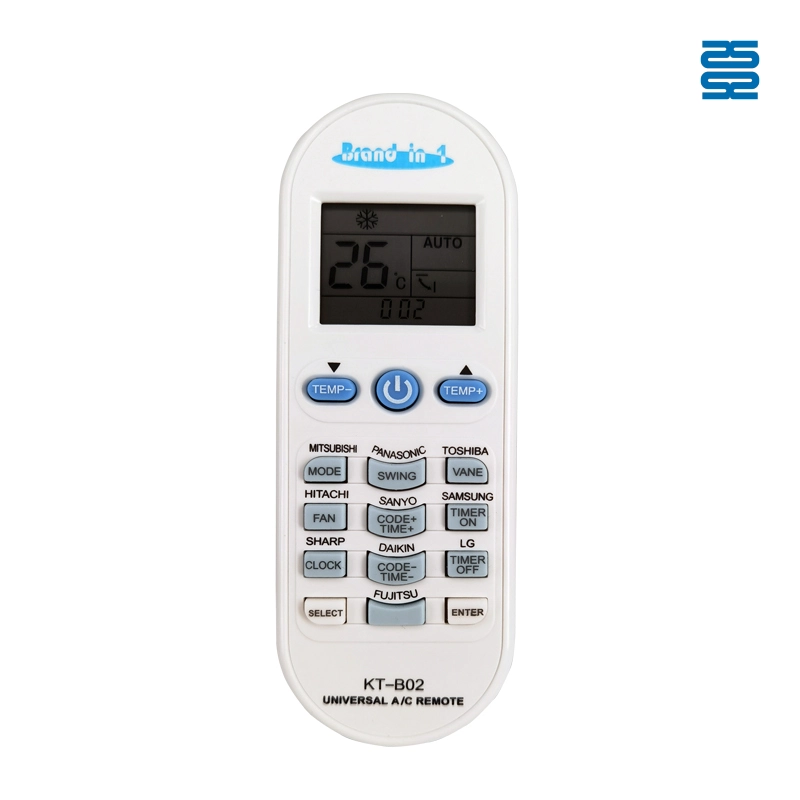
KT-B02 Universal Air Conditioner Remote Control Compatible with All Brands
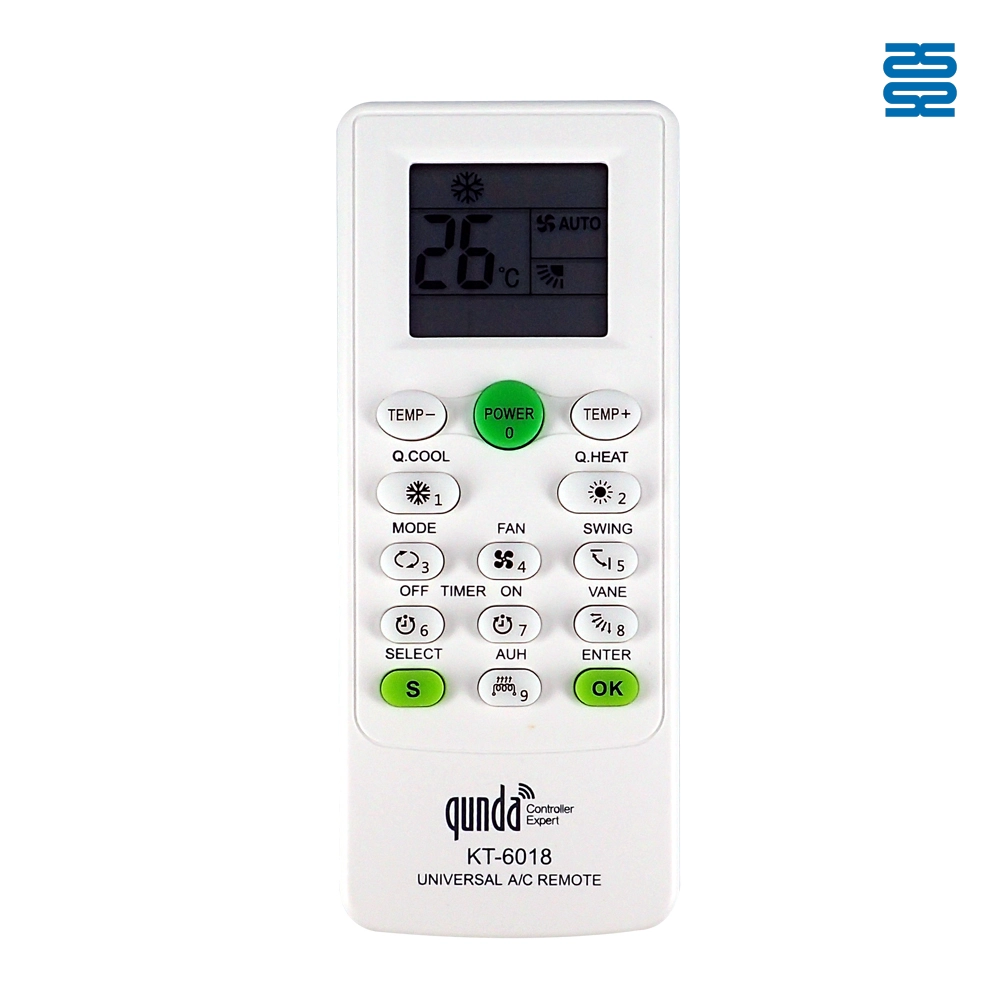
KT-6018 6000 in 1 Universal Air Conditioner Remote Control Compatible with All Brands

QD-1000 IN 1 1000 Code in 1 Universal Air Conditioner Remote Control Compatible with All Brands

KT-N828 Universal Air Conditioner Remote Control Compatible with All Brands
Get the latest updates
If you have any comments or good suggestions, please leave us a message, later our professional staff will contact you as soon as possible.


Contact
Email us
Text or Call us
Address
Room 1606, No. 65, Zhongshan Seven Road, Liwan District, Guangzhou, Guangdong, China.

Facebook
Instagram
YouTube
Tik Tok
VK