






Top Thermostat Remote Control Protocols: Wi-Fi, Zigbee, BACnet, Modbus
- Understanding communication protocols for building controls
- What a protocol must deliver for a thermostat in HVAC
- Layers and endpoints: edge, gateway, and cloud
- Standards and compliance matter
- Comparing Wi‑Fi, Zigbee, BACnet, and Modbus for thermostat remote control
- Key protocol characteristics and use cases
- Performance: latency, throughput, and scalability
- Security and compliance considerations
- Implementation considerations and best practices
- Network design and topology implications
- Provisioning, OTA updates, and lifecycle management
- Interoperability and vendor strategy
- Protocol selection by scenario and cost considerations
- Residential smart thermostat (single home or small rental)
- Commercial buildings and enterprise HVAC
- Industrial and legacy systems
- Cost comparison (indicative)
- Case studies, standards, and vendor collaboration
- Real deployments I recommend
- Standards and references I trust
- Working with manufacturers and OEM partners
- Why partner with a specialized remote control manufacturer
- SYSTO: product capabilities and global reach
- SYSTO advantages for thermostat in HVAC projects
- How to engage vendors for protocol specific projects
- FAQ
- 1. Which protocol is best for a home smart thermostat?
- 2. Should I use BACnet or Modbus for a commercial HVAC project?
- 3. How do I secure my thermostat communications?
- 4. Can I mix protocols in the same building?
- 5. What should I ask vendors before purchasing thermostats?
- 6. How do standards bodies affect protocol choice?
I write from years of hands‑on experience designing and deploying remote control solutions for HVAC systems and buildings. In this article I break down the four dominant communications protocols used for thermostat remote control—Wi‑Fi, Zigbee, BACnet, and Modbus—so you can choose the right approach for your project. I integrate technical performance, security, installation considerations, and real‑world use cases, and I reference authoritative standards and industry sources so every recommendation is verifiable.
Understanding communication protocols for building controls
What a protocol must deliver for a thermostat in HVAC
When I evaluate protocols for a thermostat in HVAC, I look for reliability, latency, security, interoperability with building management systems (BMS), and the ease of provisioning and maintenance. Thermostats must report temperature, humidity, setpoints, operating mode, fan status, and sometimes diagnostics. The chosen protocol should transport those data reliably across the deployment topology—single home, multi‑unit residential, or commercial building—with appropriate security and control granularity.
Layers and endpoints: edge, gateway, and cloud
Architectures vary: devices can be edge‑connected directly to cloud services (common with Wi‑Fi), or they can use a mesh/network and gateway approach (common with Zigbee). BACnet and Modbus typically integrate directly with local BMS controllers or gateways to the enterprise network. Thinking in terms of edge, gateway, and cloud helps me pick where to apply encryption, logging, and OTA updates.
Standards and compliance matter
For commercial deployments, adherence to industry standards matters. BACnet is governed by ASHRAE for building automation, and Modbus has its own open standard maintained by the Modbus Organization. Zigbee is now stewarded by the Connectivity Standards Alliance, while Wi‑Fi relies on IEEE 802.11 family standards. I rely on those sources for technical references and certification guidance (BACnet - Wikipedia, Modbus Organization, Connectivity Standards Alliance, Wi‑Fi - Wikipedia).
Comparing Wi‑Fi, Zigbee, BACnet, and Modbus for thermostat remote control
Key protocol characteristics and use cases
Below I present a concise comparison table to help you quickly see which protocol aligns with your goals—whether it's a smart home retrofit, a large commercial retrofit, or a campus BMS deployment. I sourced technical attributes from standards and authoritative descriptions.
| Protocol | Topology | Typical Use Cases | Security | Interoperability |
|---|---|---|---|---|
| Wi‑Fi | Star (AP based) | Residential & cloud‑connected thermostats, remote access | WPA2/WPA3; TLS for cloud comms | High with cloud APIs; local integration varies |
| Zigbee | Mesh | Smart home mesh networks, battery‑powered sensors | Network key, AES‑128; updated profiles via CSA | Good within Zigbee profiles; needs gateway for cloud/BMS |
| BACnet | MS/TP, IP (BACnet/IP) | Commercial BMS, multi‑vendor building automation | Secure BACnet options (BACnet/SC emerging) | Designed for interoperability across HVAC manufacturers |
| Modbus | Serial (RTU), TCP/IP | Industrial and legacy device integration, controllers | Plain Modbus has no built‑in encryption; Modbus TCP with TLS via gateways | Very widespread; often used for direct device control |
Sources: Modbus - Wikipedia, BACnet - Wikipedia, Zigbee - Wikipedia, Wi‑Fi - Wikipedia.
Performance: latency, throughput, and scalability
In my deployments, Wi‑Fi delivers high throughput and low latency suitable for cloud interactions and rich telemetry. Zigbee excels in low‑power mesh scalability for dozens to hundreds of endpoints per gateway, but with higher latency than local Ethernet. BACnet/IP and Modbus TCP provide deterministic performance on wired networks, which is key in commercial HVAC where predictability matters.
Security and compliance considerations
Security is mission‑critical for thermostat in HVAC control because attackers might manipulate setpoints or gain building access. I prefer protocols that support modern encryption and secure provisioning. For example, I enforce TLS for Wi‑Fi cloud traffic and recommend gateways that implement secure Modbus/BACnet wrapping or use BACnet/SC where available (see ASHRAE guidance: ASHRAE BACnet resources).
Implementation considerations and best practices
Network design and topology implications
Choosing the protocol affects wiring, gateways, maintenance, and failure modes. For a small building retrofit, I often recommend Zigbee for sensor networks with a Wi‑Fi gateway for cloud connectivity if cloud features are required. For campus or large commercial deployments, BACnet/IP on a managed VLAN gives deterministic behavior and better integration with BMS.
Provisioning, OTA updates, and lifecycle management
Operational costs often dominate lifecycle decisions. I insist on secure OTA mechanisms, device identity management, and central monitoring. Wi‑Fi devices typically rely on cloud OTA; Zigbee devices may use local coordinators for OTA; Modbus/BACnet devices usually require vendor‑specific update procedures or management tools. Plan for long‑term firmware support when selecting devices.
Interoperability and vendor strategy
I often see projects stall due to vendor lock‑in. BACnet was explicitly designed for multi‑vendor interoperability; for Modbus, verify register maps and vendor documentation. For Wi‑Fi and Zigbee, ensure the device exposes open APIs or local control options if you require BMS integration without cloud dependencies.
Protocol selection by scenario and cost considerations
Residential smart thermostat (single home or small rental)
For retrofits and consumer smart thermostats I usually choose Wi‑Fi for direct cloud features, mobile app control, and integration with voice assistants. If minimal power draw and mesh resilience are priorities (battery sensors spread across rooms), Zigbee with a gateway is a strong alternative.
Commercial buildings and enterprise HVAC
For enterprise HVAC, BACnet/IP is my default choice because it supports standardized objects for thermostats and HVAC equipment, enabling true multi‑vendor BMS integration. Use Modbus for integrating industrial controllers or legacy devices that don't support BACnet.
Industrial and legacy systems
Modbus RTU remains common in industrial environments due to simplicity and widespread adoption. However, when security and integration matter, I recommend encapsulating Modbus devices behind secure gateways or migrating to Modbus TCP over managed networks with encryption.
Cost comparison (indicative)
Below are typical cost drivers I evaluate during procurement. Actual costs vary by region, volume, and support terms.
| Cost Area | Wi‑Fi | Zigbee | BACnet | Modbus |
|---|---|---|---|---|
| Device unit cost | Medium | Low–Medium | Medium–High | Low–Medium |
| Network infrastructure | Existing Wi‑Fi APs required | Coordinator/gateway needed | Structured cabling, switches, VLANs | Serial wiring or TCP network |
| Maintenance & updates | Cloud OTA common | Coordinator OTA | Vendor BMS tools required | Vendor/update complexity |
Case studies, standards, and vendor collaboration
Real deployments I recommend
I recently led a retrofit for a multi‑tenant office building where we used BACnet/IP for central HVAC control and Zigbee for in‑room occupancy sensors. The BACnet backbone enabled vendor‑neutral thermostats and easy integration with the building energy management platform; Zigbee sensors lowered wiring costs and improved occupancy‑based control.
Standards and references I trust
I base my implementations on recognized standards and reference materials: ASHRAE and BACnet resources for building automation (ASHRAE), the Modbus Organization for device integration (modbus.org), and the Connectivity Standards Alliance for Zigbee profile guidance (CSA). For Wi‑Fi I reference IEEE 802.11 family summaries (Wi‑Fi - Wikipedia) for practical capabilities.
Working with manufacturers and OEM partners
Successful deployments require tight collaboration with hardware vendors and integrators. I advise involving vendors early to confirm register maps, object models (for BACnet), security features, and long‑term firmware support.
Why partner with a specialized remote control manufacturer
SYSTO: product capabilities and global reach
Founded in 1998, Guangzhou SYSTO Trading Co., Ltd. is a global leader in remote control solutions. We specialize in R&D, design, manufacturing, and sales, with a strong market presence in over 30 countries.Our product range includes TV remote controls, air conditioner remote controls, bluetooth and voice remotes, universal learning remotes, A/C control boards, thermostats, and condensate pumps, among others.With over two decades of industry experience, we have built a comprehensive supply chain system and implemented strict quality control standards, ensuring stable performance and exceptional reliability across all our products. Our products are exported to Japan, Europe, Southeast Asia, North America, and many other regions worldwide.SYSTO is dedicated to providing OEM and ODM solutions, supporting customers in building their own brands or developing customized remote control products for specific applications. Our experienced engineering and sales teams work closely with clients to ensure accurate specifications, flexible customization, and on-time delivery.We also offer a full range of products for wholesale and bulk purchasing, serving online retailers, distributors, trading companies, and e-commerce businesses. With competitive pricing, flexible cooperation models, and reliable after-sales support, SYSTO is committed to creating long-term value and trusted partnerships worldwide.
SYSTO advantages for thermostat in HVAC projects
I often recommend suppliers like SYSTO when customers need reliable OEM/ODM support. Their two decades of supply chain experience, strict QC, and product range—TV remote control, air conditioner remote control, wireless remote, air conditioner control systems, HVAC thermostat—mean reduced vendor risk, faster prototyping, and scalable production. For projects that require custom IR/ RF/ Bluetooth or thermostat control boards meeting specific protocol needs, SYSTO provides the kind of integrated support I look for in partners.
How to engage vendors for protocol specific projects
When I engage a manufacturer, I define communication requirements (protocol, data model), security expectations (TLS, secure boot), and lifecycle support (firmware updates). If you plan to integrate thermostats into BACnet or Modbus BMS, request vendor documentation such as BACnet object lists or Modbus register maps during selection to avoid later surprises.
FAQ
1. Which protocol is best for a home smart thermostat?
For most homes, I recommend Wi‑Fi for direct cloud features and mobile control. If you prefer a local smart home ecosystem or low‑power sensors, Zigbee with a gateway is a strong choice.
2. Should I use BACnet or Modbus for a commercial HVAC project?
Use BACnet/IP if multi‑vendor interoperability and BMS integration are priorities. Use Modbus to integrate legacy industrial controllers or where simple register‑based control is acceptable.
3. How do I secure my thermostat communications?
Enforce encryption (WPA3/TLS for Wi‑Fi, secure key management for Zigbee), network segmentation (VLANs), device authentication, and secure OTA updates. For BACnet, consider BACnet/SC where available; for Modbus, use secure gateways to provide TLS or VPNs.
4. Can I mix protocols in the same building?
Yes. It’s common to use BACnet for central HVAC, Zigbee for wireless sensors, and Wi‑Fi for cloud‑enabled controls. Gateways translate between protocols—plan for latency, mapping of data models, and security boundaries.
5. What should I ask vendors before purchasing thermostats?
Request protocol support and profiles, security features, firmware update mechanisms, register/object documentation (Modbus/BACnet), API availability, warranty, and references for similar installations.
6. How do standards bodies affect protocol choice?
Standards bodies (ASHRAE for BACnet, Connectivity Standards Alliance for Zigbee, Modbus Organization) define interoperability and certification paths. Choosing a protocol with active standards governance reduces long‑term integration risk.
If you want help evaluating protocols for a specific project, or need OEM/ODM thermostat and remote control solutions that support Wi‑Fi, Zigbee, BACnet, or Modbus integration, contact me or reach out to Guangzhou SYSTO Trading Co., Ltd. for product information, samples, and customization options. I can assist with technical specifications, network design, and vendor evaluation to ensure your thermostat in HVAC deployment meets performance, security, and budget goals.
Contact/Request products: reach out to SYSTO for catalog, OEM/ODM details, and volume pricing. I’m also available for consultation on protocol selection and architecture design.
Choosing the Best Thermostat for HVAC Remote Control
Top Universal Remotes for Window Air Conditioner Compatibility
How to Integrate TV Remotes with Smart Home Systems
RF vs IR remotes for home theater: pros and cons
PU01
Is this pump suitable for both Split wall-mounted and Cabinet floor-standing air conditioners?
Yes, PU01E fits split units under 3HP or cabinet units under 2HP; PU01F fits split units under 5HP or cabinet units under 2–3HP.
QD-U03C+
What type of air conditioners can the QD-U03C+ control?
It is designed for wall-mounted split A/C units. We also have other control system supporting multiple system types. Pls contact us for more details.
QD-U08PGC+
Does QD-U08PGC+ work with all wall-mounted air conditioners?
It supports most split-type wall-mounted units using PG motors. Please verify motor type before installation.
CRC86E
What should I do if the remote is unresponsive?
Check battery polarity, replace low batteries, ensure line of sight to the device, and confirm the correct device mode is selected.
About Products
Can I request logo or packaging customization?
Yes, OEM/ODM customization is available, including logo, packaging, and functions.
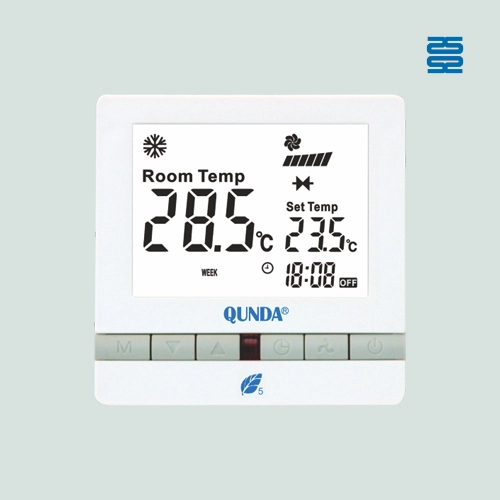
QD-HVAC05E Qunda Digital Thermostat for Central Air Conditioner
QD-HVAC05E can control a two-way electric valve and a three-way electric valve.
QD-HVAC05E is applicable to two-pipe water system or air system HVAC. lt controls the working condition of FCU (Fan Coil Unit) and electric valve by comparing the ambient temperature and setting temperature, to adjust the temperature for a comfortable environment and save energy.
QD-HVAC05E is based on industrial-grade micro-computer technology with touching key operation and LCD display. The controller is simple-operating, stable and reliable.

QD-HVAC03E Qunda Digital Thermostat for Central Air Conditioner
QD-HVAC03E can control a two-way electric valve and a three-way electric valve.
QD-HVAC03E is applicable to two-pipe water system or air system HVAC. lt controls the working condition of FCU (Fan Coil Unit) and electric valve by comparing the ambient temperature and setting temperature, to adjust the temperature for a comfortable environment and save energy.
QD-HVAC03E is based on industrial-grade micro-computer technology with touching key operation and LCD display. The controller is simple-operating, stable and reliable.
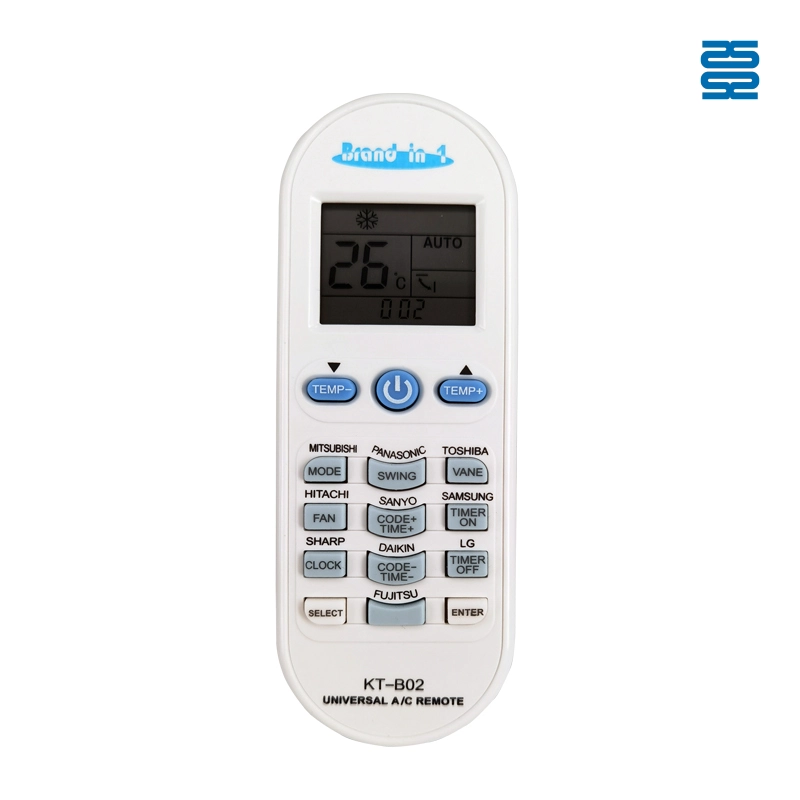
KT-B02 Universal Air Conditioner Remote Control Compatible with All Brands
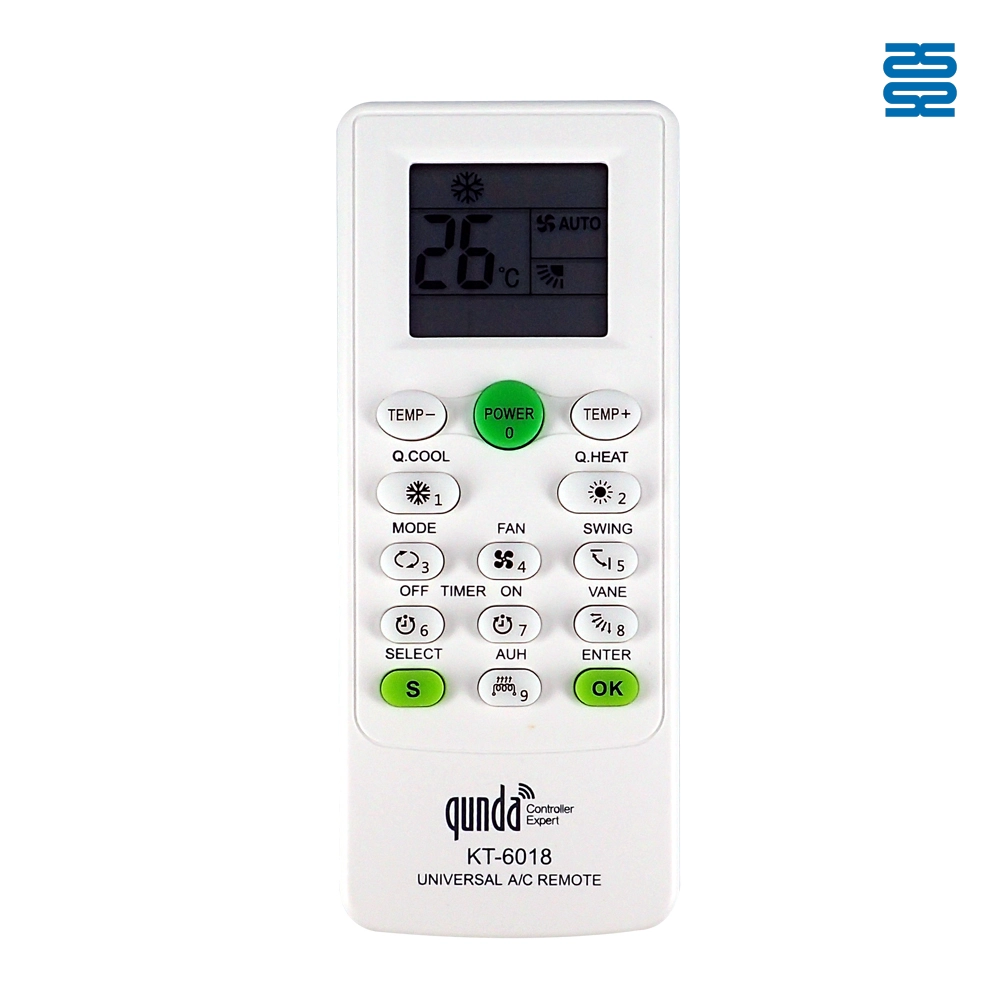
KT-6018 6000 in 1 Universal Air Conditioner Remote Control Compatible with All Brands
Get the latest updates
If you have any comments or good suggestions, please leave us a message, later our professional staff will contact you as soon as possible.


Contact
Email us
Text or Call us
Address
Room 1606, No. 65, Zhongshan Seven Road, Liwan District, Guangzhou, Guangdong, China.

Facebook
Instagram
YouTube
Tik Tok
VK