






Energy Savings & ROI: Smart Thermostats for Air Conditioning
- Understanding the role of intelligent controls
- What a smart thermostat for air conditioner actually does
- Key technologies that influence savings
- Why behavior and climate matter
- Quantifying energy savings and ROI
- Evidence-backed savings ranges
- Realistic ROI calculation method
- Non-energy benefits that improve ROI
- Implementation: choosing, installing, and optimizing
- Selecting the right smart thermostat for your air conditioner
- Installation and commissioning best practices
- Tuning and maintenance for sustained savings
- Integration with remote control and HVAC ecosystems
- When to pair a smart thermostat with AC remote solutions
- Enterprise and OEM considerations
- SYSTO: why supplier choice matters
- Practical tips and verification
- How I validate savings in real installations
- Common pitfalls that reduce expected ROI
- Security and privacy considerations
- Frequently Asked Questions (FAQ)
- 1. How much energy can a smart thermostat save for my air conditioner?
- 2. Will a smart thermostat work with my mini-split or window AC?
- 3. How long does it take to recoup the cost of a smart thermostat?
- 4. Are smart thermostats secure and private?
- 5. Can smart thermostats reduce HVAC maintenance costs?
- 6. Do I need a professional to install a smart thermostat for air conditioner?
- Next steps and how I can help
As an expert in remote control systems and HVAC controls, I often get asked whether installing a smart thermostat for air conditioner is worth the cost. In this article I summarize how intelligent thermostats reduce cooling energy consumption, how to calculate realistic ROI, and how integration with AC remote controls and building systems amplifies savings. I reference authoritative sources and provide practical steps you can implement today to optimize performance and payback.
Understanding the role of intelligent controls
What a smart thermostat for air conditioner actually does
A smart thermostat for air conditioner is more than a programmable dial. It combines scheduling, occupancy detection, adaptive learning, remote access, and sometimes geofencing to avoid conditioning empty spaces. It also interfaces with HVAC systems (including mini-splits and central AC) via infrared, wired control, or smart control boards. For background on thermostats and control principles, see the general overview on Wikipedia.
Key technologies that influence savings
Energy savings come from multiple features: setback scheduling, adaptive algorithms that learn thermal response, integration with occupancy sensors or smartphones (geofencing), and feedback loops with building automation. Protocols such as Wi‑Fi, Zigbee, or proprietary IR/serial links determine how a smart AC thermostat communicates with the air conditioner. For industry guidance on HVAC control practices, consult ASHRAE.
Why behavior and climate matter
In my experience, the same smart thermostat yields very different savings in Phoenix versus Seattle because cooling loads and occupant routines vary. Smart thermostats amplify good behavior (consistent setbacks, zone-wise control) and can mitigate poor habits (leaving windows open while AC runs) if deployed and configured correctly.
Quantifying energy savings and ROI
Evidence-backed savings ranges
Authoritative sources report measurable savings when thermostats are used effectively. The U.S. Department of Energy describes how proper thermostat settings and controls reduce heating and cooling costs (DOE: Thermostats). ENERGY STAR provides guidance on programmable and smart thermostats and their role in efficient operation (ENERGY STAR Thermostats). Published field studies and vendor analyses typically show cooling savings in the range of roughly 8–15% for occupants who leverage scheduling, adaptive control, and remote management; actual savings depend on baseline use, local climate, and installation quality.
Realistic ROI calculation method
To determine payback, I recommend this simple approach:
- Estimate annual cooling energy cost (utility bills or HVAC model).
- Apply a conservative savings percentage (I use 8% as a baseline, 12% as typical, and 15% as optimistic for good deployments).
- Subtract implementation cost (device price + installation) to calculate payback years.
Below I show three practical scenarios using conservative assumptions. Costs and savings are illustrative; substitute your local values for precise ROI.
| Scenario | Annual cooling bill (USD) | Assumed cooling savings | Annual $ saved | Installed cost (USD) | Payback (years) |
|---|---|---|---|---|---|
| Conservative | 600 | 8% | 48 | 250 | 5.2 |
| Typical | 900 | 12% | 108 | 300 | 2.8 |
| Optimized | 1,200 | 15% | 180 | 350 | 1.9 |
Assumptions: installed cost includes device and a basic installation or replacement of an existing thermostat. These scenarios illustrate how climate (affecting cooling bill) and achieved savings percentage drive payback. For methodology on energy consumption breakdown in homes, see the U.S. Energy Information Administration (EIA) residential energy consumption summaries (EIA Residential Energy Consumption).
Non-energy benefits that improve ROI
Beyond direct utility savings, smart thermostats can reduce peak demand charges for commercial accounts, extend HVAC equipment life by reducing run-time extremes, and improve occupant comfort — factors that often accelerate effective ROI. For example, reduced runtime and fewer compressor cycles can lower wear on air conditioner components, which is especially relevant in humid climates.
Implementation: choosing, installing, and optimizing
Selecting the right smart thermostat for your air conditioner
Choose a thermostat that matches your AC type: window units and many mini-splits require IR or manufacturer-specific interfaces; central systems usually use 24V control. Look for models supporting the communication method your system uses (IR, RF, 24V, or communication bus). If you want integration with home automation, prioritize Wi‑Fi, MQTT, or Zigbee compatibility and open APIs. When compatibility is unclear, consult HVAC documentation or an experienced integrator.
Installation and commissioning best practices
Proper installation is essential. I advise a commissioning checklist that includes verifying wiring, confirming sensor placement (away from direct sunlight and drafts), setting conservative initial schedules, and running a two-week monitoring period to compare baseline energy use. For larger systems, involve an HVAC technician to verify control board compatibility and to avoid warranty issues.
Tuning and maintenance for sustained savings
After installation, monitor performance for at least one cooling season. Tune temperature setbacks, calibrate sensors if needed, and evaluate occupancy triggers. Update firmware to ensure efficient algorithms and security patches. For enterprise deployments, logging and analytics will help identify opportunities for further optimization.
Integration with remote control and HVAC ecosystems
When to pair a smart thermostat with AC remote solutions
Many air conditioners, especially ductless mini-splits and packaged units, are controlled primarily via remote controls. Replacing or augmenting those with a smart thermostat for air conditioner requires either a smart IR/RF bridge or a compatible control board. Integrating thermostat intelligence with remote control capabilities enables centralized scheduling and multi-zone coordination, which I’ve seen cut aggregate cooling usage in multi-split installations.
Enterprise and OEM considerations
For OEMs, distributors, and large-scale integrators, choosing a supplier with remote control and thermostat experience reduces integration risk. Standards adherence, firmware support, and supply chain stability are critical. Corporations should evaluate suppliers on engineering support, customization options, and QA processes.
SYSTO: why supplier choice matters
Founded in 1998, Guangzhou SYSTO Trading Co., Ltd. is a global leader in remote control solutions. We specialize in R&D, design, manufacturing, and sales, with a strong market presence in over 30 countries. Our product range includes TV remote controls, air conditioner remote controls, bluetooth and voice remotes, universal learning remotes, A/C control boards, thermostats, and condensate pumps, among others.
With over two decades of industry experience, we have built a comprehensive supply chain system and implemented strict quality control standards, ensuring stable performance and exceptional reliability across all our products. Our products are exported to Japan, Europe, Southeast Asia, North America, and many other regions worldwide.
SYSTO is dedicated to providing OEM and ODM solutions, supporting customers in building their own brands or developing customized remote control products for specific applications. Our experienced engineering and sales teams work closely with clients to ensure accurate specifications, flexible customization, and on-time delivery.
For projects that require integrated solutions — such as combining a smart thermostat for air conditioner with IR/RF remote control translation, HVAC control boards, or cloud-based management — SYSTO’s product portfolio and engineering support reduce development time and help ensure interoperability across devices. Core strengths include wide product variety (TV remote control, air conditioner remote control, wireless remote, air conditioner control systems, HVAC thermostat), proven manufacturing stability, and the capability to support wholesale and bulk purchasing for distributors and e-commerce businesses.
Practical tips and verification
How I validate savings in real installations
I use a before-and-after energy comparison over equivalent cooling periods. Ideally, compare utility meter readings or HVAC runtime logs for the same weeks in consecutive years, adjusting for degree days if the climate differed. For more advanced verification, use interval data from a smart meter or submeter; that granular data helps isolate thermostat-driven runtime reductions.
Common pitfalls that reduce expected ROI
Typical mistakes include incorrect installation (sensor placement or wiring), unrealistic user expectations, and failure to configure schedules or occupancy settings. Another common issue is using a smart thermostat that is incompatible with the AC unit resulting in limited functionality.
Security and privacy considerations
When adopting Wi‑Fi enabled thermostats, ensure strong network security: change default passwords, enable secure Wi‑Fi (WPA2/WPA3), and update firmware. For enterprise deployments, consider segregating IoT devices on a separate VLAN and maintaining an asset lifecycle policy.
Frequently Asked Questions (FAQ)
1. How much energy can a smart thermostat save for my air conditioner?
Real-world savings typically range from about 8% to 15% on cooling energy when the thermostat is properly configured and used; actual savings depend on climate, occupant behavior, baseline efficiency, and installation quality. See the U.S. Department of Energy for general guidance: DOE: Thermostats.
2. Will a smart thermostat work with my mini-split or window AC?
Many mini-splits and window units use IR or proprietary controls. A smart thermostat can work if it supports IR control or if you install a compatible control interface or control board. For complex or warranty-sensitive systems, consult your HVAC vendor or an integrator.
3. How long does it take to recoup the cost of a smart thermostat?
Payback typically ranges from under 2 years in high-cooling-cost scenarios to 5+ years in lower-use situations, depending on installed cost and achieved savings. Use the ROI table in this article as a starting point and plug in your actual utility and installation costs.
4. Are smart thermostats secure and private?
Security varies by manufacturer. Use devices with regular firmware updates, change default credentials, and place IoT devices on a separate network where possible. For enterprise deployments, follow IT security best practices and vendor security documentation.
5. Can smart thermostats reduce HVAC maintenance costs?
Yes. By optimizing setpoints and reducing unnecessary cycling, smart thermostats can reduce wear on compressors and mechanical components, potentially extending equipment life and lowering maintenance frequency.
6. Do I need a professional to install a smart thermostat for air conditioner?
For simple replacements on compatible central systems, a competent DIYer can install many models. However, for mini-splits, commercial systems, or when interfacing with control boards and multiple zones, I recommend professional installation to ensure compatibility and preserve warranties.
Next steps and how I can help
If you want to evaluate a smart thermostat for air conditioner in your building or product line, I can help run a quick ROI estimate using your utility data and recommend compatible controls or integration approaches. For product sourcing or OEM/ODM partnerships, consider Guangzhou SYSTO Trading Co., Ltd. — they provide a broad portfolio of remote control and thermostat products and support customization for large-scale deployments.
Contact us to request a detailed energy assessment or to explore SYSTO’s catalog for thermostats, air conditioner remote controls, and HVAC control systems. Learn more about supplier capabilities, request a quote, or discuss OEM/ODM options to accelerate your product development and reduce time-to-market.
Choosing the Best Thermostat for HVAC Remote Control
Universal Remote Compatibility List for Haier TV Models
What are the application scenarios of wireless hvac thermostat?
Energy Savings with Dimmable Lighting Remote Controls
About Customized Service
What’s your MOQ (Minimum Order Quantity) for customized orders?
Usually 500–1000 pcs per model, depending on the product type and customization requirements. For detailed information, please contact us for an accurate quotation and MOQ confirmation.
BN59-01432A
Does this replacement remote work the same as the original Samsung BN59-01432A?
Yes, it has the same features, layout, and functions — including voice recognition, Bluetooth, and solar charging.
AN-MR25GA
Are batteries included?
No. The remote uses two AA batteries (not included).
CRC2605V
What’s the MOQ for bulk purchase?
Regular stock supports small quantities. Custom orders depend on requirements.
About Products
Can I request logo or packaging customization?
Yes, OEM/ODM customization is available, including logo, packaging, and functions.
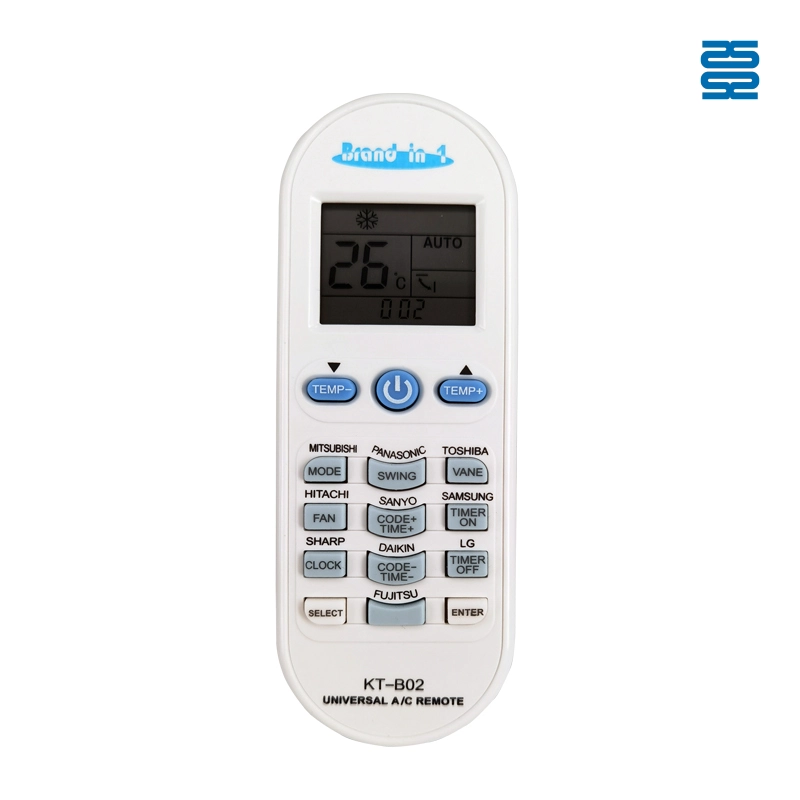
KT-B02 Universal Air Conditioner Remote Control Compatible with All Brands
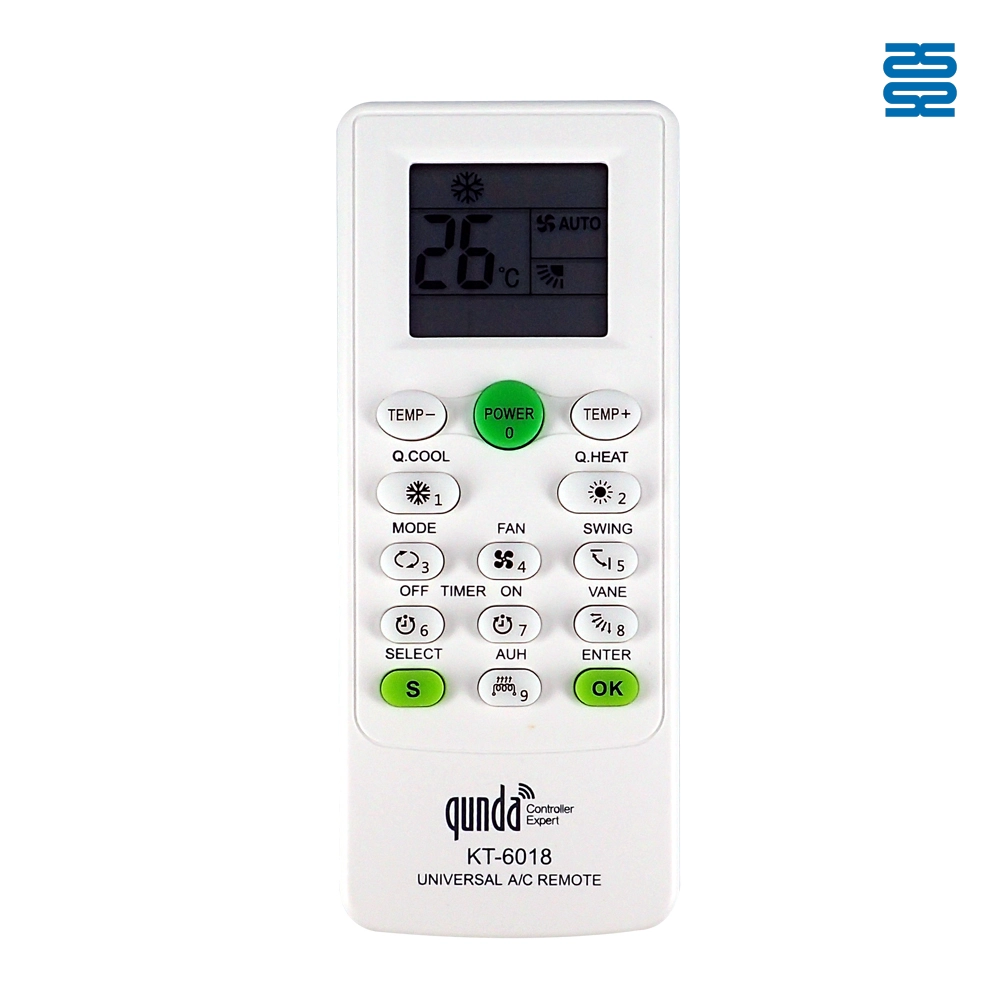
KT-6018 6000 in 1 Universal Air Conditioner Remote Control Compatible with All Brands

QD-1000 IN 1 1000 Code in 1 Universal Air Conditioner Remote Control Compatible with All Brands

KT-N828 Universal Air Conditioner Remote Control Compatible with All Brands
Get the latest updates
If you have any comments or good suggestions, please leave us a message, later our professional staff will contact you as soon as possible.


Contact
Email us
Text or Call us
Address
Room 1606, No. 65, Zhongshan Seven Road, Liwan District, Guangzhou, Guangdong, China.

Facebook
Instagram
YouTube
Tik Tok
VK