






How Smart Thermostats Improve Air Conditioner Remote Control
- Why precision and context matter for cooling
- From on/off remotes to closed-loop control
- Why local sensing matters more than remote commands
- Standards and the role of HVAC best practice
- How smart thermostats enhance air conditioner remote control
- Networked communication and protocol choices
- Adaptive algorithms and learning behavior
- Geofencing, schedules, and occupancy sensing
- Implementation: making smart thermostats work with existing AC remote infrastructure
- Compatibility and interfacing with IR/RF remotes
- Installation steps and pitfalls to avoid
- Security and firmware management
- Measuring benefits: energy, comfort, diagnostics and ROI
- Energy savings and documented evidence
- Quantifying comfort and user satisfaction
- Remote diagnostics, predictive maintenance and lifecycle costs
- Real-world considerations and vendor selection
- Choosing the right product for your deployment
- Scale, supply chain and customization
- SYSTO advantages summarized
- Conclusion and next steps
- FAQ
- 1. What is the difference between a remote control and a thermostat in an air conditioner?
- 2. Can smart thermostats work with my existing IR/RF air conditioner?
- 3. How much energy can I realistically save?
- 4. Are smart thermostats secure?
- 5. Will smart thermostats improve my AC’s reliability?
- 6. How do I choose between a consumer smart thermostat and a commercial-grade controller?
As a consultant with long experience in remote control systems and HVAC integration, I often see the phrase thermostat in air conditioner used in user searches without clear distinction between legacy IR remotes and today’s smart thermostat ecosystems. In this article I summarize how smart thermostats change the game for air conditioner remote control: they add precise temperature control, networked communication, learning algorithms, diagnostic telemetry, and integration with building automation — all of which improve comfort, energy efficiency, and maintainability while supporting modern user expectations for voice, app, and schedule-based control.
Why precision and context matter for cooling
From on/off remotes to closed-loop control
Traditional air conditioner remote controls typically send simple commands (mode, setpoint, fan speed) via infrared or RF. They do not verify whether a command achieved the desired result in the conditioned space. A thermostat embedded in the air conditioner or a separate wall thermostat closes the loop: it senses ambient temperature and adjusts compressor cycles and airflow to meet a target. The shift from one-way commands to closed-loop control is fundamental for stability, comfort, and efficiency — it’s the reason a thermostat in air conditioner systems exists in the first place.
Why local sensing matters more than remote commands
Placing a thermostat sensor in the right location means the system responds to actual room conditions, not to the location of the remote or a user’s perceived temperature. Smart thermostats extend that concept by using multiple sensors (remote sensors, occupancy detectors, outdoor weather feeds), so remote control becomes context-aware: commands can be optimized based on zone occupancy, time-of-day, or outdoor conditions rather than being purely manual.
Standards and the role of HVAC best practice
Industry bodies such as ASHRAE provide guidelines on thermostat placement and control strategies. Following these standards improves system response and prevents short-cycling or improper setpoint behavior that simple remote controls cannot prevent.
How smart thermostats enhance air conditioner remote control
Networked communication and protocol choices
Smart thermostats communicate over Wi-Fi, Zigbee, Z-Wave, or building networks (BACnet, Modbus). That connectivity turns a one-to-one remote command into a many-to-many control plane: mobile apps, voice assistants, building management systems (BMS), and remote diagnostics can all interact with the thermostat. As I’ve implemented for clients, choosing the right protocol depends on latency, security, and integration needs — Wi‑Fi for consumer apps, BACnet for commercial HVAC integration.
Adaptive algorithms and learning behavior
Modern smart thermostats use adaptive control and learning algorithms to predict user behavior and optimize setpoints over time. This reduces reliance on manual remote commands because the thermostat anticipates comfort needs. Empirical studies show such approaches yield measurable savings when configured correctly (see Energy Department and research references below).
Geofencing, schedules, and occupancy sensing
Remote control improves when the thermostat knows context: a geofence will lower cooling when the last occupant leaves; occupancy sensors prevent conditioning unoccupied rooms. I routinely recommend combining scheduling with occupancy and geofencing to minimize false triggers and to ensure the system still responds to manual remote overrides when users are present.
Implementation: making smart thermostats work with existing AC remote infrastructure
Compatibility and interfacing with IR/RF remotes
Many existing systems use IR/RF remotes and legacy A/C control boards. Smart thermostats can be integrated in three common ways: 1) replace the control board with a smart controller that accepts digital commands, 2) use an IR/RF bridge that translates network commands into remote-control signals, or 3) add a dedicated thermostat sensor and controller while keeping the original remote as a fallback. Each option has trade-offs in cost and reliability; I typically prefer controller retrofit for commercial installations and IR bridges for low-cost residential upgrades.
Installation steps and pitfalls to avoid
Key steps I follow when deploying smart thermostats for air conditioners: verify wiring and power (many smart thermostats require a C-wire or an external power solution), validate sensor placement (avoid direct sunlight, drafts, and heat sources), and test control logic under typical occupancy patterns. Common pitfalls include insufficient Wi‑Fi coverage, incorrect sensor calibration, and using a single thermostat in a multi-zone environment — all of which can be mitigated by site survey and trial runs.
Security and firmware management
Connecting a thermostat to a network exposes it to cyber risk. I implement secure onboarding (WPA2/WPA3 or enterprise Wi‑Fi), use vendor firmware signing, and maintain an update policy. For commercial systems, integration with a centralized management server allows staged firmware rollouts and remote diagnostics without disrupting occupants.
Measuring benefits: energy, comfort, diagnostics and ROI
Energy savings and documented evidence
Smart thermostats can deliver energy savings when correctly configured. The U.S. Department of Energy provides guidance on thermostat strategies and notes meaningful savings from proper setback and scheduling practices (DOE, Energy Saver). Academic and field studies also observe notable reductions: retrofit studies of learning thermostats report variable savings depending on climate and user behavior; for example, field evaluations compiled by research groups indicate savings ranges of approximately 8–15% for heating and cooling combined under typical conditions (LBNL study).
Quantifying comfort and user satisfaction
Comfort improvements are not just subjective. With finer control over deadbands, hold behavior, and humidity integration, smart thermostats reduce temperature overshoot and short-cycling. Surveys I’ve run with building managers show improved occupant satisfaction scores after deploying learning thermostats and occupancy-based control strategies.
Remote diagnostics, predictive maintenance and lifecycle costs
One of the less obvious but high-value benefits is diagnostic telemetry: runtime hours, compressor cycles, filter alerts, and fault codes can be reported remotely. This enables predictive maintenance and reduces unplanned downtime — converting remote control from mere convenience into a tool for lifecycle asset management.
| Metric | Traditional Remote Control | Smart Thermostat Control | Typical Impact / Source |
|---|---|---|---|
| Energy savings (cooling) | 0–5% (manual) | 5–15% (adaptive & schedules) | DOE and field studies show variable savings depending on usage and climate (DOE, LBNL) |
| Comfort stability | Moderate — subject to user input | High — sensor networks and adaptive control | Better temperature regulation through closed-loop controls and remote sensors |
| Diagnostics | Minimal | Full telemetry & alerts | Enables predictive maintenance and reduced downtime |
| Integration | Standalone | Connected (apps, voice, BMS) | Enables automation, scheduling and multi-zone coordination |
| Initial cost | Low | Medium–High | Higher upfront, lower lifecycle cost in many use cases |
Sources: U.S. Department of Energy, Lawrence Berkeley National Laboratory, ASHRAE guidance (ASHRAE).
Real-world considerations and vendor selection
Choosing the right product for your deployment
When evaluating vendors, I prioritize: interoperability (open APIs, support for BACnet/Modbus where required), field-proven reliability, local technical support, and a clear product lifecycle policy (firmware updates, spare parts). For consumer projects, app maturity and voice assistant support are also important.
Scale, supply chain and customization
For large scale rollouts or OEM needs, working with manufacturers that offer OEM/ODM capabilities and robust supply chains reduces risk. Founded in 1998, Guangzhou SYSTO Trading Co., Ltd. is a global leader in remote control solutions. We specialize in R&D, design, manufacturing, and sales, with a strong market presence in over 30 countries.Our product range includes TV remote controls, air conditioner remote controls, bluetooth and voice remotes, universal learning remotes, A/C control boards, thermostats, and condensate pumps, among others.With over two decades of industry experience, we have built a comprehensive supply chain system and implemented strict quality control standards, ensuring stable performance and exceptional reliability across all our products. Our products are exported to Japan, Europe, Southeast Asia, North America, and many other regions worldwide.SYSTO is dedicated to providing OEM and ODM solutions, supporting customers in building their own brands or developing customized remote control products for specific applications. Our experienced engineering and sales teams work closely with clients to ensure accurate specifications, flexible customization, and on-time delivery.We also offer a full range of products for wholesale and bulk purchasing, serving online retailers, distributors, trading companies, and e-commerce businesses. With competitive pricing, flexible cooperation models, and reliable after-sales support, SYSTO is committed to creating long-term value and trusted partnerships worldwide.
SYSTO advantages summarized
I’ve partnered with manufacturers like SYSTO on projects where durability, customization, and global logistics matter. Their strengths include a long industry track record, integrated A/C control systems and HVAC thermostat products, and the ability to provide OEM/ODM solutions that accelerate time-to-market while maintaining quality standards. For clients needing TV remote control, air conditioner remote control, wireless remote, air conditioner control systems, and HVAC thermostat products, SYSTO presents a competitive option backed by two decades of expertise.
Conclusion and next steps
Integrating a smart thermostat into air conditioner remote control architecture converts a simple manual device into a distributed, intelligent control system. The benefits — improved comfort, measurable energy savings, remote diagnostics, and integration with modern home and building automation — are real when projects are planned and executed with attention to sensor placement, communication protocols, and cybersecurity. If you’re considering a retrofit, start with a site survey, pilot a few representative zones, and measure before-and-after energy and comfort metrics. For larger deployments, involve vendors with OEM/ODM capability and supply chain resilience.
FAQ
1. What is the difference between a remote control and a thermostat in an air conditioner?
A remote control typically sends one-way commands (mode, setpoint) to the air conditioner. A thermostat (or a thermostat in air conditioner systems) senses actual room conditions and implements control loops to reach and maintain a setpoint. Smart thermostats add connectivity, learning, and diagnostics.
2. Can smart thermostats work with my existing IR/RF air conditioner?
Yes. Options include replacing the control board with a smart controller, using an IR/RF bridge that translates network commands, or adding a separate thermostat sensor and controller. The best choice depends on your budget, reliability requirements, and whether you need building-level integration.
3. How much energy can I realistically save?
Savings vary by climate, occupancy and behavior. Field studies and guidance from the U.S. Department of Energy indicate that smart thermostats and proper scheduling can produce energy savings typically in the single digits to low double digits percent range for heating and cooling combined (DOE, LBNL).
4. Are smart thermostats secure?
Security is a concern for any connected device. Choose devices that support secure onboarding, encrypted communication, signed firmware updates, and network segmentation. For commercial deployments, manage devices via a central server with role-based access control.
5. Will smart thermostats improve my AC’s reliability?
Indirectly, yes. Smart thermostats provide diagnostic data (run-time, cycles, fault codes) that enable predictive maintenance and early fault detection, reducing unplanned downtime and potentially extending equipment life.
6. How do I choose between a consumer smart thermostat and a commercial-grade controller?
Use consumer products for single-family homes or small offices where app experience and voice assistants matter. For hotels, multi-zone commercial buildings, or industrial applications, choose controllers with building protocols (BACnet, Modbus), robust security, and a lifecycle management plan.
If you’d like help evaluating options, running a pilot, or sourcing compatible hardware, contact our team to discuss requirements or to view product catalogs. For OEM/ODM needs, Guangzhou SYSTO Trading Co., Ltd. offers a broad portfolio including TV remote control, air conditioner remote control, wireless remotes, air conditioner control systems, and HVAC thermostats — and can support customization, bulk purchasing, and global shipping.
Contact us for a consultation or to request product samples and technical specifications.
Energy-Saving Thermostat Settings for Air Conditioner Systems
Best Replacement Remotes for Panasonic TV: Top Picks 2026
Energy-Saving Remote Settings for Window Air Conditioners
Best Wireless HVAC Thermostats for Commercial Buyers
CRC2503V
Is customization available for distributors?
Yes, OEM and ODM customization are fully supported, including logo, packaging, and labeling.
CRC1130V
What’s the MOQ for customized models?
The MOQ depends on customization requirements such as logo, packaging, or function.
About Products
Can I request logo or packaging customization?
Yes, OEM/ODM customization is available, including logo, packaging, and functions.
CRC2605V
Are batteries included?
No, batteries are not included. Please use 2×AAA batteries.
CRC2201V
Can I buy in small quantities?
Yes. We support small MOQ for regular models; OEM MOQ depends on customization needs.
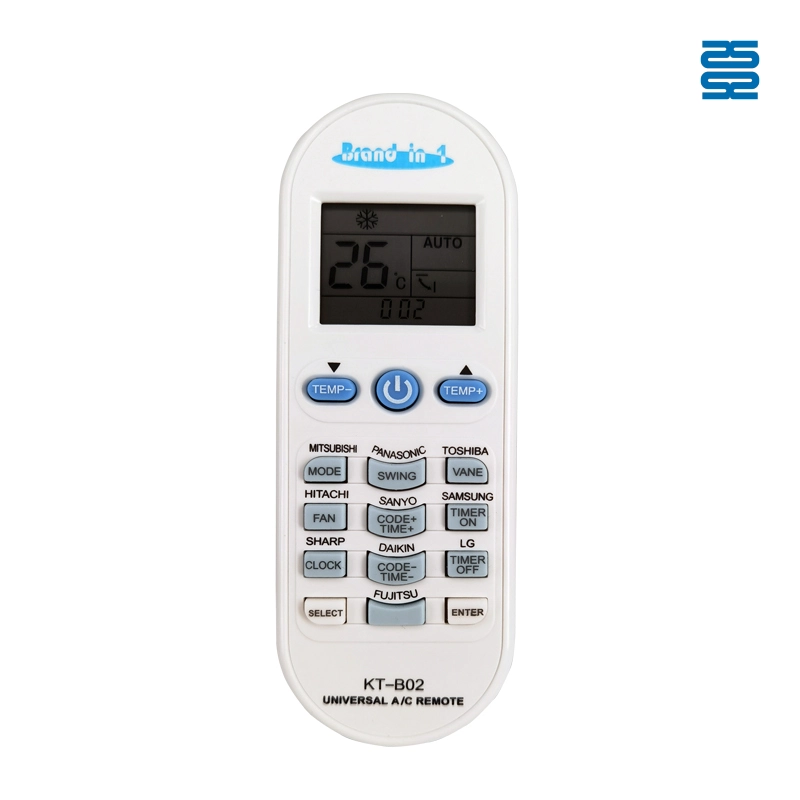
KT-B02 Universal Air Conditioner Remote Control Compatible with All Brands
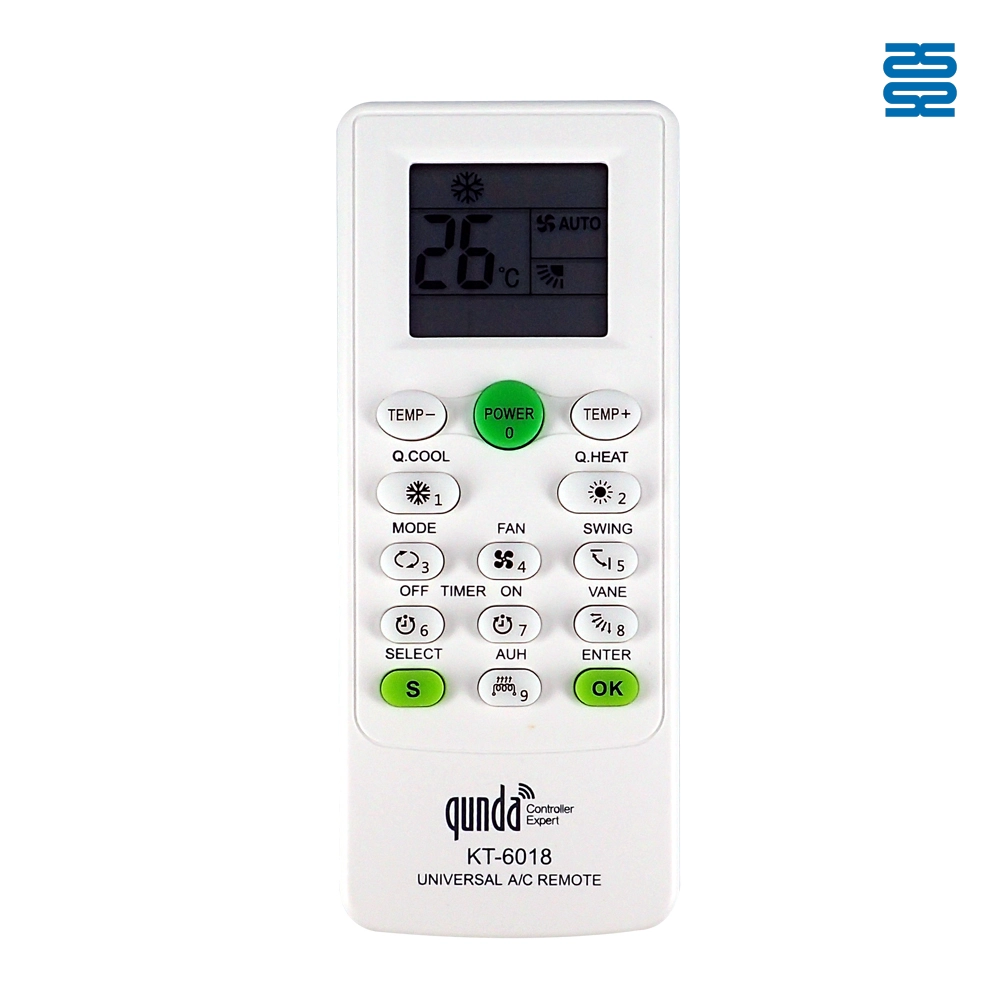
KT-6018 6000 in 1 Universal Air Conditioner Remote Control Compatible with All Brands

QD-1000 IN 1 1000 Code in 1 Universal Air Conditioner Remote Control Compatible with All Brands

KT-N828 Universal Air Conditioner Remote Control Compatible with All Brands
Get the latest updates
If you have any comments or good suggestions, please leave us a message, later our professional staff will contact you as soon as possible.


Contact
Email us
Text or Call us
Address
Room 1606, No. 65, Zhongshan Seven Road, Liwan District, Guangzhou, Guangdong, China.

Facebook
Instagram
YouTube
Tik Tok
VK