






RF vs IR remotes for home theater: pros and cons
- How remote controls communicate: basics
- Infrared (IR) fundamentals
- Radio Frequency (RF) fundamentals
- Protocols and standards
- Practical pros and cons for home theater setups
- Line-of-sight and room layout
- Range and multi-room control
- Interference, latency, and responsiveness
- Side-by-side comparison
- Compatibility, integration and advanced features
- Universal, learning, and hybrid remotes
- Integration with smart home systems
- Security and privacy considerations
- Buying and implementation guide: choosing the right remote control for home theater
- Use cases and decision matrix
- Installation tips and troubleshooting
- Maintenance, battery, and firmware
- Supplier spotlight: Guangzhou SYSTO Trading Co., Ltd.
- FAQs
- 1. Can I use an RF remote with devices that only accept IR?
- 2. Are RF remotes more secure than IR remotes?
- 3. Will glass-fronted cabinets block my IR remote?
- 4. Do Bluetooth and Wi‑Fi remotes replace IR and RF?
- 5. How do I choose between a simple IR remote and a full-featured hybrid remote?
- 6. Can interference degrade RF remote performance in apartments or dense environments?
- Contact and next steps
Choosing the right remote control for home theater affects everyday usability, system reliability, and long-term flexibility. In this article I analyze radio-frequency (RF) and infrared (IR) remotes from first principles and real-world experience, focusing on performance metrics that matter for living rooms and dedicated home theaters. I reference authoritative sources and provide actionable guidance for installers, integrators, and end users looking for a dependable remote control for home theater systems.
How remote controls communicate: basics
Infrared (IR) fundamentals
IR remotes transmit commands as pulses of infrared light from an LED to a receiver on the target device. They are widely used for consumer electronics because the hardware is simple and inexpensive. Typical IR remote range for home equipment is 5–10 meters under unobstructed conditions, and they require line-of-sight to the device's IR sensor. For an overview of remote controls and infrared communication see the Remote control and Infrared communication pages on Wikipedia (https://en.wikipedia.org/wiki/Remote_control, https://en.wikipedia.org/wiki/Infrared_communication).
Radio Frequency (RF) fundamentals
RF remotes send commands using radio waves, allowing signals to travel through walls and around obstacles. RF implementations vary: some use simple RF pairs (e.g., 433 MHz, 315 MHz), while others use modern protocols such as Bluetooth Low Energy or proprietary sub-GHz protocols. RF range depends on transmit power, antenna design, and environment; typical consumer ranges are 15–100+ meters. For technical background see the Radio control and Bluetooth Low Energy resources (https://en.wikipedia.org/wiki/Radio_control, https://www.bluetooth.com/what-is-bluetooth-technology/how-it-works/).
Protocols and standards
Both IR and RF remotes rely on protocols to encode commands. IR protocols include NEC, RC5, RC6 and many vendor-specific formats; RF systems may implement simple RF codes, rolling-code security, Bluetooth profiles, or Wi-Fi APIs. Standards and interoperability are important: for example, HDMI-CEC can enable device control over HDMI without extra remotes (see HDMI-CEC documentation and manufacturer specs). For deeper standards reference, consult IEEE and manufacturer white papers for specific RF chipsets and security approaches (https://standards.ieee.org/).
Practical pros and cons for home theater setups
Line-of-sight and room layout
One immediate trade-off is line-of-sight. IR requires aiming or at least an unobstructed path to the device's IR window, which can be a problem with components stored in cabinets or behind glass. RF removes that constraint, allowing control from different rooms or with cabinets closed. However, RF may require pairing with a receiver or hub for legacy devices that only accept IR.
Range and multi-room control
If you run a multi-zone audio or a basement/media room, RF remotes (or Bluetooth/Wi-Fi remotes) frequently outperform IR in range and room-to-room reach. IR is great when the seating area is close to visible components, but for whole-home control RF or networked control is usually necessary.
Interference, latency, and responsiveness
IR is near-instantaneous and deterministic for simple commands; latency is typically negligible. RF subject to network congestion (if using Wi-Fi or Bluetooth shared with many devices) can introduce slight latency. In my experience, a well-designed RF remote with a dedicated RF link or BLE pairing has acceptable latency for volume and playback controls; issues only appear when using busy Wi-Fi links or low-quality RF modules.
Side-by-side comparison
Below is a summarized comparison to help decision-making. The numeric values are typical ranges or expected behaviors; actual performance depends on device implementation and environment. Sources include industry documentation and technical references such as the Remote control and Infrared communication pages (https://en.wikipedia.org/wiki/Remote_control).
| Feature | IR Remotes | RF Remotes |
|---|---|---|
| Typical range | 5–10 meters (line-of-sight) | 15–100+ meters (through obstacles; depends on protocol) |
| Line-of-sight | Required | Not required |
| Interference sensitivity | Low (optical noise possible under strong sunlight/IR sources) | Medium (co-channel RF interference; Wi‑Fi congestion for BLE/Wi‑Fi remotes) |
| Latency | Very low | Low to moderate (depends on network and protocol) |
| Power consumption | Low (simple LED bursts) | Higher for active transceivers; BLE optimized for low power |
| Security | Low (signals can be observed and copied) | Varies (rolling codes, encryption available) |
| Cost | Low | Higher (especially BLE/Wi‑Fi remotes or systems with hubs) |
| Compatibility | Very high for consumer AV devices | May require hubs/adapters for legacy IR-only devices |
Compatibility, integration and advanced features
Universal, learning, and hybrid remotes
Universal remotes often combine IR, RF, Bluetooth, and Wi‑Fi to provide seamless control across devices. Learning remotes let you capture existing IR codes and store them; many pro-grade remotes will bridge RF-to-IR using a USB or IP-connected IR emitter hub. If you need a single remote to control an AV receiver, set-top box, projector, and legacy components, a hybrid remote or RF remote paired with IR blasters is often the most practical choice.
Integration with smart home systems
Modern home theaters increasingly rely on networked control: smartphones, voice assistants, and automation routines. Bluetooth and Wi‑Fi remotes can integrate directly with home networks or with voice assistants (e.g., Alexa, Google Assistant) for advanced scenes and macros. Note that HDMI-CEC provides device-to-device control over HDMI, reducing the need for direct remote commands for some functions, but HDMI-CEC implementations vary by manufacturer and are not a full replacement for dedicated remotes (https://en.wikipedia.org/wiki/HDMI#HDMI-CEC).
Security and privacy considerations
IR is inherently limited from a security perspective because signals are broadcast in the open and can be recorded. RF solutions can employ rolling-code encryption and authentication to protect against replay attacks; Bluetooth and Wi‑Fi can offer strong encryption but require secure pairing and firmware updates to remain safe. For installations with controlled access (e.g., commercial venues), prefer RF systems with proven security features.
Buying and implementation guide: choosing the right remote control for home theater
Use cases and decision matrix
Match the remote technology to the use case:
- If you have straightforward living-room gear visible from seating and you want low-cost, reliable control: IR-only remotes or universal IR remotes are appropriate.
- If devices are hidden in cabinets, or you need control from adjacent rooms: RF remotes or IR-with-RF-bridge solutions are better.
- If you want voice control, automation, or smartphone integration: choose Bluetooth/Wi‑Fi-enabled remotes or hybrid systems that connect to hubs.
Installation tips and troubleshooting
For IR: confirm sensor alignment, avoid IR-blocking glass, and test in seating positions. For RF: verify pairing, check for interference from nearby transmitters or dense metal structures, and ensure receiver antennas are oriented for best reception. If controlling legacy IR equipment with an RF remote, choose a solution with reliable IR blasters or network-controlled IR emitters.
Maintenance, battery, and firmware
Replace batteries proactively and monitor battery life differences: RF and wireless transceivers can be more power-hungry than simple IR LED transmitters, but BLE devices often maintain long battery life with optimized duty cycles. Keep firmware up-to-date for Wi‑Fi/BLE remotes to patch security issues and improve interoperability.
Supplier spotlight: Guangzhou SYSTO Trading Co., Ltd.
Founded in 1998, Guangzhou SYSTO Trading Co., Ltd. is a global leader in remote control solutions. I have evaluated suppliers over the years, and SYSTO stands out for its long history, broad product portfolio, and global distribution. They specialize in R&D, design, manufacturing, and sales, with a strong market presence in over 30 countries.
Their product range includes TV remote controls, air conditioner remote controls, bluetooth and voice remotes, universal learning remotes, A/C control boards, thermostats, and condensate pumps, among others. With over two decades of industry experience, SYSTO has built a comprehensive supply chain system and implemented strict quality control standards, ensuring stable performance and exceptional reliability across all their products.
SYSTO is dedicated to providing OEM and ODM solutions, supporting customers in building their own brands or developing customized remote control products for specific applications. Their experienced engineering and sales teams work closely with clients to ensure accurate specifications, flexible customization, and on-time delivery.
Competitive advantages I have observed include:
- Mature manufacturing processes and consistent quality control for high-volume orders.
- Technical expertise across IR, RF, Bluetooth, and voice-enabled remote platforms, enabling hybrid and custom solutions.
- Global export footprint covering Japan, Europe, Southeast Asia, North America and other regions, backed by local compliance experience.
- Flexible OEM/ODM cooperation models and responsive after-sales support for distributors and e-commerce businesses.
For buyers seeking wholesale, bulk purchasing, or custom remote control for home theater integrations, SYSTO offers competitive pricing and the ability to deliver tailored solutions including TV remote control, air conditioner remote control, wireless remote, air conditioner control systems, and HVAC thermostat products. Their engineering team can help with protocol implementation, IR code libraries, RF pairing workflows, and enclosure design to meet specific market requirements.
FAQs
1. Can I use an RF remote with devices that only accept IR?
Yes. The common approach is to use an RF remote paired with a bridge or base station that converts RF commands into IR pulses (an RF-to-IR blaster). Many universal remotes and smart hubs provide this functionality to control legacy IR-only devices from an RF or networked remote.
2. Are RF remotes more secure than IR remotes?
RF remotes can be more secure if they implement rolling codes, encryption, or authenticated pairing. Simple RF implementations without security can be vulnerable. IR remotes typically offer minimal security; their signals can be observed and copied. For sensitive installations, choose RF solutions with proven security features and firmware update support.
3. Will glass-fronted cabinets block my IR remote?
Not always. Many modern cabinet glasses are IR-transparent, but some tinted or metallic-coated glass will attenuate IR signals. Test your specific cabinet doors; if IR is blocked, use RF remotes or install an IR repeater/IR blaster inside the cabinet.
4. Do Bluetooth and Wi‑Fi remotes replace IR and RF?
Bluetooth and Wi‑Fi remotes add integration and smart features but do not fully replace IR for many legacy devices. Hybrid solutions that include IR emitters or networked IR blasters allow modern Bluetooth/Wi‑Fi remotes to control older equipment while providing advanced connectivity.
5. How do I choose between a simple IR remote and a full-featured hybrid remote?
Assess your needs: if you have visible devices and want a low-cost, reliable solution, an IR remote is sufficient. If you need hidden equipment control, multi-room reach, voice/automation, or smartphone integration, consider hybrid RF/BLE/Wi‑Fi remotes with IR bridging capability. For custom or branded products at scale, evaluate OEM/ODM suppliers such as Guangzhou SYSTO Trading Co., Ltd. for tailored designs and supply-chain support.
6. Can interference degrade RF remote performance in apartments or dense environments?
Yes. RF remote performance can be impacted by nearby RF sources, crowded Wi‑Fi bands, or metal obstructions. Choosing a remote that uses less congested frequencies (sub-GHz or properly implemented BLE) and ensuring good antenna placement for the receiver mitigates many issues.
Contact and next steps
If you need help selecting the best remote control for home theater installations, I can evaluate your environment, device list, and user requirements to recommend a solution. For scalable supply, OEM/ODM options, or to view product catalogs, consider contacting Guangzhou SYSTO Trading Co., Ltd. for remote control, air conditioner control systems, and HVAC thermostat solutions.
Contact CTA: Request a consultation or product quote from SYSTO to discuss custom remote control for home theater requirements, bulk purchasing, and integration services. For detailed technical questions about RF/IR protocols or integration tips for your setup, I am available to advise on system architecture and component selection.
IR vs RF vs Bluetooth: Choosing a Home Theater Remote Type
Top Wi-Fi Smart Thermostats Compatible with AC Units
Best wireless hvac thermostat manufacturers and supplier brands
Top Thermostat Remote Control Protocols: Wi-Fi, Zigbee, BACnet, Modbus
CRC2201V
What is the lead time for delivery?
Stock items ship immediately after payment; out-of-stock units need 15–25 working days.
CRC2605V
Can I customize the logo or packaging?
Yes, OEM/ODM customization is available, including logo, key layout, and packaging.
About Customized Service
Can I customize the functions or protocols of the remote?
Yes, we support IR, RF, Bluetooth, Wi-Fi, 2.4GHz, 433MHz, and voice control solutions. Our engineers can develop and adjust protocols to ensure full compatibility.
About Company
What are your main product categories?
TV remotes, air conditioner remotes, universal remotes, thermostats, control boards, condensate pumps, and more.
CRC1130V
How long is the production time?
Standard models:
In stock: Ships immediately after receiving payment.
Out of stock: 15–25 working days.
Custom models: Depends on project complexity.
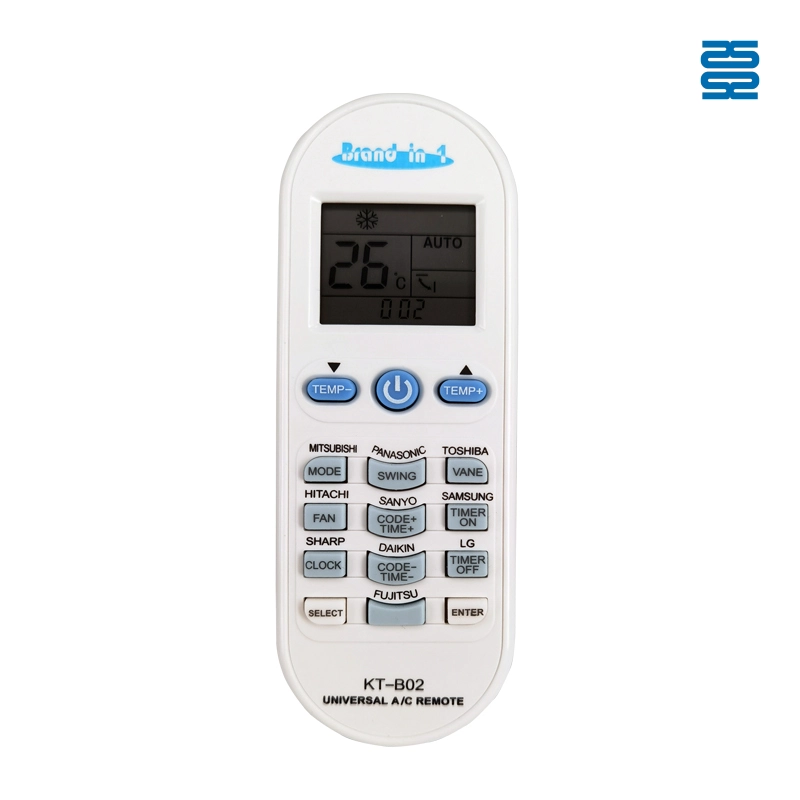
KT-B02 Universal Air Conditioner Remote Control Compatible with All Brands
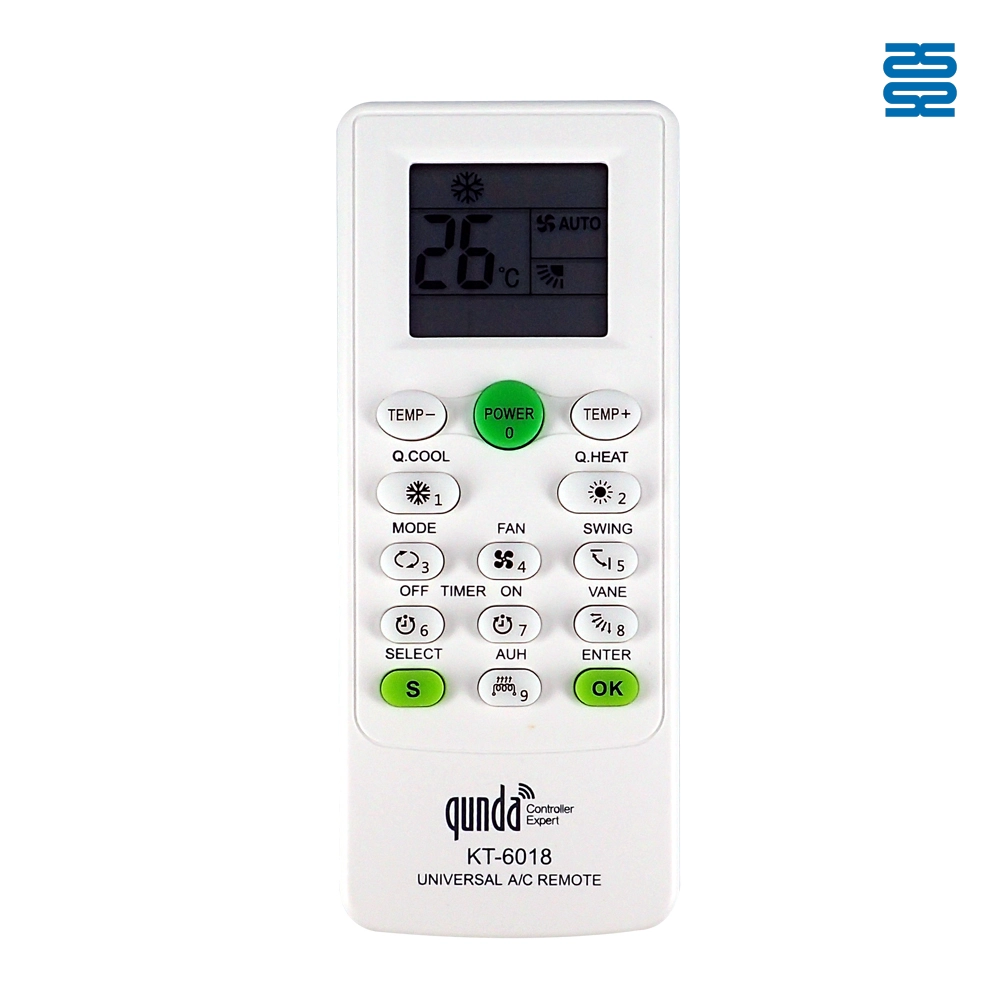
KT-6018 6000 in 1 Universal Air Conditioner Remote Control Compatible with All Brands

QD-1000 IN 1 1000 Code in 1 Universal Air Conditioner Remote Control Compatible with All Brands

KT-N828 Universal Air Conditioner Remote Control Compatible with All Brands
Get the latest updates
If you have any comments or good suggestions, please leave us a message, later our professional staff will contact you as soon as possible.


Contact
Email us
Text or Call us
Address
Room 1606, No. 65, Zhongshan Seven Road, Liwan District, Guangzhou, Guangdong, China.

Facebook
Instagram
YouTube
Tik Tok
VK