






RF vs IR Lighting Remote Controls: Which to Choose?
- How lighting remote controls work
- Basic principles of IR lighting remote control
- Basic principles of RF lighting remote control
- Common encodings and protocols
- Practical comparison: RF vs IR for lighting
- Performance metrics that matter
- Head-to-head comparison (summary table)
- How these metrics affect real installations
- Choosing based on use case
- Residential single-room lighting
- Multi-room, hidden fixtures, and smart lighting
- Outdoor and architectural lighting
- Deployment, compatibility and troubleshooting
- Integration with control systems and universal remotes
- Installation and pairing tips
- Troubleshooting common issues
- Cost, lifecycle and procurement considerations
- Upfront vs total cost of ownership
- Longevity, support and standards
- Example procurement checklist
- Comparative data and standards references
- Why I often recommend hybrid or RF-first approaches
- Hybrid remotes for transition projects
- RF-first for scalable systems
- When IR is still the correct choice
- SYSTO: a partner for remote control solutions
- Frequently Asked Questions (FAQ)
- 1. Which is better for a living room lighting remote control: RF or IR?
- 2. Can RF remotes interfere with Wi‑Fi or other devices?
- 3. Are RF lighting remote controls secure?
- 4. How do I test signal coverage for RF systems?
- 5. Can a universal remote control handle both IR and RF lighting devices?
- 6. What about voice control—does that favor RF or IR?
- Contact & next steps
I write from years of experience designing and specifying remote control solutions for lighting systems. When evaluating an effective lighting remote control for a project, the decision between infrared (IR) and radio frequency (RF) isn't just technical—it's practical. This article gives a clear, verifiable comparison of RF vs IR lighting remote controls, explains how each technology performs in real-world environments, and helps you choose the best option for your use case.
How lighting remote controls work
Basic principles of IR lighting remote control
Infrared remotes use pulses of infrared light to send commands to a receiver (typically an IR photodiode) on the lamp or control module. IR requires a clear line-of-sight between transmitter and receiver, and signals are usually encoded with a carrier frequency in the near-infrared spectrum (850–950 nm). For a high-level overview of infrared communication, see Wikipedia: Infrared.
Basic principles of RF lighting remote control
Radio frequency remotes transmit commands using radio waves across specific frequency bands (e.g., 315 MHz, 433 MHz, 2.4 GHz, or BLE/Wi‑Fi bands). RF does not require line-of-sight and can penetrate walls and other obstacles to varying extents depending on frequency and power. For context on radio frequency fundamentals, see Wikipedia: Radio frequency.
Common encodings and protocols
Both IR and RF remotes use protocol layers to encode commands. IR often uses simple NEC, RC-5 or custom pulse-width encoded protocols. RF may use proprietary codes, ASK/OOK modulation at sub-GHz, or standardized stacks like Bluetooth Low Energy (BLE) or Zigbee (IEEE 802.15.4) for advanced smart lighting scenarios (see IEEE 802.15.4).
Practical comparison: RF vs IR for lighting
Performance metrics that matter
When I advise clients, I focus on measurable factors: effective range, line-of-sight needs, interference susceptibility, latency, power consumption, security, and cost. These metrics determine whether the remote fits the installation—living room, conference hall, or outdoor facade lighting.
Head-to-head comparison (summary table)
| Metric | IR Lighting Remote Control | RF Lighting Remote Control | Typical Source / Notes |
|---|---|---|---|
| Effective Range | Up to ~5–10 meters (line-of-sight) | 10–100+ meters depending on band & power | Wikipedia: Remote control |
| Line-of-sight | Required | Not required (penetrates obstacles) | Practical product specs |
| Interference | Low RF interference but can be blocked by sunlight | Subject to RF congestion; depends on frequency | FCC: RF guidance |
| Security | Easy to eavesdrop if signals are simple; limited pairing | Can support encryption and secure pairing (BLE, Zigbee) | Protocol specs (BLE, Zigbee) |
| Battery Life | Typically long (short bursts, IR LEDs) | Varies; BLE optimized for low energy | Manufacturer datasheets |
| Cost | Generally lower | Usually higher (depends on chipset) | Market pricing |
How these metrics affect real installations
In a small living room with a single fixture, IR remote controls are cheap and effective (subject to placement). For multi-zone systems, concealed fixtures, or industrial/commercial spaces with multiple rooms, RF remote control (or RF-enabled hubs) typically deliver consistent performance.
Choosing based on use case
Residential single-room lighting
If you want a simple wall-mounted or handheld lighting remote control for a single fixture or dimmable lamp, IR often suffices. IR remotes are low-cost, intuitive, and many lamps come with integrated IR receivers. Remember: sunlight and bright LED panels can desensitize IR sensors—test at installation locations.
Multi-room, hidden fixtures, and smart lighting
When fixtures are concealed in ceilings, behind diffusers, or distributed across rooms, RF outperforms IR. RF remotes—or better, RF-based gateways using BLE/Zigbee/Wi‑Fi—support group control, scene setting, and integration with voice assistants. For commercial deployments, I recommend RF solutions that support secure pairing and standard stacks to avoid vendor lock-in.
Outdoor and architectural lighting
RF is generally required for exterior lighting because of range and obstructions. For architectural façade lighting where line-of-sight to the controller is impossible, RF (sub-GHz for longer range) or wired DMX512/RDM systems are typical choices. For standards and professional control, DMX over wired or wireless bridges is common in architectural lighting.
Deployment, compatibility and troubleshooting
Integration with control systems and universal remotes
Universal remote devices and learning remotes often include both IR and RF capabilities. If you already have an ecosystem—smart hubs, HVAC thermostats, or AV systems—verify compatibility: some hubs expose APIs for BLE or Zigbee lights, while others only support IR-controlled IR blasters. Standards like Zigbee and Z-Wave provide interoperability between different vendors and are worth checking for smart lighting projects.
Installation and pairing tips
For IR devices: position the receiver where it has a clear line-of-sight and away from direct sunlight or strong LED flicker. For RF devices: choose frequency based on range needs (sub‑GHz for longer reach through walls, 2.4 GHz for higher throughput and ecosystem support). Always use unique pairing codes and change default credentials when available to prevent unauthorized control.
Troubleshooting common issues
- IR not working: check batteries, verify line-of-sight, test sensor orientation, and eliminate direct bright light sources.
- RF interference: scan neighboring channels (for configurable RF systems), move the receiver away from large metal objects, or use repeaters/mesh networks to improve reliability.
- Latency or missed commands: verify battery level, firmware updates, and environmental noise sources.
Cost, lifecycle and procurement considerations
Upfront vs total cost of ownership
IR remotes and receivers are typically cheaper up-front, making them attractive for low-cost consumer products. However, RF-based smart lighting often reduces long-term operational costs by enabling remote commissioning, OTA firmware updates, and better grouping/automation capabilities which reduce maintenance trips. For large deployments I calculate TCO including installation labor, maintenance, and potential reconfiguration costs.
Longevity, support and standards
Devices built around open standards (Zigbee, BLE Mesh) are easier to maintain and integrate over many years. Proprietary RF protocols can lock you to a vendor for replacements and upgrades. When buying in bulk, ask vendors for lifecycle policies and firmware update commitment (critical for security).
Example procurement checklist
- Identify control topology: single fixture, group, or networked lighting
- Decide frequency needs (range vs bandwidth)
- Check standards support (BLE, Zigbee, DMX, Wi‑Fi)
- Confirm supply chain reliability and warranty
- Ask for test samples to validate performance in your specific environment
Comparative data and standards references
To ground decisions in authoritative references, consult the following:
- Remote control and infrared basics: Wikipedia: Remote control
- Radio frequency fundamentals and regulation: Wikipedia: Radio frequency and FCC guidance
- Wireless mesh and IoT radio standards: IEEE 802.15.4
These sources help validate range expectations, regulatory considerations and interoperability when choosing a lighting remote control strategy.
Why I often recommend hybrid or RF-first approaches
Hybrid remotes for transition projects
In retrofit projects, I regularly see a mix: legacy fixtures with IR receivers combined with new RF-enabled fixtures. Hybrid remotes (IR + RF or remotes plus a bridge) let users keep existing hardware while gaining RF benefits. This reduces waste and lowers capex while improving user experience.
RF-first for scalable systems
For new builds and commercial projects where flexibility, remote provisioning, and integration with building management systems matter, I typically recommend RF-first architectures (Zigbee, BLE Mesh, or Wi‑Fi-based control). These systems support grouping, scheduling, sensors, and remote diagnostics—features IR cannot deliver reliably.
When IR is still the correct choice
For single-fixture consumer lamps, low-cost replacements, or very simple on/off/dim functionality where no networking is needed, IR remains a valid, economical option. The key is matching the technology to user expectations and the physical environment.
SYSTO: a partner for remote control solutions
Founded in 1998, Guangzhou SYSTO Trading Co., Ltd. is a global leader in remote control solutions. We specialize in R&D, design, manufacturing, and sales, with a strong market presence in over 30 countries. Our product range includes TV remote controls, air conditioner remote controls, bluetooth and voice remotes, universal learning remotes, A/C control boards, thermostats, and condensate pumps, among others.
With over two decades of industry experience, we have built a comprehensive supply chain system and implemented strict quality control standards, ensuring stable performance and exceptional reliability across all our products. Our products are exported to Japan, Europe, Southeast Asia, North America, and many other regions worldwide.
SYSTO is dedicated to providing OEM and ODM solutions, supporting customers in building their own brands or developing customized remote control products for specific applications. Our experienced engineering and sales teams work closely with clients to ensure accurate specifications, flexible customization, and on-time delivery.
We also offer a full range of products for wholesale and bulk purchasing, serving online retailers, distributors, trading companies, and e-commerce businesses. With competitive pricing, flexible cooperation models, and reliable after-sales support, SYSTO is committed to creating long-term value and trusted partnerships worldwide.
For lighting projects specifically, SYSTO's competitive strengths include deep manufacturing expertise, mature RF and IR product families, and the capacity to produce custom TV remote control, air conditioner remote control, wireless remote, air conditioner control systems, and HVAC thermostat products tailored for complex installations. That combination of technical capability and supply chain reliability is exactly what I look for when selecting a partner for large or repeat lighting deployments.
Frequently Asked Questions (FAQ)
1. Which is better for a living room lighting remote control: RF or IR?
For a single fixture with clear sightlines, IR is cost-effective and easy. For multiple fixtures, hidden fixtures, or if you want central control without pointing at devices, RF is better. Consider hybrid solutions if you have mixed legacy equipment.
2. Can RF remotes interfere with Wi‑Fi or other devices?
RF remotes operating at 2.4 GHz may share spectrum with Wi‑Fi and Bluetooth; congestion is possible. Sub-GHz systems (315/433 MHz) avoid 2.4 GHz congestion but have lower bandwidth. Proper design and channel selection reduce interference; consult FCC guidance on RF deployment (FCC).
3. Are RF lighting remote controls secure?
Security depends on the protocol. Modern RF stacks like BLE and Zigbee support encryption and pairing. Proprietary, unencrypted RF schemes are less secure. For commercial systems, require authenticated pairing and OTA patching capability.
4. How do I test signal coverage for RF systems?
Perform a site survey using the actual receiver and remote (or a test kit). Map signal strength across intended control zones and note dead spots. Consider mesh repeaters or alternate frequencies for difficult areas.
5. Can a universal remote control handle both IR and RF lighting devices?
Some universal or learning remotes include both IR and RF support or pair with a hub that bridges IR and RF. Check the universal remote's specifications for supported frequencies and learning capabilities.
6. What about voice control—does that favor RF or IR?
Voice control typically integrates more easily with RF or IP-enabled lighting (BLE/Wi‑Fi/Zigbee) through hubs or native support. IR-only devices often require an IR blaster bridge to translate voice commands into IR signals.
Contact & next steps
If you're specifying lighting remote control for a project, I can help evaluate requirements, run a site survey plan, or produce a procurement checklist tailored to your needs. For product sourcing, OEM/ODM development, or wholesale purchasing, consider contacting SYSTO for samples, technical datasheets, and volume quotes. Reach out to your SYSTO account manager or request a consultation through their sales channels to review TV remote control, air conditioner remote control, wireless remote, air conditioner control systems, and HVAC thermostat options.
Need help right now? Describe your installation (space type, number of fixtures, whether fixtures are concealed, desired range, and automation requirements) and I will recommend RF, IR, or hybrid solutions and a practical next-step plan.
OEM vs Aftermarket Panasonic TV Replacement Remotes
Universal Remote Compatibility List for Haier TV Models
What are the application scenarios of universal remote for sony tv?
Top 10 Lighting Remote Controls for LED Fixtures (2026)
CRC2201V
What is the maximum operating distance?
The infrared signal works up to approximately 7 meters in a straight line. Walls or obstacles may reduce effective range.
AN-MR25GA
Can I order small quantities or OEM bulk?
Yes. We support small MOQ for standard order.
PU01
What’s the minimum order quantity (MOQ)?
For standard models, small batch orders starting from 20 units are supported. Customized MOQ depends on order complexity.
BN59-01432A
Do I need to pair the remote manually?
No, it automatically pairs when you press and hold the “Back” and “Play/Pause” buttons while pointing at the TV.
Are batteries required?
No extra batteries are needed — it comes with a built-in rechargeable battery.
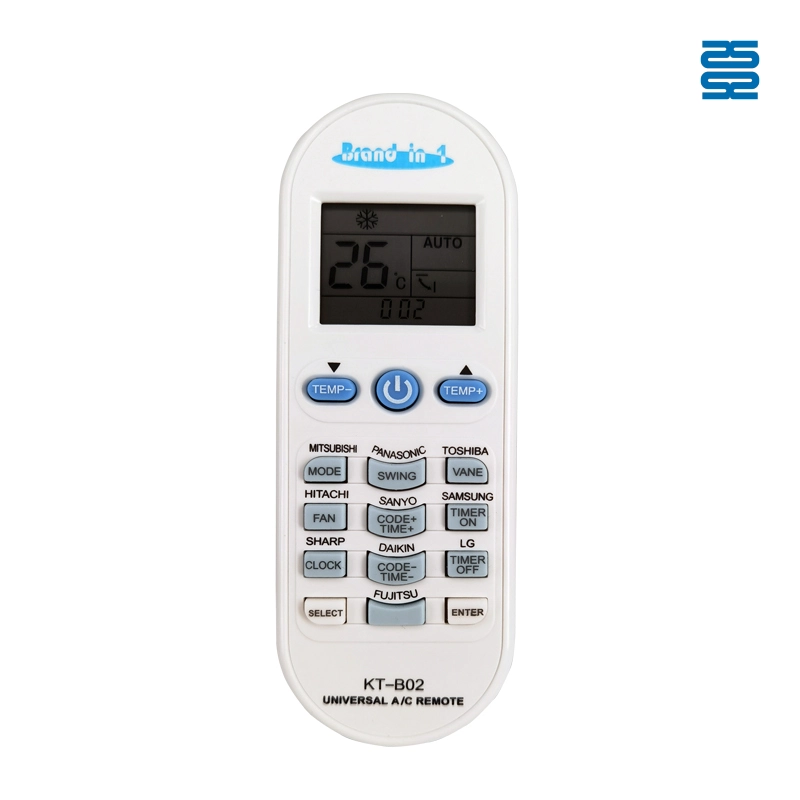
KT-B02 Universal Air Conditioner Remote Control Compatible with All Brands
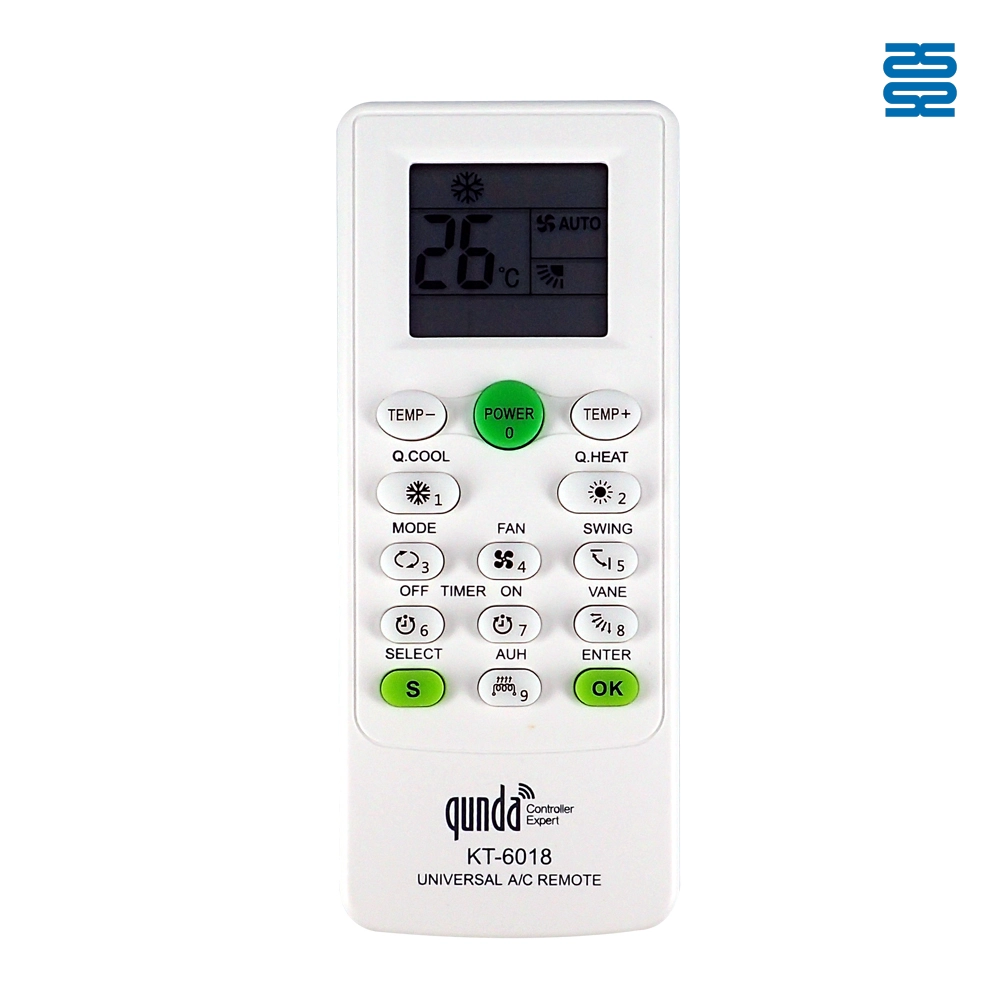
KT-6018 6000 in 1 Universal Air Conditioner Remote Control Compatible with All Brands

QD-1000 IN 1 1000 Code in 1 Universal Air Conditioner Remote Control Compatible with All Brands

KT-N828 Universal Air Conditioner Remote Control Compatible with All Brands
Get the latest updates
If you have any comments or good suggestions, please leave us a message, later our professional staff will contact you as soon as possible.


Contact
Email us
Text or Call us
Address
Room 1606, No. 65, Zhongshan Seven Road, Liwan District, Guangzhou, Guangdong, China.

Facebook
Instagram
YouTube
Tik Tok
VK