






How to Compare RF vs Bluetooth Wireless Remote Controls
- Understanding Wireless Control Technologies
- What is RF in remote controls?
- What is Bluetooth and BLE?
- Common product uses
- Technical Comparison: RF vs Bluetooth
- Range, frequency and penetration
- Latency and responsiveness
- Power consumption and battery life
- Design, Security, and Interference Considerations
- Security and pairing
- Interference and coexistence
- Regulatory and certification
- Choosing the Right Solution for Your Application
- Use-case mapping and cost analysis
- Manufacturing, OEM/ODM and supply chain
- Deployment and maintenance
- Real-world comparative data and case notes
- About SYSTO: Industry Experience and Product Capabilities
- FAQ
- Q1: Which is better for long-range control: RF or Bluetooth?
- Q2: Can Bluetooth remotes operate without a smartphone or hub?
- Q3: Are RF remotes less secure than Bluetooth?
- Q4: How do I estimate battery life for a remote?
- Q5: What certifications are required to sell remotes internationally?
- Q6: Is OTA firmware update possible with RF remotes?
- Next steps & contact
I often get asked by product managers and engineers which technology to choose when designing a wireless remote control: RF or Bluetooth? In this article I compare RF (radio frequency) and Bluetooth approaches across technical, regulatory, cost, security and manufacturing dimensions. I draw on industry standards, published specifications and field experience to show when one choice outperforms the other, how trade-offs affect product design, and what to check during prototyping and mass production.
Understanding Wireless Control Technologies
What is RF in remote controls?
When I say RF in the context of wireless remote control, I mean simple sub-gigahertz or ISM-band radio links commonly used for dedicated control applications. These remotes often use fixed-frequency or simple rolling-code schemes in bands like 315 MHz, 433 MHz, 868 MHz or 915 MHz depending on regional allocations. They are designed primarily for one-way or lightweight two-way signaling with minimal protocol overhead. For background, see the general overview of Radio frequency on Wikipedia and the remote control history at Remote control.
What is Bluetooth and BLE?
Bluetooth is a standardized short-range wireless technology defined and maintained by the Bluetooth SIG. Modern designs for consumer remotes use Bluetooth Classic or, increasingly, Bluetooth Low Energy (BLE). BLE provides a structured, secure, energy-efficient stack suitable for devices that exchange state or telemetry in addition to commands. See Bluetooth and Bluetooth Low Energy for technical context.
Common product uses
From my experience, RF remotes excel in simple point-and-shoot controls for garage doors, gate openers, and some AV remotes where range and wall-penetration matter but complex pairing isn't required. Bluetooth remotes are preferred for smart TVs, media players, IoT controllers, and voice-enabled devices where integration with phones, tablets, or hubs and security/pairing are important.
Technical Comparison: RF vs Bluetooth
Range, frequency and penetration
Range and indoor penetration depend on frequency, antenna design and RF power. Sub-GHz RF (315/433/868/915 MHz) generally offers better wall penetration and longer line-of-sight distances than 2.4 GHz Bluetooth. Bluetooth LE devices are typically designed around 10–40 meters indoor range for Class 2, while RF systems can reach tens to hundreds of meters depending on power and antenna. For reference, Bluetooth SIG specifications and academic measurements provide practical ranges and link budgets: Bluetooth specifications.
Latency and responsiveness
Latencies for simple RF protocols are often lower because the packet structures are minimal and there is no stack negotiation. Bluetooth introduces stack overhead, connection interval negotiation (BLE), and may have slightly higher latency, though BLE is optimized for low-latency interactions when properly configured. For media remotes where sub-100 ms response is required, both can be engineered to meet UX targets; I recommend measuring latency in your target environment during prototyping.
Power consumption and battery life
Battery life depends on transmit duty cycle and modem efficiency. BLE (especially BLE 5.x) is designed for low power and can deliver multi-year battery life for typical remote duty cycles. Traditional RF remotes using low-duty-cycle transmissions (momentary pulses) can also achieve multi-year life on coin cells. The critical point is that BLE enables added functionality (bidirectional status, telemetry) while still maintaining low average power if implemented correctly.
| Metric | RF (sub-GHz) | Bluetooth/BLE (2.4 GHz) |
|---|---|---|
| Typical indoor range | 30–200+ m (varies by band/antenna) | 5–40 m (Class & environment dependent) |
| Frequency bands | 315/433/868/915 MHz (regional rules) | 2.4 GHz ISM band |
| Power | Low (simple TX bursts) — long life common | Low (BLE optimized) — additional features cost energy |
| Latency | Very low (simple packet) | Low to moderate (stack overhead, tunable) |
| Security | Varies — simple rolling codes to secure links | Robust (built-in pairing, encryption) per Bluetooth SIG |
| Complexity | Lower (custom protocols) | Higher (standardized stack, profiles) |
| Typical use cases | Gates, garage, long-range sensors, some TV remotes | Smart TVs, media controllers, IoT, companion apps |
Sources: Bluetooth SIG specifications (bluetooth.com) and industry measurements summarized in technical overviews such as Bluetooth and Remote control.
Design, Security, and Interference Considerations
Security and pairing
Security matters when remotes control critical systems (HVAC, access control, gates) or when pairing to personal devices. Bluetooth offers standardized pairing and link-layer encryption (see Bluetooth SIG security guidance at bluetooth.com/security), making it easier to meet modern security expectations. RF systems can be secured with rolling codes or encrypted payloads, but they depend on custom implementations. I advise reviewing threat models and running security tests (replay, jamming, code extraction) regardless of technology.
Interference and coexistence
2.4 GHz is congested (Wi‑Fi, Bluetooth, Zigbee). BLE and Bluetooth Classic include adaptive frequency hopping and coexistence mechanisms, but dense environments can still affect reliability. Sub-GHz RF often faces less local congestion and typically penetrates obstacles better. Regulatory coexistence is covered by agencies like the FCC and regional authorities; ensure emissions and spurious limits are met for your target markets.
Regulatory and certification
Regulatory constraints differ by frequency and country. Bluetooth-based remotes typically need Bluetooth qualification through the Bluetooth SIG and regional approvals (FCC in the US, CE in Europe). Sub-GHz devices must comply with regional ISM rules and may require special listings (e.g., FCC Part 15 in the US). Consult the relevant authorities early—see FCC general RF device guidance at fcc.gov.
Choosing the Right Solution for Your Application
Use-case mapping and cost analysis
When I advise clients, I map requirements to these decision factors: range/penetration needs, security, feature set (voice, telemetry), integration with smartphones or hubs, power budget, unit BOM cost, and time-to-market. Low-cost, single-function remotes for long-range control often favor sub-GHz RF for lower BOM and simpler firmware. Products that require smart pairing, over-the-air updates, integration with apps, or voice control generally favor Bluetooth despite a higher initial BOM and development overhead.
Manufacturing, OEM/ODM and supply chain
From an OEM perspective, choosing a technology affects supplier selection, antenna certification, RF testing, and firmware lifecycle. Standardized Bluetooth modules can accelerate time-to-market because they encapsulate RF and stack complexity; however, module sourcing must consider firmware and certification transfer to avoid surprises. If you plan to scale globally, confirm your supply chain partner can handle different frequency variants and regional certifications.
Deployment and maintenance
Maintenance factors include how updates are delivered (OTA via BLE is widely supported), field debugging capability, and spare parts lifecycle. Bluetooth remotes commonly support OTA upgrade via companion apps, which simplifies post-sale fixes. RF-based systems may require physical recalls for major firmware updates unless you design a provisioning gateway path upfront.
Real-world comparative data and case notes
To ground these comparisons, here are practical takeaways I’ve observed while testing dozens of prototypes and production units:
- In multi-story buildings, sub-GHz RF remotes kept command reliability where 2.4 GHz devices struggled due to wall attenuation.
- BLE remotes improved user experience with pairing to phones and allowed one-tap diagnostics—valuable for High Quality products.
- Interference testing in retail environments showed BLE coexistence worked well if you tuned connection intervals; out-of-the-box defaults sometimes caused missed commands.
- Security audits revealed that poorly implemented RF rolling-code schemes are still vulnerable—use proven libraries or secure MCU elements.
For engineering validation, I recommend documenting key metrics: packet error rate (PER) vs distance, latency distribution, battery drain per usage profile, and field failure modes. Refer to standards and measurement methods defined by organizations such as IEEE when you need formal test procedures.
About SYSTO: Industry Experience and Product Capabilities
Founded in 1998, Guangzhou SYSTO Trading Co., Ltd. is a global leader in remote control solutions. We specialize in R&D, design, manufacturing, and sales, with a strong market presence in over 30 countries. Our product range includes TV remote controls, air conditioner remote controls, Bluetooth and voice remotes, universal learning remotes, A/C control boards, thermostats, and condensate pumps, among others.
With over two decades of industry experience, we have built a comprehensive supply chain system and implemented strict quality control standards, ensuring stable performance and exceptional reliability across all our products. Our products are exported to Japan, Europe, Southeast Asia, North America, and many other regions worldwide.
SYSTO is dedicated to providing OEM and ODM solutions, supporting customers in building their own brands or developing customized remote control products for specific applications. Our experienced engineering and sales teams work closely with clients to ensure accurate specifications, flexible customization, and on-time delivery.
Why clients choose SYSTO (competitive edges I highlight when we consult):
- Deep RF and Bluetooth expertise across product lines like TV remote control, air conditioner remote control, wireless remote, air conditioner control systems, and HVAC thermostat.
- Proven manufacturing scale and QA processes—critical when you need consistent performance across thousands of units.
- Flexible OEM/ODM models and competitive pricing for wholesale and bulk purchases, backed by after-sales support.
- Local engineering support for antenna tuning, regulatory documentation, and firmware integration—reducing integration risk and time-to-market.
If you are evaluating whether to use Bluetooth or RF for a new wireless remote control product, SYSTO can help with prototype-to-production support, including module selection, regulatory planning, RF testing and customized firmware development.
FAQ
Q1: Which is better for long-range control: RF or Bluetooth?
A1: For long-range and better wall penetration, sub-GHz RF usually outperforms 2.4 GHz Bluetooth. However, Bluetooth Long Range (LE Coded PHY in BLE 5) can extend range significantly, though antenna and environment still matter. Test in your target environment before committing to a design.
Q2: Can Bluetooth remotes operate without a smartphone or hub?
A2: Yes. Bluetooth remotes can pair directly to a host device (TV, set-top box, smart speaker) or operate in broadcast modes. The host must implement the appropriate GATT profiles or HID profiles. Bluetooth brings the advantage of standardized pairing and security.
Q3: Are RF remotes less secure than Bluetooth?
A3: Not inherently, but security depends on implementation. Bluetooth provides standardized, well-reviewed security mechanisms. RF remotes require careful implementation of rolling codes or encryption and should be validated through security testing to avoid replay or code-cloning attacks.
Q4: How do I estimate battery life for a remote?
A4: Battery life is a function of transmit power, duty cycle (how often a user presses buttons), sleep currents and battery capacity. For BLE, you can model current draw based on connection intervals and advertising rates; for RF, model based on pulse transmit durations. Empirical testing with realistic usage patterns is essential.
Q5: What certifications are required to sell remotes internationally?
A5: Certifications depend on frequency and region. Bluetooth devices need Bluetooth qualification plus regional approvals (e.g., FCC for US, CE/RED for Europe). Sub-GHz devices must comply with regional ISM/short-range device rules. Plan certification early and consult local regulatory experts.
Q6: Is OTA firmware update possible with RF remotes?
A6: OTA is more straightforward with Bluetooth (BLE supports DFU/OTA flows). RF remotes can support OTA if you design a gateway or use a more advanced RF protocol, but it adds complexity. Decide based on your need for post-sale updates.
Next steps & contact
If you need help selecting technology, prototyping, or scaling production of wireless remote control solutions, I recommend starting with a short feasibility project: define use cases, run RF range and latency tests in representative environments, and confirm certification pathways. For OEM/ODM partnerships, consider suppliers with multi-decade remote control experience and global market reach.
To discuss a project, request samples, or explore custom solutions, contact Guangzhou SYSTO Trading Co., Ltd. — we offer end-to-end support from R&D to mass production and can tailor wireless remote control solutions to your requirements.
Quick links: Bluetooth specifications: https://www.bluetooth.com/specifications/; FCC RF guidance: https://www.fcc.gov/general/radio-frequency-devices; Remote control overview: https://en.wikipedia.org/wiki/Remote_control.
Custom Wireless Remote Controls: OEM & ODM Options
Best Universal Home Theater Remote Controls for 2026 Buyers
Top 10 Wireless Thermostats for Smart Building Integration
How to choose a home theater remote: buyer's guide
CRC2503V
How do I set up the remote for my A/C brand?
Choose your brand from the preset list (brand name shown on screen). If not listed, use the Auto Search mode to find the matching code.
CRC2605V
Does CRC2605V work with all Hisense TVs?
It is optimized for new Hisense Smart TVs. Older models may not be compatible.
PU01
Can I order with my own logo or packaging?
Yes, OEM & ODM customization is available, including logo printing and packaging design.
About Customized Service
Can you develop remotes compatible with specific brands or models?
Yes, we can develop IR codes for most global brands and devices.
Do you provide packaging design and printing?
Yes, we provide full packaging customization including color box design, manual printing, barcode, and labeling to match your brand identity.

QD-HVAC23 Qunda Touch-Screen Thermostat for Air Conditioner

QD-HVAC06E Qunda Digital Thermostat for Central Air Conditioner
QD-HVAC06E can control a two-way electric valve and a three-way electric valve, or two two-way electric valves on Heating and Cooling.
QD-HVAC06E is applicable to two-pipe HVAC, and four à pipe water system or air system HVAC. lt controls the working condition of FCU (Fan Coil Unit) and electric valve by comparing the ambient temperature and setting temperature, to adjust the temperature for a comfortable environment and save energy.
QD-HVAC06E is based on industrial-grade micro-computer technology with touching key operation and LCD display. The controller is simple-operating, stable and reliable.
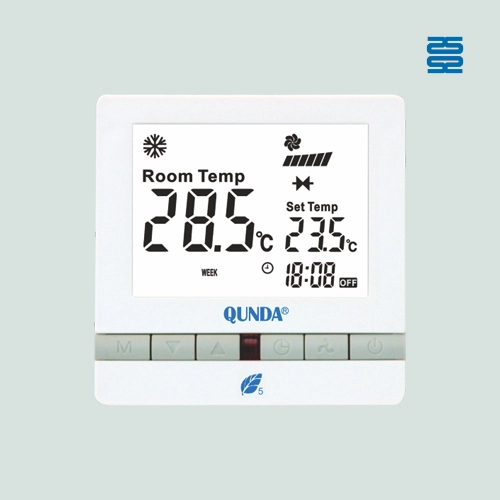
QD-HVAC05E Qunda Digital Thermostat for Central Air Conditioner
QD-HVAC05E can control a two-way electric valve and a three-way electric valve.
QD-HVAC05E is applicable to two-pipe water system or air system HVAC. lt controls the working condition of FCU (Fan Coil Unit) and electric valve by comparing the ambient temperature and setting temperature, to adjust the temperature for a comfortable environment and save energy.
QD-HVAC05E is based on industrial-grade micro-computer technology with touching key operation and LCD display. The controller is simple-operating, stable and reliable.

QD-HVAC03E Qunda Digital Thermostat for Central Air Conditioner
QD-HVAC03E can control a two-way electric valve and a three-way electric valve.
QD-HVAC03E is applicable to two-pipe water system or air system HVAC. lt controls the working condition of FCU (Fan Coil Unit) and electric valve by comparing the ambient temperature and setting temperature, to adjust the temperature for a comfortable environment and save energy.
QD-HVAC03E is based on industrial-grade micro-computer technology with touching key operation and LCD display. The controller is simple-operating, stable and reliable.
Get the latest updates
If you have any comments or good suggestions, please leave us a message, later our professional staff will contact you as soon as possible.


Contact
Email us
Text or Call us
Address
Room 1606, No. 65, Zhongshan Seven Road, Liwan District, Guangzhou, Guangdong, China.

Facebook
Instagram
YouTube
Tik Tok
VK