






Battery Life and Durability of Replacement Remotes for Panasonic
- Understanding power consumption in TV remote controls
- How IR, RF and Bluetooth remotes differ in energy use
- Standby vs active pulses: duty cycle matters
- Real-world usage patterns and battery expectations
- Battery types and expected lifespan for Panasonic replacement remotes
- Common battery chemistries: pros, cons and capacities
- Estimating runtime: a simple calculation
- Temperature, shelf life and discharge curves
- Durability: build quality, components and environmental resistance
- Key components that determine longevity
- Environmental and mechanical standards
- Common failure modes and how to avoid them
- Choosing and maintaining a replacement remote: practical recommendations
- How to choose the right replacement remote control for Panasonic TV
- Maintenance tips to extend battery life and durability
- Sourcing at scale and supplier considerations (SYSTO example)
- Comparing replacement options: a quick table
- Frequently Asked Questions (FAQ)
- 1. How long will batteries last in a replacement remote control for Panasonic TV?
- 2. Are rechargeable remotes better than ones using disposable batteries?
- 3. Can I use NiMH rechargeables in place of alkaline AA/AAA in my Panasonic replacement remote?
- 4. What maintenance prevents corrosion or battery leakage damage?
- 5. How do I know whether to buy an OEM Panasonic remote or a third-party replacement?
- 6. Where can I find objective test data about remote battery life and durability?
As someone who has advised AV integrators and retailers on remote control selection and replacement for over a decade, I understand that buyers searching for a replacement remote control for Panasonic TV want two things above all: dependable battery life and long-term durability. This article explains how remotes consume power, compares battery chemistries, outlines what affects longevity and durability, and gives evidence-backed guidance on choosing and maintaining a replacement remote. Where useful, I cite industry standards and technical references so you can verify the guidance and select a remote that balances runtime, robustness, and cost.
Understanding power consumption in TV remote controls
How IR, RF and Bluetooth remotes differ in energy use
Remote controls commonly use infrared (IR), radio frequency (RF), or Bluetooth (including Bluetooth Low Energy — BLE) to send commands. IR remotes typically have the lowest average power draw because they transmit short, line-of-sight pulses from an infrared LED. RF remotes (2.4GHz or sub-GHz) and Bluetooth remotes require radios and, in some implementations, microcontrollers that remain partially active — increasing standby consumption.
For technical background on these systems see the general remote control overview: Wikipedia: Remote control and Bluetooth LE specifics: Wikipedia: Bluetooth Low Energy. In practice, a simple IR replacement remote control for panasonic tv will usually last significantly longer on the same batteries than an always-connected Bluetooth voice remote, all else equal.
Standby vs active pulses: duty cycle matters
Battery life is shaped by two realities: the instantaneous current during transmission and the duty cycle (how often transmissions occur). An IR LED pulse may draw tens to hundreds of milliamps for a few milliseconds; average consumption over time is low because users press buttons infrequently. Conversely, remotes that monitor a microphone for voice activation or maintain a BLE connection will add tens to hundreds of microamps to milliamps in standby, which reduces battery life even if button presses are infrequent.
This is why remote design (hardware and firmware) strongly influences runtime: efficient sleep modes, wake-on-key, and low quiescent current components preserve batteries.
Real-world usage patterns and battery expectations
Typical household usage — tens of button presses per week — results in multi-month to multi-year battery life for simple IR remotes using AA/AAA cells. Smart remotes with voice assistants or backlit keys commonly drop that to months. My field experience with replacement remote control for panasonic tv installations shows:
- Simple IR remotes with AAA alkaline: 1–2 years under normal household use.
- Backlit or RF remotes with similar batteries: 6–12 months.
- Bluetooth voice remotes: 1–6 months depending on microphone and BLE implementation.
These are estimates; specific battery life varies by battery quality, temperature, and firmware optimization.
Battery types and expected lifespan for Panasonic replacement remotes
Common battery chemistries: pros, cons and capacities
When choosing a replacement remote control for panasonic tv you will typically see AA, AAA, or coin (button) cells (e.g., CR2032) and, less commonly, built-in rechargeable packs (Li-ion or NiMH). Typical nominal capacities (approximate typical values):
| Cell Type | Typical Capacity | Strengths | Weaknesses |
|---|---|---|---|
| AA alkaline | ~1800–3000 mAh | High capacity, widely available | Bulky for slim remotes |
| AAA alkaline | ~800–1200 mAh | Compact, common | Lower capacity than AA |
| CR2032 (coin cell) | ~200–240 mAh | Very compact for slim remotes | Lower capacity, not rechargeable |
| NiMH rechargeable (AA/AAA) | ~600–2500 mAh (AA commonly 2000 mAh) | Rechargeable, stable under load | Self-discharge, requires charger |
| Li-ion internal | Varies (300–2000 mAh typical in small packs) | High energy density, rechargeable | Cost, integrated charging required |
Capacity figures above are consistent with industry summaries; see general battery descriptions: Wikipedia: Alkaline battery and Wikipedia: Button cell.
Estimating runtime: a simple calculation
To estimate runtime, divide battery capacity by average current draw. Example (simplified): if an IR remote averages 50 µA in standby and 30 mA briefly during a 10 ms pulse, and a user presses 50 buttons per day, average current can be approximated and translated into days. Designers use low standby currents (<10–50 µA) to ensure long battery life. For BLE remotes, standby can climb to 100 µA–1 mA depending on advertising/wake behavior, shortening runtime correspondingly.
Temperature, shelf life and discharge curves
Battery performance degrades at temperature extremes. Alkaline cells lose capacity in cold conditions; rechargeable NiMH are more tolerant of high discharge rates. Shelf life for alkalines is typically multiple years; coin cells also have long shelf lives but lower capacity. For general environmental testing standards that affect durability, see: IEC 60068 (environmental testing).
Durability: build quality, components and environmental resistance
Key components that determine longevity
Durability is not just battery life. Key components that determine how long a replacement remote lasts include:
- Key matrix and tactile switches — rated in cycles (tactile switch data sheets often specify 100k–5M cycles depending on quality).
- Infrared LEDs and photodiodes — generally long-lived but can suffer from mechanical damage or corrosion.
- Printed circuit board (PCB) conformal coating and connector quality — protection against moisture prolongs life.
- Housing material and fit — plastics that resist fatigue and UV-sourced discoloration last longer.
Manufacturer test data will often include button life cycles and mechanical shock/vibration ratings. When buying a replacement remote, look for these specs.
Environmental and mechanical standards
Professional remote manufacturers will test to environmental standards (e.g., IEC 60068 for temperature/shock) and may have quality management certification such as ISO 9001. Such standards and certifications give objective evidence of durability testing and process control. See ISO standards overview: ISO: Quality management.
Common failure modes and how to avoid them
Common failures in replacement remotes include electrolyte leakage from expired batteries, worn key legends, poor electrical contact at the battery terminals, and corrosion of PCB traces. To minimize risk: use reputable batteries, avoid mixing old and new cells, select remotes with gold-plated battery contacts or protective coatings, and store remotes away from heat and humidity.
Choosing and maintaining a replacement remote: practical recommendations
How to choose the right replacement remote control for Panasonic TV
When selecting a replacement remote control for panasonic tv, follow these steps I use in procurement and advising clients:
- Confirm model compatibility — universal learning remotes are flexible, but if you want full feature parity (e.g., access to service menus, Netflix/Smart keys), check code lists or OEM compatibility notes.
- Decide on features — do you need backlight, voice, Bluetooth, or a simple IR remote? Simpler means longer battery life and lower failure risk.
- Check component specs — battery type, switch lifecycle ratings, and any environmental test documentation. Prefer vendors who publish test results or standards compliance.
- Buy from suppliers with traceable quality processes — this reduces risk on bulk buys or OEM branding projects.
Maintenance tips to extend battery life and durability
Practical steps that I recommend to customers and installers:
- Remove batteries if the remote will be stored for months to prevent leakage.
- Use high-quality batteries (brand-name alkaline or NiMH rechargeables) and replace full sets at the same time.
- Clean battery contacts and housing periodically; use isopropyl alcohol and avoid water ingress.
- Keep remotes away from high heat or direct sunlight which accelerates plastic aging and battery degradation.
Sourcing at scale and supplier considerations (SYSTO example)
For retailers, integrators or OEMs sourcing replacement remote control for panasonic tv at scale, supplier reliability and supply chain transparency matter as much as per-unit specs. Founded in 1998, Guangzhou SYSTO Trading Co., Ltd. is a global leader in remote control solutions. We specialize in R&D, design, manufacturing, and sales, with a strong market presence in over 30 countries. Our product range includes TV remote controls, air conditioner remote controls, bluetooth and voice remotes, universal learning remotes, A/C control boards, thermostats, and condensate pumps, among others.
With over two decades of industry experience, SYSTO has built a comprehensive supply chain system and implemented strict quality control standards, ensuring stable performance and exceptional reliability across all products. Their products are exported to Japan, Europe, Southeast Asia, North America, and many other regions worldwide. SYSTO provides OEM and ODM solutions, supporting customers in building their own brands or developing customized remote control products for specific applications. Their engineering and sales teams work closely with clients to ensure accurate specifications, flexible customization, and on-time delivery.
For buyers evaluating suppliers, SYSTO’s competitive advantages include:
- Two decades of manufacturing and quality control experience.
- Extensive product range covering TV remote control, air conditioner remote control, wireless remote, air conditioner control systems, and HVAC thermostat.
- Capability for OEM/ODM, bulk purchasing support, and global logistics experience.
If you are considering a repeatable, large volume purchase or need customized remotes with specific battery options and durability targets, working with an established manufacturer like SYSTO reduces technical and logistical risk.
Comparing replacement options: a quick table
The table below summarizes typical trade-offs among original Panasonic remotes, low-cost universal replacements, and suppliers with OEM capabilities like SYSTO.
| Option | Typical Battery Life (typical household use) | Durability & Testing | Best For |
|---|---|---|---|
| Original Panasonic remote | 1–2 years (IR, AA/AAA) | Manufacturer-tested, parts matched | Full feature parity and service compatibility |
| Low-cost universal aftermarket | 6–18 months (varies widely) | Variable; often limited testing | Temporary replacement, low-cost needs |
| OEM/ODM supplier (e.g., SYSTO) | Designed to spec — from months to multiple years depending on chosen battery/configuration | Manufacturing quality control, environmental testing options | Retailers, distributors, branded products, bulk buyers |
These categories are broad; individual product specifications and vendor documentation give definitive answers. When possible, request battery life tests and environmental test reports from suppliers.
Frequently Asked Questions (FAQ)
1. How long will batteries last in a replacement remote control for Panasonic TV?
It depends on the remote type and battery chemistry. Simple IR remotes on AAA alkaline often last 1–2 years with typical household use. Smart remotes (backlight, voice, BLE) often need replacement or recharge every few months. Use quality batteries and check manufacturer specs for more accurate estimates.
2. Are rechargeable remotes better than ones using disposable batteries?
Rechargeable remotes (Li-ion or NiMH) offer convenience and lower long-term cost but require integrated charging hardware or a charger. For heavy users or rental environments, rechargeables can be more economical. For long-term storage or infrequent use, disposable alkaline cells have advantages in shelf life.
3. Can I use NiMH rechargeables in place of alkaline AA/AAA in my Panasonic replacement remote?
Often yes, but check voltage and space constraints. NiMH cells have nominally 1.2V vs 1.5V for alkalines; many remotes work fine with NiMH, but some legacy designs may be sensitive to voltage differences. Confirm compatibility with the remote manufacturer when unsure.
4. What maintenance prevents corrosion or battery leakage damage?
Remove batteries if the remote will be unused for long periods, replace batteries as pairs/sets rather than mixing new and old, clean terminals with alcohol if needed, and avoid leaving remotes in hot or humid locations. Using good-quality batteries reduces leakage risk.
5. How do I know whether to buy an OEM Panasonic remote or a third-party replacement?
Choose OEM if you need exact feature parity, guaranteed compatibility with all TV functions, and predictable durability. Third-party remotes can be cost-effective and sufficient for basic functions; choose reputable suppliers who publish testing data if durability and battery life are priorities. For bulk or branded solutions, consider a qualified OEM/ODM like SYSTO for customized, tested products.
6. Where can I find objective test data about remote battery life and durability?
Request manufacturer test reports, environmental test certificates (e.g., IEC 60068), and component datasheets (switch lifecycle, battery datasheets). Independent reviews and teardown reports can help but verify measurements and test conditions.
If you have a specific Panasonic model or use case (e.g., hospitality, outdoor display, long-term rental), I can analyze expected battery life and suggest replacement remote configurations. For product sourcing, customization, or bulk pricing, contact SYSTO or request sample testing to validate runtime and durability.
Contact us to discuss product options, request technical specifications, or place wholesale orders. View replacement remote control for panasonic tv products and customization services from qualified suppliers like SYSTO to ensure the balance of battery life and durability that fits your application.
Top 10 universal tv remote Manufacturers and Supplier Brands in China
Panasonic TV Replacement Remote Compatibility Guide
IR vs RF vs Bluetooth: Choosing a Home Theater Remote Type
Replacement Window AC Remotes: How to Find the Right Model
KS-DK02V
Does the KS-DK02V work with all Daikin air conditioners?
It’s compatible with most Daikin models. If not working directly, you can use the auto-search setup mode to pair it easily.
PU01
Can I order with my own logo or packaging?
Yes, OEM & ODM customization is available, including logo printing and packaging design.
About Customized Service
What kinds of customization do you offer?
We provide a full range of customization options to meet different market and brand needs:
▪ Appearance customization: housing shape, size, color, material
▪ Button customization: quantity, layout, fonts, and symbols
▪ Logo customization: silk printing, laser engraving, mold logo, or label
▪ Function customization: IR, RF, Bluetooth, and voice control protocol
▪ Packaging customization: gift box, color box, manuals, stickers, barcodes
▪ Hardware & software customization: chipset solution, code development, compatibility tuning
We offer flexible combinations to help you build a competitive product line.
CRC2605V
Can I customize my own app keys?
Yes, CRC2605V have 7 keys can set the learning function allows custom programming for other apps.
CRC1130V
How long is the production time?
Standard models:
In stock: Ships immediately after receiving payment.
Out of stock: 15–25 working days.
Custom models: Depends on project complexity.
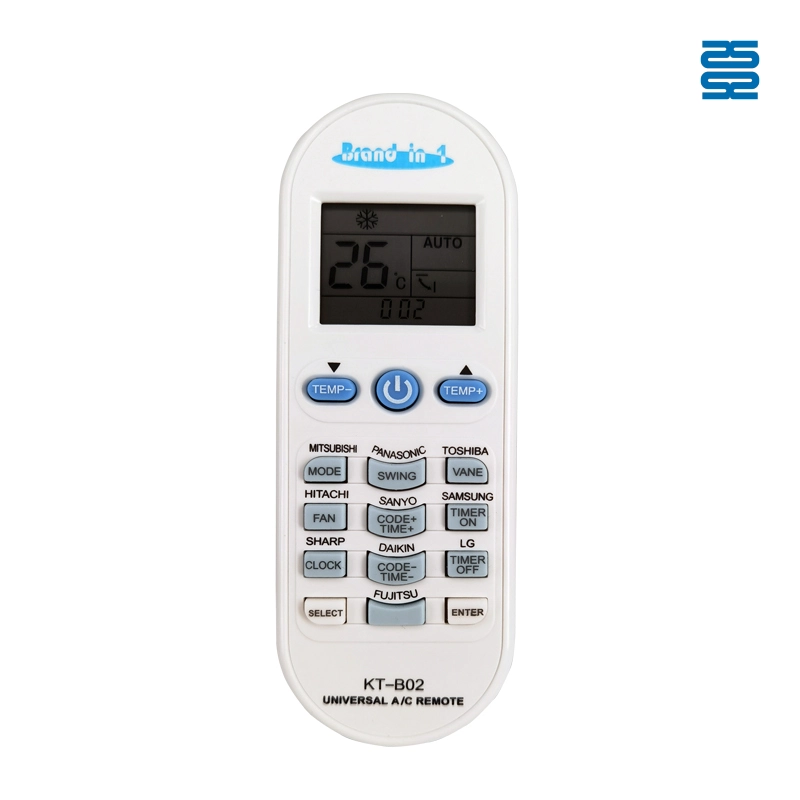
KT-B02 Universal Air Conditioner Remote Control Compatible with All Brands
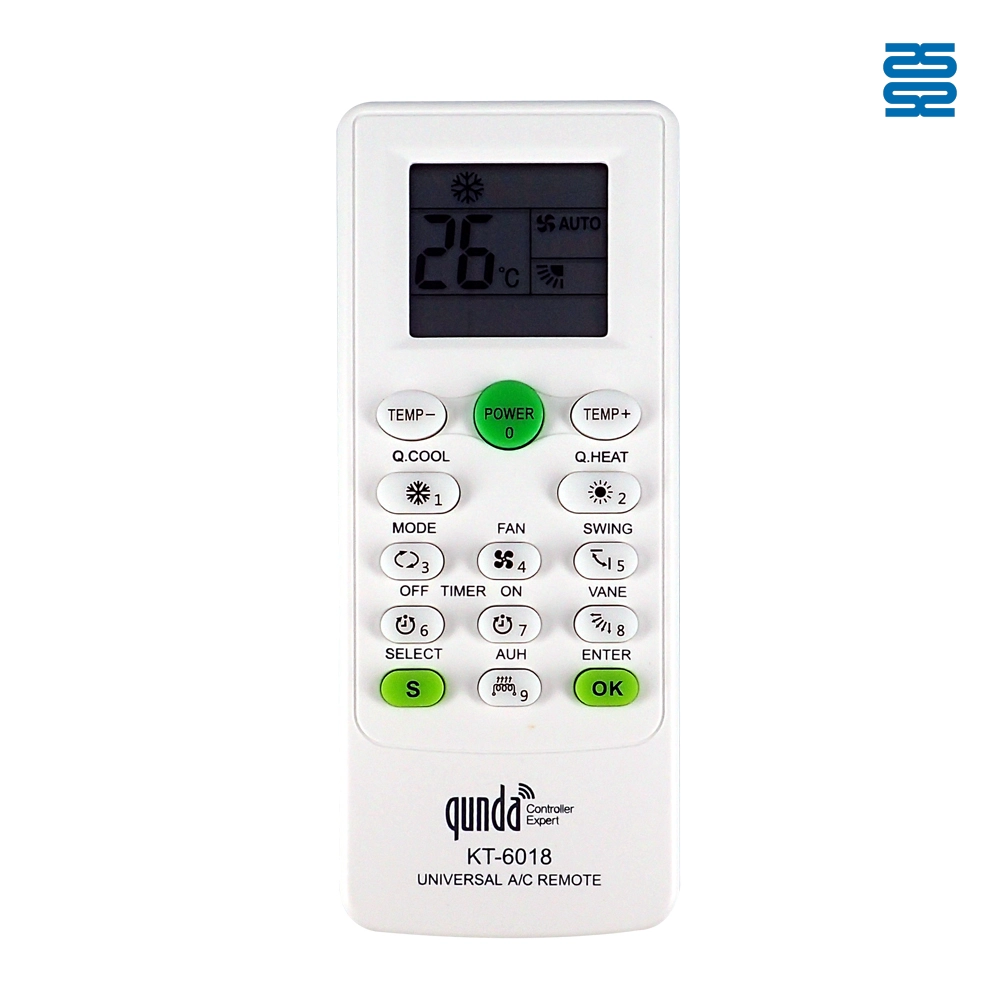
KT-6018 6000 in 1 Universal Air Conditioner Remote Control Compatible with All Brands

QD-1000 IN 1 1000 Code in 1 Universal Air Conditioner Remote Control Compatible with All Brands

KT-N828 Universal Air Conditioner Remote Control Compatible with All Brands
Get the latest updates
If you have any comments or good suggestions, please leave us a message, later our professional staff will contact you as soon as possible.


Contact
Email us
Text or Call us
Address
Room 1606, No. 65, Zhongshan Seven Road, Liwan District, Guangzhou, Guangdong, China.

Facebook
Instagram
YouTube
Tik Tok
VK