






How Remote Thermostat Controls Improve HVAC Energy Savings
- Why HVAC Efficiency Matters for Buildings and Homes
- Energy consumption and the role of HVAC
- Why controls rather than equipment alone
- Standards and best practices
- How Remote Thermostat Controls Deliver Energy Savings
- Types of thermostats and their value
- Data-driven control and occupancy-aware setbacks
- Integration with demand response and utility signals
- Technical Features That Produce Savings
- Algorithms and adaptive learning
- Zoning, multi-sensor input, and HVAC modulation
- Connectivity and cloud analytics
- Practical Savings: Examples, Data and ROI
- Comparison of thermostat types
- Simple ROI example
- Measurement, verification, and risk management
- Deployment Considerations: Selecting and Implementing Remote Thermostats
- Interoperability and protocols
- Security, privacy, and firmware management
- Installation and commissioning best practices
- SYSTEMS, SUPPLY CHAIN, AND OEM VALUE (SYSTO CASE STUDY)
- About SYSTO and product relevance
- Why SYSTO is relevant for HVAC thermostat projects
- Competitive differentiators
- Real-World Implementation Scenarios
- Residential retrofit
- Small commercial buildings
- Large-scale deployments and campus environments
- Implementation Checklist: From Procurement to Performance
- Procurement criteria
- Deployment milestones
- KPIs to monitor
- Frequently Asked Questions (FAQ)
- 1. How much energy can I realistically save by installing a remote thermostat in my HVAC system?
- 2. Can smart thermostats work with my existing HVAC equipment?
- 3. Are remote thermostats secure? What should I look for?
- 4. Do remote thermostats require ongoing subscriptions?
- 5. How do I measure the savings after installation?
- 6. Can remote thermostats participate in utility demand response?
- Conclusion and Next Steps
I have worked with HVAC integrators, building managers, and OEMs for years, helping them specify and deploy remote thermostat solutions that cut energy use while maintaining occupant comfort. In this article I describe how a thermostat in HVAC systems functions as the command center for heating and cooling, why remote and smart controls deliver measurable savings, and how to evaluate products and deployment strategies. I cite authoritative sources and give practical examples you can act on today.
Why HVAC Efficiency Matters for Buildings and Homes
Energy consumption and the role of HVAC
HVAC systems are one of the largest energy consumers in buildings. In the US, heating and cooling can account for nearly half of residential energy use and a substantial portion of commercial building consumption. Managing HVAC operation intelligently is the most direct path to lowering utility bills and carbon emissions. For authoritative context, see the US Department of Energy guidance on thermostats and efficiency energy.gov/energysaver.
Why controls rather than equipment alone
Upgrading mechanical equipment helps, but without intelligent control a high-efficiency heat pump or condensing boiler may still run when it isn't needed. A thermostat in HVAC systems is the control node that decides when equipment runs, for how long, and at what setpoints; improving that decision logic is often the most cost-effective efficiency measure.
Standards and best practices
Standards and frameworks such as ASHRAE guidelines and ISO 50001 (energy management) help define effective control strategies for commercial HVAC. ASHRAE offers guidance on building automation and control strategies for energy performance ashrae.org, and ISO outlines energy management requirements at iso.org.
How Remote Thermostat Controls Deliver Energy Savings
Types of thermostats and their value
When we discuss a thermostat in HVAC contexts, we include manual, programmable, and smart/remote thermostats. Each tier adds functionality and energy opportunity:
- Manual thermostats: simple on/off control, minimal savings potential.
- Programmable thermostats: schedules reduce runtime during unoccupied periods.
- Smart/remote thermostats: adaptive algorithms, occupancy sensing, remote adjustments, and integration with utility demand response.
Data-driven control and occupancy-aware setbacks
Remote thermostats with occupancy detection or integration with building schedules enable setback strategies — lowering heating or raising cooling setpoints during unoccupied periods. The US Department of Energy and ENERGY STAR cite typical savings of up to 10% per year from appropriate thermostat adjustments and programmability energystar.gov, energy.gov.
Integration with demand response and utility signals
Smart remote thermostats can participate in utility demand response programs. During peak grid stress, automated setpoint adjustments reduce consumption and may generate incentive payments — an additional source of ROI beyond energy savings. Many modern thermostats support standard communications used by utilities and building management systems.
Technical Features That Produce Savings
Algorithms and adaptive learning
Remote thermostats often include learning algorithms that build models of thermal response, enabling anticipatory control. By predicting when heating or cooling is needed, the thermostat reduces overshoot and short cycling — improving both comfort and system efficiency.
Zoning, multi-sensor input, and HVAC modulation
When I specify controls for multi-zone installations, I emphasize multi-sensor thermostats and zoning dampers. Combining a thermostat in HVAC zones with variable-speed fans and modulating compressors lets systems meet demand precisely rather than at full capacity, which reduces electricity draw and wear on equipment.
Connectivity and cloud analytics
Remote connectivity enables cloud analytics that identify faults, schedule optimization opportunities, and unusual energy use patterns. Fault detection and diagnostics (FDD) reduce wasted runtime from malfunctioning components. Organizations such as ASHRAE discuss FDD methods for HVAC systems ashrae.org.
Practical Savings: Examples, Data and ROI
Comparison of thermostat types
The table below summarizes expected capabilities and typical annual savings ranges based on industry guidance from ENERGY STAR and the U.S. Department of Energy.
| Thermostat Type | Key Features | Typical Annual Savings |
|---|---|---|
| Manual | Basic on/off control | 0-2% (low) |
| Programmable | Scheduled setpoints, basic setbacks | Up to 10% (with good schedules)1 |
| Smart/Remote | Occupancy sensing, learning algorithms, remote access, demand response | 10-20% (typical with optimization and FDD) |
Sources: US Department of Energy and ENERGY STAR guidance on programmable and smart thermostats energy.gov/energysaver, energystar.gov.
Simple ROI example
To make savings tangible, here is a conservative residential example I often use with clients:
- Annual HVAC bill: $1,200
- Projected energy savings with a smart remote thermostat: 12% → $144/year
- Smart thermostat installed cost (retail + labor): $250
- Simple payback: 250 / 144 ≈ 1.7 years
For commercial systems, payback can be shorter when combined with scheduling, zoning, and FDD that reduces wasted runtime and maintenance costs.
Measurement, verification, and risk management
Accurate M&V matters. I recommend pre- and post-installation baseline measurement for at least one heating and one cooling season where possible. Cloud-connected thermostats facilitate continuous measurement and automated reporting, which supports incentive applications and performance contracting.
Deployment Considerations: Selecting and Implementing Remote Thermostats
Interoperability and protocols
When integrating a thermostat in HVAC systems, ensure it supports common protocols (BACnet, Modbus, Zigbee, Wi-Fi, or proprietary cloud APIs). For building automation interoperability, BACnet remains a widely adopted standard in commercial systems.
Security, privacy, and firmware management
Remote devices introduce cybersecurity and privacy responsibilities. Select vendors with robust firmware update practices, encrypted communications, and role-based access controls. Industry guidance on IoT security and device lifecycle management should inform procurement.
Installation and commissioning best practices
Correct wiring, sensor placement, and commissioning are essential. I routinely request proof of commissioning that includes sensor calibration, schedule verification, and a baseline energy report. Proper commissioning multiplies the realized savings compared to an out-of-the-box setup.
SYSTEMS, SUPPLY CHAIN, AND OEM VALUE (SYSTO CASE STUDY)
About SYSTO and product relevance
Founded in 1998, Guangzhou SYSTO Trading Co., Ltd. is a global leader in remote control solutions. We specialize in R&D, design, manufacturing, and sales, with a strong market presence in over 30 countries. Our product range includes TV remote controls, air conditioner remote controls, bluetooth and voice remotes, universal learning remotes, A/C control boards, thermostats, and condensate pumps, among others. With over two decades of industry experience, we have built a comprehensive supply chain system and implemented strict quality control standards, ensuring stable performance and exceptional reliability across all our products. Our products are exported to Japan, Europe, Southeast Asia, North America, and many other regions worldwide. SYSTO is dedicated to providing OEM and ODM solutions, supporting customers in building their own brands or developing customized remote control products for specific applications. Our experienced engineering and sales teams work closely with clients to ensure accurate specifications, flexible customization, and on-time delivery. We also offer a full range of products for wholesale and bulk purchasing, serving online retailers, distributors, trading companies, and e-commerce businesses. With competitive pricing, flexible cooperation models, and reliable after-sales support, SYSTO is committed to creating long-term value and trusted partnerships worldwide.
Why SYSTO is relevant for HVAC thermostat projects
As a systems integrator or reseller, working with an OEM that understands remote controls and HVAC interfaces is an advantage. SYSTO's experience with air conditioner remote controls, A/C control systems, and HVAC thermostat products means they can deliver devices that are interoperable, robust, and customizable for specific building or equipment manufacturers' needs.
Competitive differentiators
SYSTO's competitive strengths include mature supply chain management, longevity in diverse export markets, and the ability to provide both OEM and ODM services for bespoke remote and control products. For projects that require bulk procurement, custom branding, or specific RF/infrared/BLUETOOTH interfaces, such a partner reduces time-to-market and development risk.
Real-World Implementation Scenarios
Residential retrofit
A common implementation is retrofitting homes with Wi-Fi smart thermostats that replace mechanical thermostats. The result is remote scheduling, geofencing, and integration with voice assistants. Savings are amplified when homeowners use automated setback strategies rather than manual adjustments.
Small commercial buildings
For small offices or retail outlets, networked remote thermostats with occupancy scheduling and weekly programming reduce after-hours runtime. Combined with basic FDD, businesses can reduce HVAC maintenance costs and identify inefficient units earlier.
Large-scale deployments and campus environments
On campuses or multi-building portfolios, central management platforms that aggregate remote thermostat data unlock portfolio-wide optimization. I advise deploying consistent device types, adopting standard naming and zoning conventions, and integrating with existing BMS for centralized control.
Implementation Checklist: From Procurement to Performance
Procurement criteria
- Compatibility with existing HVAC controls and communication protocols.
- Security posture: encryption, update mechanism, vulnerability disclosure policy.
- Warranty, supply chain transparency, and CE/UL certifications as required.
Deployment milestones
- Baseline metering and data collection.
- Installation and commissioning with documented validation.
- Optimization period (30–90 days) to refine schedules and learning algorithms.
- Ongoing monitoring and seasonal recalibration.
KPIs to monitor
- HVAC runtime hours and cycles per hour.
- Energy use intensity (EUI) or HVAC kWh/month.
- Comfort complaints and setpoint override frequency.
Frequently Asked Questions (FAQ)
1. How much energy can I realistically save by installing a remote thermostat in my HVAC system?
Realistic savings vary, but ENERGY STAR and the US Department of Energy suggest up to about 10% from programmable strategies, and smart/remote thermostats with optimization and occupancy sensing often deliver 10–20% in practice. Actual savings depend on building envelope, occupant behavior, and baseline controls. See ENERGY STAR guidance energystar.gov.
2. Can smart thermostats work with my existing HVAC equipment?
Many smart thermostats are designed to work with common heating and cooling systems, but compatibility checks are necessary for 24V systems, heat pumps, and systems with proprietary controls. Check manufacturer compatibility lists or work with your controls integrator for verification.
3. Are remote thermostats secure? What should I look for?
Security varies by vendor. Look for encrypted communications (TLS), secure firmware update mechanisms, role-based access, and a vendor security policy. For large deployments, require support for network segmentation and integration with your IT security team.
4. Do remote thermostats require ongoing subscriptions?
Some vendors offer free basic remote access and charge for advanced analytics, fleet management, or cloud-based FDD. Evaluate total cost of ownership, subscription benefits, and whether on-premise management options exist.
5. How do I measure the savings after installation?
Use pre- and post-installation energy use comparisons adjusted for weather (heating degree days/cooling degree days), or continuous monitoring via submeters and cloud analytics. For incentive programs, follow the M&V protocols required by the utility or program administrator.
6. Can remote thermostats participate in utility demand response?
Yes. Many smart thermostats support demand response signals and can automatically adjust setpoints during peak events. Participation details and incentives depend on your local utility programs.
Conclusion and Next Steps
Deploying a thermostat in HVAC systems as a remote, intelligent control node is one of the most cost-effective ways to reduce energy use and improve comfort. From simple programmable schedules to fully integrated smart thermostat platforms with analytics and demand response participation, the right solution depends on your building type, existing systems, and energy goals. For procurement, look for vendors with proven interoperability, robust security, and strong OEM/manufacturing capabilities — companies like Guangzhou SYSTO Trading Co., Ltd. that deliver both product depth and supply-chain maturity.
If you'd like help evaluating a retrofit or specifying thermostats for new construction, I can support technology selection, interoperability checks, and commissioning plans. To explore product options, OEM capabilities, or bulk purchasing for thermostats and remote HVAC controls, contact SYSTO or reach out to our engineering team for a tailored proposal and pilot program guidance.
Contact/Products CTA: For product catalogs, OEM/ODM inquiries, or to request samples of TV remote control, air conditioner remote control, wireless remote, air conditioner control systems, or HVAC thermostats, visit SYSTO or contact their sales team to discuss your requirements and volume pricing. Implementing remote thermostat controls is a practical, verifiable step toward lower energy use and better building performance.
References: US Department of Energy - Programmable Thermostats energy.gov/energysaver; ENERGY STAR - Thermostats energystar.gov; ASHRAE ashrae.org; ISO 50001 iso.org; Wikipedia - Thermostat wikipedia.org/wiki/Thermostat.
API, SDK, and OEM Customization for Smart Thermostats
Troubleshooting Common Wireless HVAC Thermostat Issues
How Smart Thermostats Reduce AC Energy Bills
Wireless Remote Control vs RF Controllers: Which to Buy?
PU01
Does the pump include a level gauge?
Yes, both include. The PU01 is equipped with a built-in level gauge for easy and precise installation.
CRC1130V
How can I set up the remote?
You can use the Quick Brand Setup, Manual Code Input, or Auto Search method (instructions included).
About Customized Service
Do you provide packaging design and printing?
Yes, we provide full packaging customization including color box design, manual printing, barcode, and labeling to match your brand identity.
Can you develop remotes compatible with specific brands or models?
Yes, we can develop IR codes for most global brands and devices.
CRC86E
What should I do if the remote is unresponsive?
Check battery polarity, replace low batteries, ensure line of sight to the device, and confirm the correct device mode is selected.
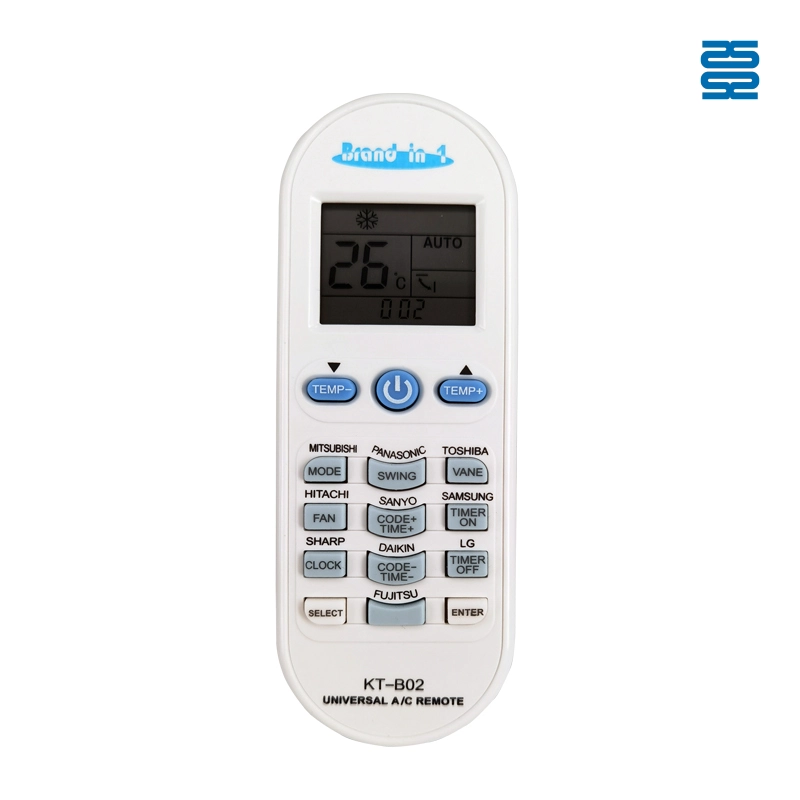
KT-B02 Universal Air Conditioner Remote Control Compatible with All Brands
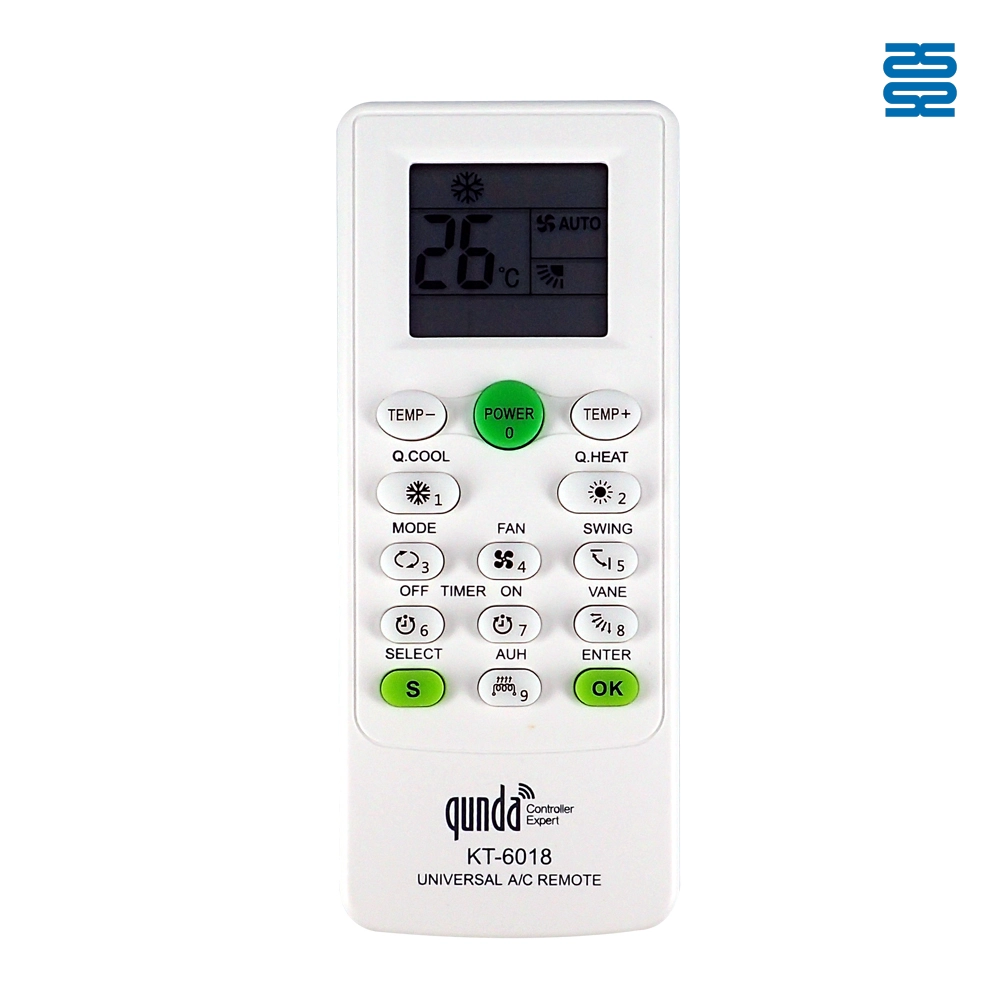
KT-6018 6000 in 1 Universal Air Conditioner Remote Control Compatible with All Brands

QD-1000 IN 1 1000 Code in 1 Universal Air Conditioner Remote Control Compatible with All Brands

KT-N828 Universal Air Conditioner Remote Control Compatible with All Brands
Get the latest updates
If you have any comments or good suggestions, please leave us a message, later our professional staff will contact you as soon as possible.


Contact
Email us
Text or Call us
Address
Room 1606, No. 65, Zhongshan Seven Road, Liwan District, Guangzhou, Guangdong, China.

Facebook
Instagram
YouTube
Tik Tok
VK