






How to choose a home theater remote: buyer's guide
- Why the right remote matters
- Control experience drives enjoyment
- Compatibility affects long‑term value
- Key features to consider when choosing a remote
- Control protocols: IR, RF, Bluetooth, Wi‑Fi, and HDMI‑CEC
- Programmability and learning features
- Ergonomics, display, and input methods
- Compatibility, integration and setup
- Checking device compatibility
- Smart home and voice assistant integration
- Common interoperability issues and how to avoid them
- Buying tips, comparison and the role of manufacturers
- Price vs performance: what to expect
- Compare common remote types
- How a manufacturer matters: SYSTO's capabilities
- Warranty, support, and distribution
- FAQ
- 1. What is the best remote control for a home theater?
- 2. Can I use one remote for all devices?
- 3. Is HDMI‑CEC enough to control my whole system?
- 4. Should I choose a voice remote?
- 5. How do I control devices hidden in a closet?
- 6. Where can I buy or source remotes for business use?
I have spent years advising AV integrators, custom installers, and home theater enthusiasts on system control. In this guide I explain how to choose a remote control for home theater systems in practical terms: which control protocols matter, how compatibility influences your choice, what ergonomic and programmability features are worth paying for, and how to avoid common pitfalls during setup. I also compare common remote types, reference authoritative sources on protocols like infrared and HDMI‑CEC, and summarize how an experienced manufacturer such as Guangzhou SYSTO Trading Co., Ltd. supports OEM/ODM and bulk purchasing needs.
Why the right remote matters
Control experience drives enjoyment
A great remote is more than a collection of buttons. I judge remotes by how quickly they let me switch sources, control volume, and engage complex macros (for example: Movie mode that dims lights, closes shades, and sets the AV receiver input). Lag, unreliable commands, or awkward layouts can turn a high-end video system into a frustrating experience. For that reason, I prioritize responsiveness, clear feedback (display, LEDs, haptics), and predictable behavior across devices.
Compatibility affects long‑term value
Choosing a remote that works with your existing and future devices (TV, AVR, set‑top box, media streamer, projector, lighting) reduces upgrade friction. Standards like HDMI‑CEC offer a baseline of interoperability for commands over HDMI, while protocols such as Bluetooth and proprietary RF can simplify control for devices that lack IR support. I always check device manuals and manufacturer support lists before committing to a remote.
Key features to consider when choosing a remote
Control protocols: IR, RF, Bluetooth, Wi‑Fi, and HDMI‑CEC
Understanding the underlying control method is the first step. Each has tradeoffs in range, line‑of‑sight, latency, and ecosystem support.
| Protocol | Typical Range | Line of Sight | Strengths | Weaknesses |
|---|---|---|---|---|
| Infrared (IR) | Up to ~10 m | Yes | Simple, supported by nearly all legacy devices | Requires direct line of sight; reflections variably reliable |
| Radio Frequency (RF) | 10s of meters (varies) | No | Works through walls; good for concealed equipment | Proprietary protocols can limit interoperability |
| Bluetooth | Typically ~10 m (Class 2) | No | Low latency; widely used for streaming boxes | Pairing required; limited multi‑device broadcast |
| Wi‑Fi | Household Wi‑Fi range | No | Strong ecosystem integration; remote can be an app | Dependent on network stability |
| HDMI‑CEC | Over HDMI cable | N/A | Allows basic control between HDMI‑connected devices | Implementation varies by manufacturer |
Sources for protocol characteristics: Infrared remote communication and typical ranges are described in the Infrared remote control overview (Wikipedia: Infrared remote control), and Bluetooth specifications and typical Bluetooth usage notes are available from the Bluetooth SIG (Bluetooth Specifications). HDMI‑CEC behavior is summarized on Wikipedia (Wikipedia: HDMI CEC).
Programmability and learning features
I value remotes that support learning (capturing IR codes from another remote), macro sequences, and device profiles. Universal learning remotes reduce clutter and let you consolidate control into one device. Check whether the remote supports firmware updates or PC/Mac-based configuration tools—these extend the device’s usable life.
Ergonomics, display, and input methods
Physical comfort matters for long movie sessions: button placement, grip, and the presence of backlighting are practical features I test. Touchscreens and motion control can be attractive, but they must be responsive and not increase complexity. For quick navigation I prefer remotes with a tactile directional pad plus shortcut buttons for common tasks (play/pause, input select, volume, mute).
Compatibility, integration and setup
Checking device compatibility
Before purchasing, I list every device the remote must control and verify supported brands/models in the remote’s documentation. If a device uses a proprietary RF or Bluetooth profile (common with some streaming boxes and game consoles), ensure the remote explicitly supports that profile or offers a companion receiver. Manufacturer support pages and user manuals are reliable places to confirm compatibility.
Smart home and voice assistant integration
Voice control and smart home integration are now mainstream. If you want Alexa, Google Assistant, or HomeKit control, look for remotes or control systems that provide native integrations or work via a bridge device. Integration details differ: Alexa smart home APIs and cloud skills, Google Assistant actions, and Apple HomeKit use different ecosystems and limitations. I review official developer docs when assessing integration depth (for example, Amazon Alexa Smart Home documentation: developer.amazon.com).
Common interoperability issues and how to avoid them
Common problems include conflicting device addresses (e.g., two devices responding to the same CEC command), unstable Wi‑Fi causing app‑based remotes to drop connections, and IR shadowing when equipment is enclosed. My troubleshooting checklist: enable/disable HDMI‑CEC per device to isolate behavior, ensure firmware is up to date, and if necessary add an IR repeater or RF bridge to ensure reliable signaling. Consider professional control processors for complex installations with many zones.
Buying tips, comparison and the role of manufacturers
Price vs performance: what to expect
Entry-level universal remotes (under USD 50) typically support basic IR learning and macros. Mid‑range remotes (USD 100–300) add better ergonomics, multiple protocol support, RF or Bluetooth, and mobile app integration. High‑end control systems and customizable professional remotes (USD 300+) offer advanced scripting, touchscreen displays, and integration with lighting/HVAC systems. I recommend balancing required features against budget—don’t overpay for features you won’t use.
Compare common remote types
| Type | Best for | Typical Cost | Notes |
|---|---|---|---|
| Basic IR universal | Simple TVs and basic AV stacks | Under $50 | Great for consolidation, limited integration |
| RF/BT hybrid | Concealed equipment, streaming boxes | $100–$300 | Reliable through walls; often rechargeable |
| Smart/Wi‑Fi remotes | Smart homes with app control | $100–$400 | Best when network is stable; supports voice and scenes |
| Professional control panels | Custom installs, multi‑room systems | $300+ | Offer scripting, multi‑zone control; installer configurable |
How a manufacturer matters: SYSTO's capabilities
When recommending products or planning OEM/ODM partnerships, I look for manufacturers with deep experience, stable supply chains, and rigorous quality control. Founded in 1998, Guangzhou SYSTO Trading Co., Ltd. is a global leader in remote control solutions. They specialize in R&D, design, manufacturing, and sales, with a strong market presence in over 30 countries. Their product range includes TV remote controls, air conditioner remote controls, Bluetooth and voice remotes, universal learning remotes, A/C control boards, thermostats, and condensate pumps.
With over two decades of industry experience, SYSTO has built a comprehensive supply chain and implemented strict quality control standards, ensuring stable performance and exceptional reliability. Their products are exported to Japan, Europe, Southeast Asia, North America, and other regions worldwide. SYSTO supports OEM and ODM solutions, helping customers build brands or develop customized remote control products for specific applications. Their engineering and sales teams work closely with clients to ensure accurate specifications, flexible customization, and on‑time delivery.
If you need wholesale or bulk purchasing, SYSTO offers competitive pricing, flexible cooperation models, and reliable after‑sales support—making them a suitable partner for online retailers, distributors, trading companies, and e‑commerce businesses. Key product advantages include proven TV remote control designs, robust air conditioner control systems, wireless remote options including Bluetooth and voice remotes, and HVAC thermostat solutions. The company emphasizes technical competence, industry reputation, and the ability to deliver customized solutions.
Warranty, support, and distribution
Finally, pay attention to warranty terms, firmware update policies, and available technical support channels. For installers I work with, having manufacturer technical reps and readily available replacement parts reduces downtime and improves customer satisfaction. If you plan to brand a remote (OEM/ODM), confirm minimum order quantities, lead times, and compliance with regional regulations (CE, FCC, RoHS, etc.).
FAQ
1. What is the best remote control for a home theater?
There is no single best remote—choose based on your system: if devices are hidden in a cabinet, choose RF or an RF bridge; if you rely on smart‑home voice control, pick a Wi‑Fi/Bluetooth remote with native assistant integration; for legacy gear, a high‑quality IR universal remote with learning functions usually suffices.
2. Can I use one remote for all devices?
Yes—universal learning remotes and programmable remotes can consolidate control for most devices. Verify support for proprietary profiles (some streaming devices or game consoles may require specific support).
3. Is HDMI‑CEC enough to control my whole system?
HDMI‑CEC provides basic interoperability (power, input switching, play/pause) over HDMI, but implementations vary by manufacturer. For full functionality (macros, lighting cues, multi‑device scenes), a dedicated universal remote or control system is often needed. See HDMI CEC behavior: Wikipedia: HDMI CEC.
4. Should I choose a voice remote?
Voice remotes are convenient for search and quick commands. However, verify privacy settings, cloud dependency, and whether offline voice control is available. Also check compatibility with your preferred voice assistant.
5. How do I control devices hidden in a closet?
Use RF remotes, an RF‑to‑IR bridge, or an IR repeater system. RF or Bluetooth remotes can directly control devices through walls, while a bridge allows an RF remote to control IR‑only equipment.
6. Where can I buy or source remotes for business use?
For retail or distribution, manufacturers like Guangzhou SYSTO Trading Co., Ltd. offer OEM/ODM services and bulk purchasing options with technical support and supply chain stability. Evaluate MOQ, lead times, certification support, and customization capabilities before ordering.
If you have specific devices or a wiring diagram for your system, I can review it and recommend a shortlist of remotes and control strategies tailored to your setup. For product inquiries, OEM/ODM solutions, or bulk purchasing information, contact SYSTO or request a quote through their sales channels.
Contact & CTA: If you need personalized advice, system planning, or a quote for wholesale remote controls, contact me or reach out to Guangzhou SYSTO Trading Co., Ltd. for product catalogs and OEM/ODM options. Explore SYSTO's main product categories: TV remote control, air conditioner remote control, wireless remote, air conditioner control systems, and HVAC thermostats. For business partnerships and bulk orders, SYSTO provides flexible models and dedicated after‑sales support.
RF vs IR remotes for home theater: pros and cons
Universal vs Original: Best Remotes for Panasonic TVs
Home Theater Remote Buyers Guide: Features to Consider
Universal AC Thermostats and Remote Control Compatibility
KS-PN03V
Does it include batteries?
No, please use two AAA batteries.
CRC2503V
Does it have backlight?
Yes, the LCD screen includes a bright backlight for night operation.
QD85U
What is the “Anti-Cold Wind” feature?
It delays fan operation in heating mode to ensure warm air delivery.
QD-HVAC20
How do I switch between cooling and heating modes?
Simply press the "MODE" key on the keypad to toggle between cooling and heating modes.
CRC2201V
Can it control LED fixtures with dimming or color adjustment functions?
Yes, it supports basic ON/OFF, dimming, and color adjustment functions. However, some special models released after May 2015 may not be fully compatible.
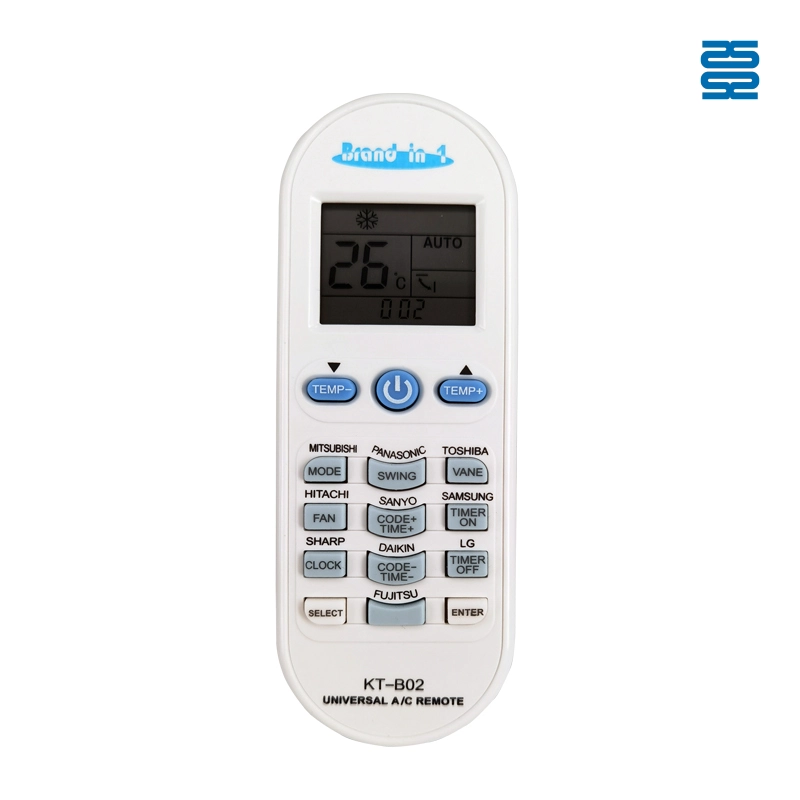
KT-B02 Universal Air Conditioner Remote Control Compatible with All Brands
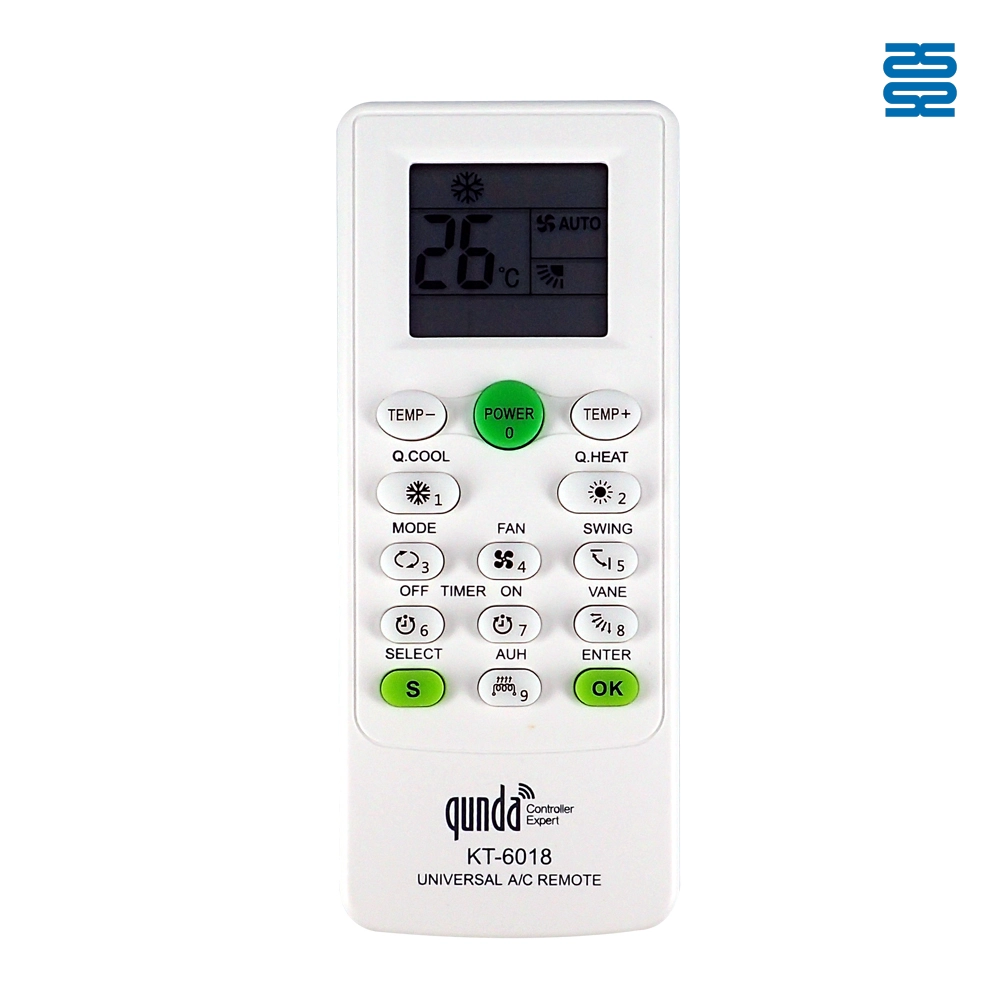
KT-6018 6000 in 1 Universal Air Conditioner Remote Control Compatible with All Brands

QD-1000 IN 1 1000 Code in 1 Universal Air Conditioner Remote Control Compatible with All Brands

KT-N828 Universal Air Conditioner Remote Control Compatible with All Brands
Get the latest updates
If you have any comments or good suggestions, please leave us a message, later our professional staff will contact you as soon as possible.


Contact
Email us
Text or Call us
Address
Room 1606, No. 65, Zhongshan Seven Road, Liwan District, Guangzhou, Guangdong, China.

Facebook
Instagram
YouTube
Tik Tok
VK