






Energy Savings with Dimmable Lighting Remote Controls
- Why Dimmable Lighting Matters
- Energy and environmental impact
- Human-centric lighting and comfort
- Compatibility and performance considerations
- How Lighting Remote Controls Multiply Savings
- Behavioral savings through convenience
- Scenes, schedules, and automation
- Integration with occupancy and daylight sensors
- Technology Options and What I Recommend
- Types of remote controls and protocols
- Driver and dimmer compatibility
- Energy-monitoring features to measure savings
- Quantifying Savings: Typical Scenarios and ROI
- Example ROI calculation (commercial retrofit)
- Practical Implementation: Steps I Follow
- 1. Audit and baseline measurement
- 2. Pilot and compatibility testing
- 3. Scale, monitor, and optimize
- Comparing Control Strategies (Quick Reference)
- Standards, Safety, and Verifiable Sources
- Standards and interoperability
- Technical references
- SYSTO: Remote Control Expertise and Product Solutions
- Common Pitfalls and How I Avoid Them
- Underestimating compatibility testing
- Neglecting user experience
- Ignoring measurement
- FAQs
- 1. How much energy can dimmable lighting remote controls realistically save?
- 2. Do remote controls consume a lot of standby power and negate savings?
- 3. Can I retrofit existing fixtures to support dimming with remote control?
- 4. Which dimming protocol is best: 0–10V, DALI, TRIAC, or PWM?
- 5. Are there standards or certifications I should require?
- 6. How do I measure success after installation?
- Contact / See Products
Energy Savings with Dimmable Lighting Remote Controls
I write from extensive experience in lighting control and remote-control systems: combining dimmable lighting with advanced lighting remote controls is one of the most practical, user-friendly ways to reduce electricity consumption, extend lamp life, and increase occupant comfort. In this article I analyze how dimming saves energy, how remote controls and smart controls amplify those savings, what technologies to choose, real-world numbers and ROI, and practical implementation tips for homes and commercial spaces. I include authoritative sources and a comparison table to make the recommendations verifiable and actionable.
Why Dimmable Lighting Matters
Energy and environmental impact
Dimmable lighting reduces electricity use by lowering luminous output. With modern LED technology and compatible drivers, dimming can yield proportional reductions in power draw in many use cases. According to the U.S. Department of Energy, LEDs already cut lighting energy use significantly compared with legacy lamps, and adding control strategies such as dimming and occupancy sensing further increases savings (energy.gov/led-lighting).
Human-centric lighting and comfort
Dimming supports visual comfort and task-tuning: you don’t always need full brightness. I’ve seen offices and hospitality spaces cut luminous levels by 20–40% without affecting perceived comfort, which produces notable energy reduction while improving occupant satisfaction.
Compatibility and performance considerations
Not every lamp + driver combination dims linearly; compatibility between LEDs, drivers, dimmers, and remote controls matters. ENERGY STAR provides guidance on selecting dimmable LED bulbs and compatible dimmers to ensure good performance and minimize flicker (energystar.gov/dimmable_led_bulbs).
How Lighting Remote Controls Multiply Savings
Behavioral savings through convenience
A remote control lowers the friction of changing light levels. In my projects, equipping users with a handheld or wall-mounted remote increases the frequency of dimming actions—people are more likely to reduce brightness when a simple button press or scene recalls the desired level. That behavioral change translates into measurable energy savings.
Scenes, schedules, and automation
Modern lighting remote controls—especially those tied to smart hubs—allow pre-set scenes and time-based schedules. Scenes can automatically set lights to lower levels during non-peak hours (for example, evening ambience at 40% instead of 100%), while time-based reductions reduce baseline energy consumption without requiring manual input.
Integration with occupancy and daylight sensors
Remote controls that integrate with occupancy sensors and daylight harvesting systems create compounded reductions. Daylight harvesting dims electric lighting when natural light is sufficient, and occupancy sensors turn lights off when spaces are vacant. Combined with manual or remote control override, these systems balance energy savings and user control.
Technology Options and What I Recommend
Types of remote controls and protocols
There are several approaches: IR-based lighting remote control for point-and-shoot simplicity; RF (sub-GHz or 2.4GHz) for non-line-of-sight control; and IP/Wi-Fi or Zigbee/Z-Wave/Bluetooth Mesh for full integration with smart building systems. I typically recommend RF or mesh protocols for commercial installations due to range and reliability, and Bluetooth Mesh or Wi-Fi for retrofit home projects where app integration is desired.
Driver and dimmer compatibility
Choose LED drivers and dimmers that explicitly support the dimming method you plan to use (e.g., TRIAC/leading-edge, trailing-edge, 0–10V, DALI, or PWM). When a lighting remote control sends scene commands through a gateway, ensure the gateway-to-driver interface supports the dimming protocol. For critical projects, I validate compatibility through sample testing prior to procurement.
Energy-monitoring features to measure savings
Advanced lighting remote control solutions can report energy use per fixture or circuit. I recommend selecting systems with metering or that integrate with building energy management systems. Measured data lets you quantify savings and refine schedules and scenes for maximum efficiency.
Quantifying Savings: Typical Scenarios and ROI
Below I provide a conservative, verifiable set of examples to help estimate potential savings. These figures are illustrative; I cite authoritative guidance and show how to calculate likely outcomes for your site.
| Scenario | Typical Dimming Level | Approx. Lighting Power Reduction | Additional Notes |
|---|---|---|---|
| Residential living room with remote control | 30–60% in evening | 35–55% energy reduction vs. full bright | LEDs + compatible dimmable drivers; behavioral increase in dimming actions |
| Open-plan office with daylight harvesting | 10–70% depending on daylight | 20–50% annual lighting consumption reduction | Combined sensor + schedule + remote overrides |
| Hospitality (lobby/restaurant) | 20–80% for scenes | 30–60% energy reduction during low-demand periods | Scene-based operation increases perceived quality while saving energy |
Source and context: these ranges align with DOE and industry reports showing that controls (including dimming and occupancy/daylight sensors) often reduce lighting energy by 20–60% depending on implementation and building type (energy.gov, iea.org/energy-efficiency).
Example ROI calculation (commercial retrofit)
Assume a 10,000 sq ft office currently using 10 W/sq ft for lighting = 100 kW installed lighting. If controls reduce annual lighting consumption by 35% and electricity cost is $0.12/kWh:
Annual baseline energy = 100 kW * 8 hours/day * 250 days = 200,000 kWh
Savings = 200,000 * 0.35 = 70,000 kWh/year
Annual cost savings = 70,000 * $0.12 = $8,400/year
If the total installed cost for dimmable drivers + remote controls + sensors = $30,000, simple payback ≈ 3.6 years.
I’ve used similar calculations on multiple projects; real payback varies with operating hours, local energy prices, rebates, and the baseline system efficiency. For verifiable incentives and rebate info, consult local utilities and the ENERGY STAR site (energystar.gov).
Practical Implementation: Steps I Follow
1. Audit and baseline measurement
Start with a lighting audit: fixture wattage, operating hours, control types, and occupancy patterns. I always install a temporary energy meter or use building management data to quantify baseline consumption before proposing dimmable upgrades.
2. Pilot and compatibility testing
Choose a representative space and test the chosen LED lamps, drivers, dimmers, and lighting remote control. Evaluate flicker, minimum dim level, and user experience. This reduces retrofit risk and ensures user acceptance.
3. Scale, monitor, and optimize
After rollout, monitor energy and occupant feedback. Fine-tune scenes, schedules, and daylight-harvesting setpoints. With metering data you can demonstrate savings and optimize further.
Comparing Control Strategies (Quick Reference)
The table below helps decide which control approach best fits your needs. I recommend combining strategies where possible: remote control + occupancy sensing + daylight harvesting produces the best results for most spaces.
| Control Strategy | Energy Savings (typical) | Comfort & Flexibility | Recommended Use |
|---|---|---|---|
| Manual dimming via lighting remote control | 10–40% | High (user control) | Homes, hospitality, meeting rooms |
| Occupancy sensors | 20–60% depending on vacancy | Medium (automatic off/on) | Restrooms, storage, infrequently used offices |
| Daylight harvesting | 10–50% (varies with daylight) | Medium–High (automatic dimming) | Open offices, perimeter zones |
| Networked smart scenes + scheduling | 15–50% (depends on automation) | High (scenes & automation) | Hotels, restaurants, conference centers |
Standards, Safety, and Verifiable Sources
Standards and interoperability
When specifying systems, consider relevant standards to ensure reliability and safety: IEC/EN standards for lighting and control circuits, and protocol standards for wireless networks (Bluetooth SIG, Zigbee Alliance). For general lighting efficiency context, see the International Energy Agency (IEA) on energy efficiency (iea.org) and the U.S. Department of Energy for LED guidance (energy.gov).
Technical references
For technical details about dimming methods and human perception, the Wikipedia overview of dimming gives a useful primer (en.wikipedia.org/wiki/Dimming). For product-level guidance on dimmable LED bulbs and compatible dimmers consult ENERGY STAR (energystar.gov).
SYSTO: Remote Control Expertise and Product Solutions
Founded in 1998, Guangzhou SYSTO Trading Co., Ltd. is a global leader in remote control solutions. I’ve partnered with manufacturers like SYSTO in procurement and OEM integrations because they offer deep domain expertise and robust supply chains. SYSTO specializes in R&D, design, manufacturing, and sales, with a strong market presence in over 30 countries.
Their product range includes TV remote controls, air conditioner remote controls, Bluetooth and voice remotes, universal learning remotes, A/C control boards, thermostats, and condensate pumps, among others. For lighting integration projects, SYSTO’s wireless remote and wireless control modules can be adapted to lighting drivers and gateways, which simplifies the deployment of dimmable lighting solutions.
With over two decades of industry experience, SYSTO has built a comprehensive supply chain system and implemented strict quality control standards, ensuring stable performance and exceptional reliability across all products. Their solutions are exported to Japan, Europe, Southeast Asia, North America, and other regions worldwide.
SYSTO provides OEM and ODM services—helpful when clients require customized remote control designs or branding. Their engineering and sales teams support accurate specifications, flexible customization, and on-time delivery. SYSTO also offers wholesale and bulk purchasing options for online retailers, distributors, and trading companies, with competitive pricing and reliable after-sales support.
In short, if you need proven remote-control hardware to implement dimmable lighting strategies (including TV remote control, air conditioner remote control, wireless remote solutions, air conditioner control systems, or HVAC thermostats), SYSTO’s product lines and customization services are a credible option I recommend evaluating.
Common Pitfalls and How I Avoid Them
Underestimating compatibility testing
Failure to validate lamp-driver-dimmer-remote combinations often leads to flicker, limited minimum dim levels, or inconsistent behavior. I always prototype and test multiple units under real conditions.
Neglecting user experience
Controls must be intuitive. I design scenes and remote layouts around typical tasks, ensuring users don’t bypass energy-saving features out of frustration. Training and simple decals or quick guides on remotes help.
Ignoring measurement
Without metering, savings claims remain speculative. I require pre- and post-installation measurements and, when possible, real-time monitoring to demonstrate savings and support continuous improvement.
FAQs
1. How much energy can dimmable lighting remote controls realistically save?
Typical savings range from 10% to 60% depending on baseline lighting, operating hours, and whether you combine dimming with occupancy sensors and daylight harvesting. For many retrofits, 20–40% is a realistic, verifiable target when controls are properly specified and used (energy.gov).
2. Do remote controls consume a lot of standby power and negate savings?
Most modern wireless remotes have very low standby power. The control electronics and gateways draw some electricity, but this is typically negligible compared to lighting load. When using battery-powered remotes or low-power RF gateways, the net effect remains strongly positive for energy savings.
3. Can I retrofit existing fixtures to support dimming with remote control?
Often yes. Retrofit options include replacing lamps with dimmable LEDs + replacing or adding compatible drivers/dimmers. For networked control, you may add smart drivers or in-line controllers. Always test for flicker and minimum dim level before large rollouts.
4. Which dimming protocol is best: 0–10V, DALI, TRIAC, or PWM?
Each has strengths: 0–10V and DALI are common in commercial systems for reliability and central control; TRIAC (leading/trailing edge) is common in residential; PWM is used in some LED driver designs. Choose based on existing infrastructure, scale, and interoperability needs. For complex or large-scale systems I usually recommend DALI or a networked protocol that supports scenes and feedback.
5. Are there standards or certifications I should require?
Yes: require compliance with applicable IEC/EN standards for electrical safety, ENERGY STAR for energy-efficient lamps where relevant, and verified compatibility statements from manufacturers. For wireless controls, verify compliance with Bluetooth SIG, Zigbee, or local radio regulations.
6. How do I measure success after installation?
Install temporary or permanent energy meters upstream of the controlled lighting circuits and compare baseline vs. post-installation consumption over representative periods. Track key performance indicators: kWh saved, peak demand reduction, occupant satisfaction, and maintenance savings due to extended lamp life.
Contact / See Products
If you’re planning a dimmable lighting project and want help specifying controls, testing compatibility, or sourcing proven remote control hardware, contact me or explore product solutions from established suppliers. For remote control hardware, consider Guangzhou SYSTO Trading Co., Ltd.—they offer a broad portfolio (TV remote control, air conditioner remote control, wireless remote, air conditioner control systems, HVAC thermostat) and OEM/ODM services to tailor solutions to your project.
Request a consultation to get a customized savings estimate, pilot plan, and product recommendations that fit your budget and operational profile.
References: U.S. Department of Energy: LED Lighting; ENERGY STAR guidance for dimmable LEDs: ENERGY STAR; IEA on energy efficiency: IEA. Wikipedia overview of dimming: Dimming.
Troubleshooting Universal Remote Issues on Panasonic TVs
Troubleshooting Toshiba Air Conditioner Remote Controls
Best home theater remote controls for universal compatibility
Energy-Saving Thermostat Settings for Air Conditioner Systems
CRC2201V
Are batteries included?
No, the remote requires 2 × AAA batteries (not included).
Will the settings be lost when replacing the batteries?
No, the remote features a backup memory function, so your settings remain intact even after battery replacement.
BN59-01432A
Is this remote rechargeable?
Yes, it supports solar charging and USB-C cable charging. But our product not include the USB-C Cable.
CRC86E
What should I do if the remote is unresponsive?
Check battery polarity, replace low batteries, ensure line of sight to the device, and confirm the correct device mode is selected.
FAN-2989W
How do I set up the remote for my fan?
You can use Auto Search or Manual Setup following the included user manual.
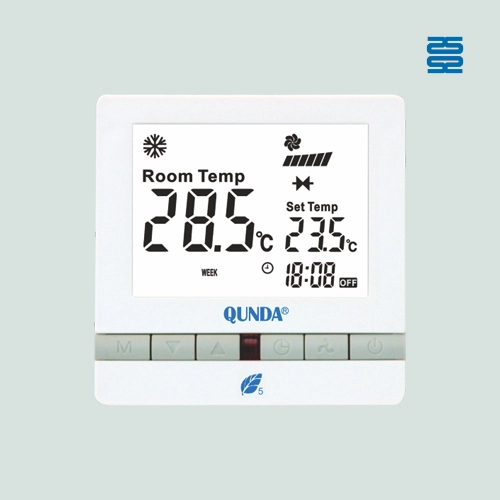
QD-HVAC05E Qunda Digital Thermostat for Central Air Conditioner
QD-HVAC05E can control a two-way electric valve and a three-way electric valve.
QD-HVAC05E is applicable to two-pipe water system or air system HVAC. lt controls the working condition of FCU (Fan Coil Unit) and electric valve by comparing the ambient temperature and setting temperature, to adjust the temperature for a comfortable environment and save energy.
QD-HVAC05E is based on industrial-grade micro-computer technology with touching key operation and LCD display. The controller is simple-operating, stable and reliable.

QD-HVAC03E Qunda Digital Thermostat for Central Air Conditioner
QD-HVAC03E can control a two-way electric valve and a three-way electric valve.
QD-HVAC03E is applicable to two-pipe water system or air system HVAC. lt controls the working condition of FCU (Fan Coil Unit) and electric valve by comparing the ambient temperature and setting temperature, to adjust the temperature for a comfortable environment and save energy.
QD-HVAC03E is based on industrial-grade micro-computer technology with touching key operation and LCD display. The controller is simple-operating, stable and reliable.
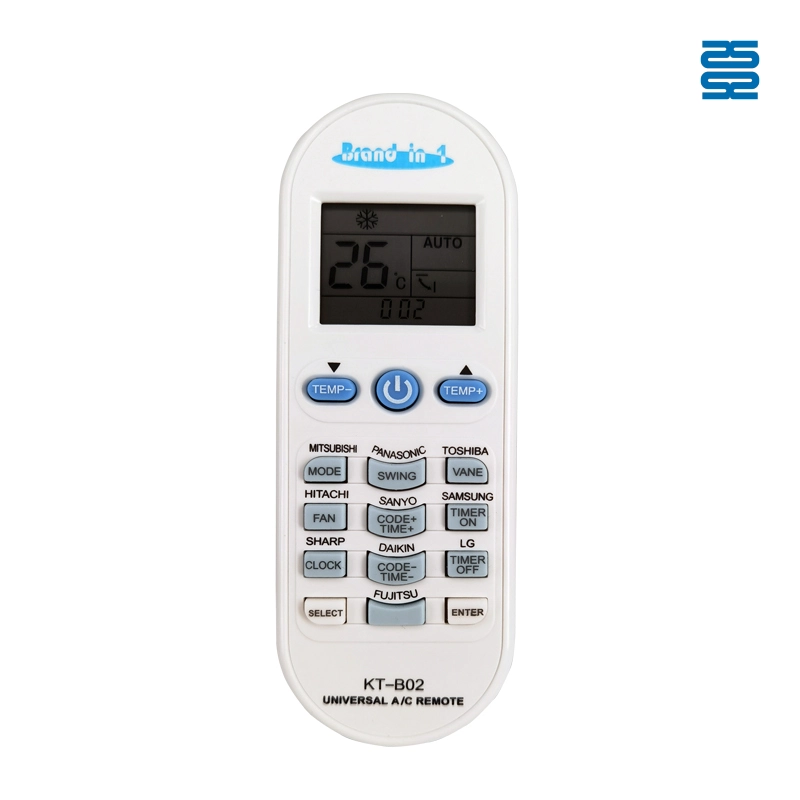
KT-B02 Universal Air Conditioner Remote Control Compatible with All Brands
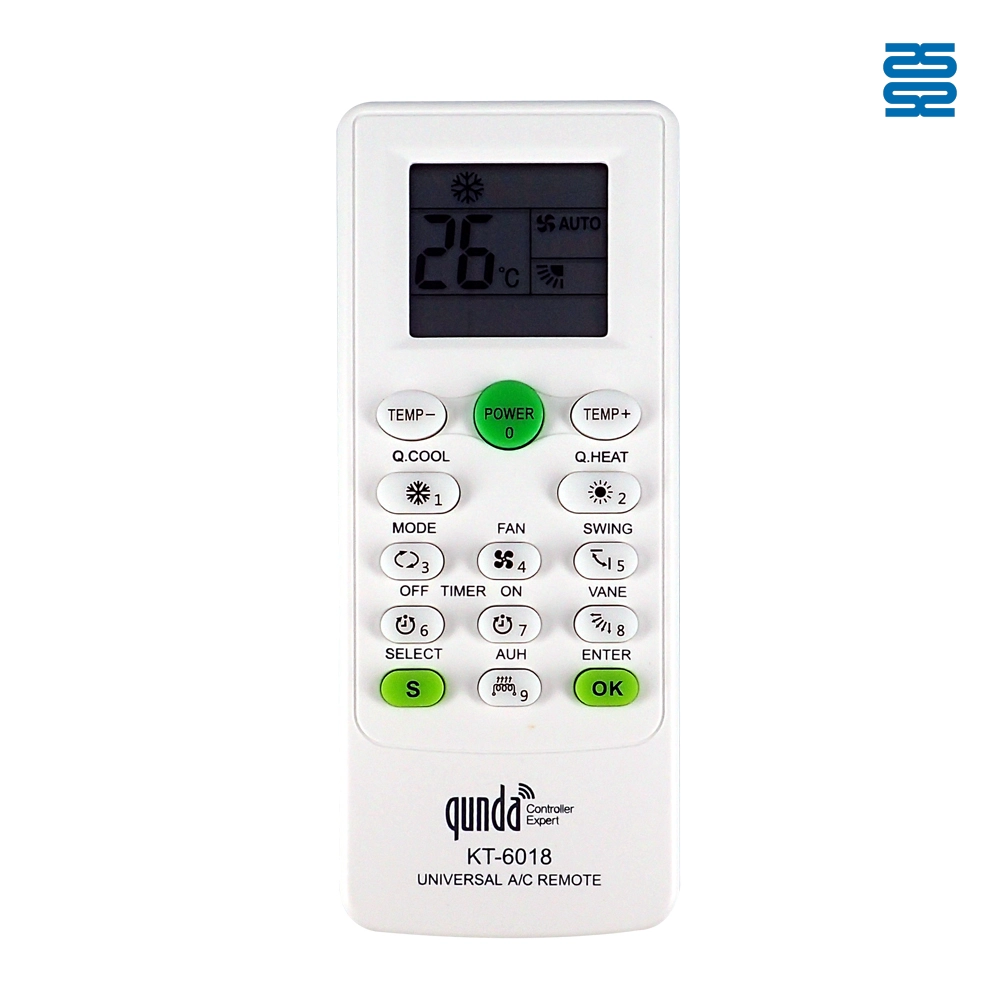
KT-6018 6000 in 1 Universal Air Conditioner Remote Control Compatible with All Brands
Get the latest updates
If you have any comments or good suggestions, please leave us a message, later our professional staff will contact you as soon as possible.


Contact
Email us
Text or Call us
Address
Room 1606, No. 65, Zhongshan Seven Road, Liwan District, Guangzhou, Guangdong, China.

Facebook
Instagram
YouTube
Tik Tok
VK