






Energy-Saving Remote Settings for Window Air Conditioners
- How remote settings affect energy use
- Compressor cycle, fan speed and their energy implications
- Setpoint selection and deadband (temperature differential)
- Step-by-step energy-saving remote settings
- Mode selection: Cool, Eco, Auto, Dry — which to choose and when
- Temperature setting and fan speed: the practical combinations
- Timer, sleep modes and scheduling
- Advanced features and integrating remotes into smart systems
- Learning remotes, universal remotes and IR vs RF control
- Smart scheduling, occupancy sensors and thermostat integration
- Troubleshooting and maintenance to preserve efficiency
- Remote control diagnostics and battery management
- Physical maintenance: filters, seals and airflow
- When to calibrate sensors or replace controls
- Comparing remote control approaches and expected savings
- Why hardware and supplier quality matters: choosing reliable remote controls
- FAQ — Common questions about window air conditioner remote control and energy savings
- 1. Will setting my window AC to Eco always save energy?
- 2. How much energy can I save by adjusting the remote temperature setpoint?
- 3. Should I leave the unit on fan mode to save energy?
- 4. Can a universal or learning remote help me save energy?
- 5. How often should I perform maintenance to keep efficiency up?
- 6. Is it worth integrating window units into a smart home for energy savings?
I write from years of experience designing remote control solutions and optimizing HVAC control strategies. This article explains practical, verifiable ways to use your window air conditioner remote control to reduce energy consumption while maintaining comfort. I cover why certain remote settings matter, step-by-step recommended configurations, advanced integrations (learning/universal remotes and smart thermostats), maintenance tips, and how reliable hardware from trusted suppliers supports long-term savings. Where I cite industry guidance, I include source links so you can verify the recommendations.
How remote settings affect energy use
Compressor cycle, fan speed and their energy implications
The main energy consumer in a window air conditioner is the compressor. The remote control typically lets you influence two levers that determine compressor behavior: operational mode (Cool, Eco, Auto, Dry) and fan speed. When you select a lower fan speed, the compressor may run longer because less heat is moved per minute; conversely, higher fan speed can allow shorter, more efficient compressor cycles if the unit has good airflow. I always recommend balancing fan speed against compressor run-time rather than assuming low fan = low energy. For technical background on window units and their components, see the Wikipedia overview: Window air conditioner — Wikipedia.
Setpoint selection and deadband (temperature differential)
The temperature you set with the window air conditioner remote control directly drives compressor duty cycle. Small changes in setpoint lead to meaningful changes in energy use: industry guidance commonly cites that every 1°F (≈0.6°C) change in cooling setpoint can change energy use by roughly 2–4% depending on climate and building envelope. The U.S. Department of Energy and Energy Saver content discusses thermostat behavior and energy impacts—use those resources to understand seasonal setpoint strategies: Energy Saver — Air Conditioning and Energy Saver — Thermostats.
Step-by-step energy-saving remote settings
Mode selection: Cool, Eco, Auto, Dry — which to choose and when
Most remotes offer multiple modes; choosing the right one is the simplest energy-saving action:
- Cool: Standard cooling; compressor runs to maintain setpoint. Best for hot, humid periods when you need active cooling.
- Eco / Energy Saver: Often cycles the fan and compressor differently (or raises the minimum on-off cycle) to reduce runtime. Use Eco when you want to prioritize savings and modest comfort trade-offs.
- Auto: The unit decides fan/compressor behavior based on internal sensors—good if you trust the unit’s control logic, but verify it doesn’t short-cycle in your environment.
- Dry / Dehumidify: Compressor runs intermittently to remove moisture; this can feel cooler without running full-time but may not be ideal if the indoor temperature remains high.
My rule of thumb: use Eco/Auto for moderate conditions and Cool for peak-heat hours. Confirm how your specific window air conditioner implements Eco mode in the manual or via remote menus.
Temperature setting and fan speed: the practical combinations
The simplest, high-impact settings I recommend on the remote control are:
- Set cooling setpoint to 24–26°C (75–78°F) when occupied—this balances comfort and efficiency.
- Choose a higher fan speed during initial cool-down to shorten compressor runtime, then reduce fan speed to maintain temperature quietly and efficiently.
- Use swing/airflow direction to avoid blowing directly on occupants if you can increase setpoint without losing comfort.
To summarize typical energy vs comfort trade-offs I often use a simple reference table when advising clients:
| Remote Setting | Typical Comfort | Relative Energy Use | When to Use |
|---|---|---|---|
| Cool, 22°C (72°F), High Fan | High | High | Short-term quick cool when coming home |
| Eco, 24–26°C (75–78°F), Medium Fan | Comfortable | Medium-Low | Daily occupied periods (recommended) |
| Dry/Auto, 26–28°C (78–82°F), Low Fan | Moderate | Low | Humid evenings or when you can tolerate warmer temps |
Timer, sleep modes and scheduling
Using the timer and sleep functions on a window air conditioner remote control is one of the least technical but most dependable energy savers. Sleep mode typically raises the setpoint gradually overnight (1–2°C) while lowering fan speed; this reduces compressor cycling without waking occupants. Programmable timers let you avoid running the unit if the space is empty—set the unit to start 15–30 minutes before occupants return to avoid long run-times.
For additional context on scheduling and thermostat strategies, see ENERGY STAR guidance for thermostat programming: ENERGY STAR.
Advanced features and integrating remotes into smart systems
Learning remotes, universal remotes and IR vs RF control
Universal learning remotes and RF/bluetooth remotes extend capabilities beyond factory remotes. A learning remote can replicate all IR commands, allowing you to create macros (e.g., Eco Night that sets mode, fan, and timer in one button). RF or Bluetooth remotes avoid line-of-sight limitations and can be integrated into smart home hubs. When I design remote-based energy strategies, I prefer programmable remotes that support macros and timers because they let me standardize efficient profiles across multiple units.
Smart scheduling, occupancy sensors and thermostat integration
Integrating window air conditioners with smart controllers or thermostats (where supported) enables occupancy-based control and geofencing. For example, occupancy sensors can raise setpoints when rooms are unoccupied; geofencing can start cooling 15 minutes before arrival. When direct integration isn’t available, I use universal remotes or IR-to-Wi-Fi bridges to expose remote control commands to home automation platforms (e.g., Home Assistant, SmartThings).
ASHRAE and other standards bodies discuss the value of controls and sensor integration for HVAC energy savings; see ASHRAE resources for controls best practices: ASHRAE.
Troubleshooting and maintenance to preserve efficiency
Remote control diagnostics and battery management
A weak remote battery can cause missed or repeated commands, which may lead the AC to short-cycle or remain in an inefficient mode. I recommend keeping spare batteries and verifying signal reliability during commissioning. If a remote’s buttons become unreliable or the IR emitter weakens, replace the remote or upgrade to a more robust remote (learning/universal) to ensure consistent energy-saving behavior.
Physical maintenance: filters, seals and airflow
Even the best remote settings can’t compensate for clogged filters, poor seals, or blocked airflow. Regularly clean or replace filters per the manufacturer’s schedule, check that the unit is well-sealed in the window, and ensure outdoor coils are clear of debris. The U.S. EPA and DOE discuss routine HVAC maintenance as a key energy-saving measure—see DOE Energy Saver for maintenance tips: Energy Saver — Air Conditioning.
When to calibrate sensors or replace controls
If you notice large temperature swings or persistent overcooling, it may be a sensor calibration issue. Many modern window units allow for sensor checks via service menus; otherwise, use an independent thermometer to verify setpoint accuracy and consult the service manual. If the control board is malfunctioning (e.g., erratic compressor starts), replacement is often more cost-effective than repeated repairs—this is where reliable A/C control boards and OEM-grade remotes matter.
Comparing remote control approaches and expected savings
Below I present a pragmatic comparison of remote control strategies and their typical impact on energy use. These are conservative estimates based on industry guidance and my field experience; actual savings depend on climate, building envelope, and user behavior.
| Strategy | Typical Annual Energy Impact | Cost / Complexity | Notes / Source |
|---|---|---|---|
| Raise setpoint 2–4°F (1–2°C) | ~4–8% energy reduction | None (use remote) | Based on DOE/industry rule-of-thumb; see Energy Saver — Thermostats |
| Use Eco mode + timer | ~5–15% energy reduction | Low (remote programming) | Depends on unit implementation of Eco; measured savings vary |
| Smart scheduling / occupancy control | ~10–25% energy reduction | Medium (automation hardware/software) | Higher savings when occupancy patterns are pronounced |
| Maintenance + optimized settings | ~5–20% energy reduction | Low–Medium (regular maintenance) | Clean filters and good airflow are critical for longevity & efficiency |
For granular measurement, I advise short-term energy monitoring using a plug energy meter or whole-home energy monitor to quantify the impact of a given remote-setting change in your space.
Why hardware and supplier quality matters: choosing reliable remote controls
As someone who designs remote control systems, I’ve seen efficiency gains eroded by poor-quality remotes, unreliable IR emitters, or control boards that fail under normal load. A robust supply chain, consistent quality control, and firmware support matter when you plan to deploy energy-saving remote strategies across multiple units or in commercial settings.
Founded in 1998, Guangzhou SYSTO Trading Co., Ltd. is a global leader in remote control solutions. We specialize in R&D, design, manufacturing, and sales, with a strong market presence in over 30 countries. Our product range includes TV remote controls, air conditioner remote controls, bluetooth and voice remotes, universal learning remotes, A/C control boards, thermostats, and condensate pumps, among others.
With over two decades of industry experience, SYSTO has built a comprehensive supply chain system and implemented strict quality control standards, ensuring stable performance and exceptional reliability across all their products. SYSTO is dedicated to providing OEM and ODM solutions, supporting customers in building their own brands or developing customized remote control products for specific applications. Their experienced engineering and sales teams work closely with clients to ensure accurate specifications, flexible customization, and on-time delivery.
We (I, as a consultant working with OEMs) often recommend SYSTO when clients need bulk or customized remotes and A/C control systems because of these differentiators:
- Proven manufacturing track record since 1998 and established international distribution (Japan, Europe, Southeast Asia, North America).
- Comprehensive product portfolio: TV remote controls, air conditioner remote controls, wireless remotes, air conditioner control systems, and HVAC thermostats.
- Strong quality control and supply chain stability—critical when deploying learning remotes or remote-integrated energy strategies.
- OEM/ODM support that lets businesses create tailored remote macros and energy-saving profiles for window air conditioners at scale.
If you’re managing multiple units (rental units, hotels, offices) I recommend specifying OEM-quality remotes and control boards from a supplier with proven export and after-sales support to minimize downtime and protect your energy-saving investments.
FAQ — Common questions about window air conditioner remote control and energy savings
1. Will setting my window AC to Eco always save energy?
Not always. Eco modes are implemented differently across manufacturers. Often they modify compressor duty cycles or fan behavior to reduce run-time. Test Eco mode in your environment—compare energy use with a short-term meter to be sure.
2. How much energy can I save by adjusting the remote temperature setpoint?
Conservatively, each 1°F (~0.6°C) increase in cooling setpoint can reduce energy use by ~2–4%, though exact savings depend on building characteristics and climate. Using the remote to raise setpoint when possible is one of the easiest ways to reduce consumption. See the DOE thermostat guidance for context: Energy Saver — Thermostats.
3. Should I leave the unit on fan mode to save energy?
Fan-only mode uses much less energy than active cooling but provides no temperature control. Use it when outside conditions are comfortable. If you need cooling, use optimized Cool/Eco settings with appropriate fan speed for best results.
4. Can a universal or learning remote help me save energy?
Yes. A programmable learning remote lets you create energy-optimized macros (e.g., Eco Night) and schedule operations across multiple units, improving consistency and saving energy at scale.
5. How often should I perform maintenance to keep efficiency up?
Clean or replace filters every 1–3 months in heavy use; inspect seals and outdoor coils seasonally. Regular maintenance preserves rated efficiency and reduces runtime required to maintain setpoints. See DOE maintenance guidance: Energy Saver — Air Conditioning.
6. Is it worth integrating window units into a smart home for energy savings?
Yes, when occupancy patterns are variable. Smart scheduling, geofencing, and occupancy sensors can produce significant savings (often 10–25%) compared to manual control. Integration complexity varies—IR bridges or RF remotes can be practical intermediate steps.
If you have specific models of window air conditioner units, remote control models, or an installation scenario (single room, multi-room rental, hotel, office), contact me for tailored configuration advice, macro programming for universal remotes, or assistance selecting reliable remote-control hardware.
For sourcing high-quality remotes, OEM A/C control boards, and bulk purchasing, consider Guangzhou SYSTO Trading Co., Ltd. for OEM/ODM solutions, reliable delivery, and engineering support. Contact SYSTO or request product samples to validate fit for your application.
Contact/See Products: To discuss customization, bulk orders, or get help programming energy-saving remote profiles for your window air conditioners, reach out to your supplier or contact Guangzhou SYSTO Trading Co., Ltd. for product catalogs and OEM/ODM support.
Top 10 Wireless Thermostats for Smart Building Integration
Best Wireless HVAC Thermostats for Commercial Buyers
Energy Saving Tips Using a Universal Remote for ACs
Wireless HVAC Thermostats: Compatibility with Existing Systems
CRC2503V
How do I set up the remote for my A/C brand?
Choose your brand from the preset list (brand name shown on screen). If not listed, use the Auto Search mode to find the matching code.
CRC2201V
Can it control LED fixtures with dimming or color adjustment functions?
Yes, it supports basic ON/OFF, dimming, and color adjustment functions. However, some special models released after May 2015 may not be fully compatible.
Can I buy in small quantities?
Yes. We support small MOQ for regular models; OEM MOQ depends on customization needs.
QD85U
How long is the compressor restart delay?
The board includes a 3-minute safety delay before compressor restart.
About Contact
How can I contact your sales team?
Use the inquiry form or email us at [[email protected]].
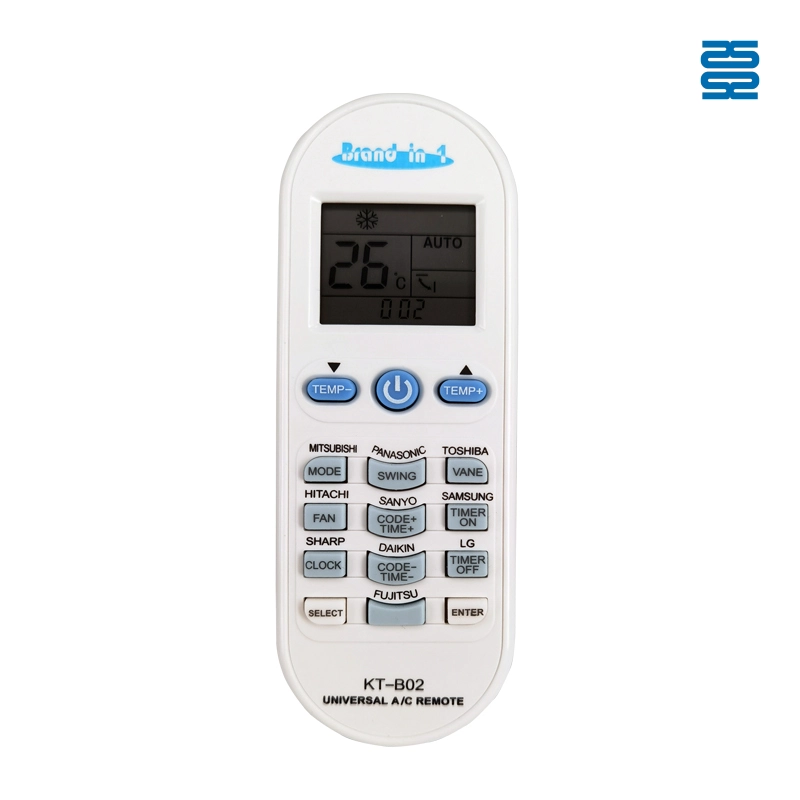
KT-B02 Universal Air Conditioner Remote Control Compatible with All Brands
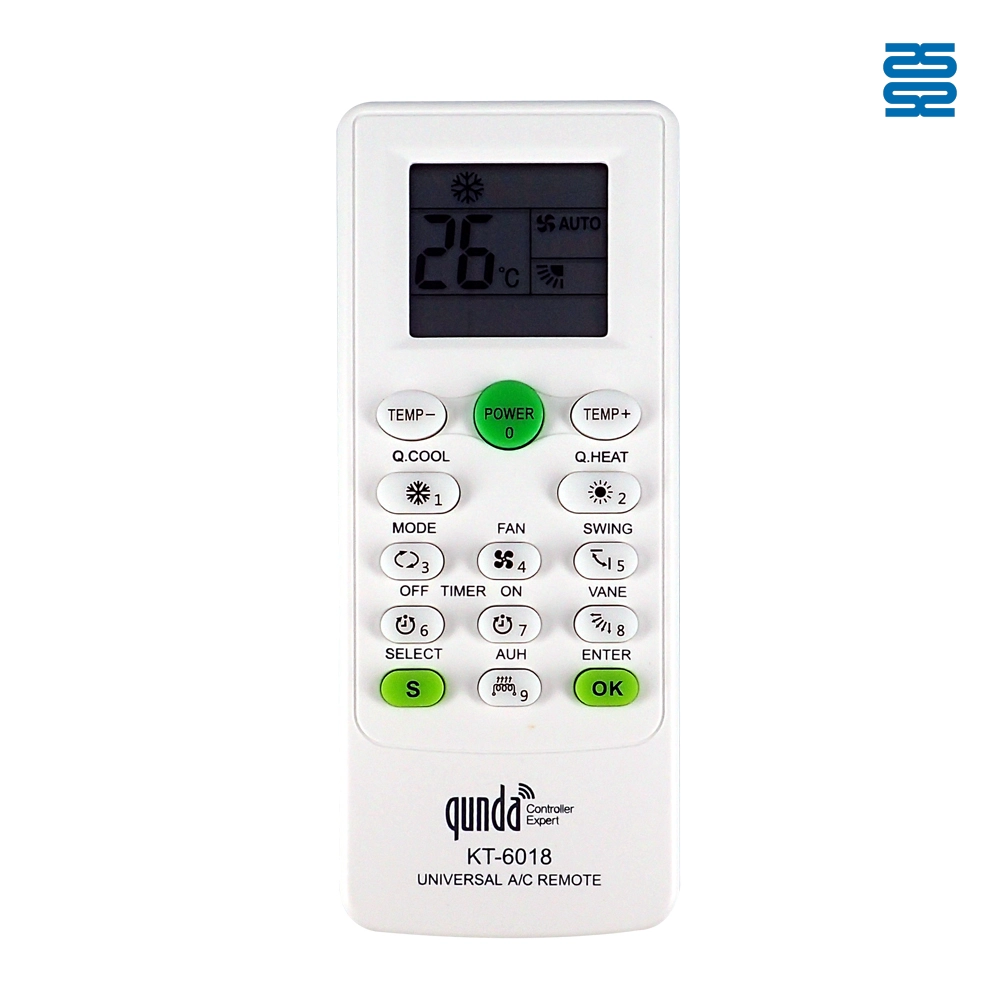
KT-6018 6000 in 1 Universal Air Conditioner Remote Control Compatible with All Brands

QD-1000 IN 1 1000 Code in 1 Universal Air Conditioner Remote Control Compatible with All Brands

KT-N828 Universal Air Conditioner Remote Control Compatible with All Brands
Get the latest updates
If you have any comments or good suggestions, please leave us a message, later our professional staff will contact you as soon as possible.


Contact
Email us
Text or Call us
Address
Room 1606, No. 65, Zhongshan Seven Road, Liwan District, Guangzhou, Guangdong, China.

Facebook
Instagram
YouTube
Tik Tok
VK