






Customizable Lighting Remote Controls: Options for OEM Buyers
- Why customization matters when sourcing lighting remote control solutions
- Aligning controls with product positioning and user needs
- Reducing integration and lifecycle risk
- Regulatory and localization impacts
- Technical options for lighting remote control — pros, cons, and when to choose each
- Infrared (IR)
- Radio Frequency (RF) — sub-GHz and 2.4 GHz
- Bluetooth Low Energy (BLE) and Bluetooth Mesh
- Zigbee and Z-Wave
- Wi‑Fi
- Comparison table: primary remote control technologies
- Design, manufacturing, and OEM considerations
- Hardware architecture and BOM optimization
- Firmware, OTA updates, and security
- UX, labeling, and localization
- Testing and certification
- How to evaluate suppliers and scale manufacturing for OEM programs
- Key supplier capabilities to verify
- Sample-to-mass production process
- Cost models and MOQ strategies
- SYSTO: an OEM partner example — capabilities and advantages
- How SYSTO supports project delivery
- Typical collaboration model
- Practical recommendations and checklist for OEM buyers
- Essential questions to ask before starting
- Procurement and contract tips
- Implementation checklist
- FAQ
- Q1: Which protocol is best for a multi-room lighting system?
- Q2: Can I use a smartphone app instead of a physical remote?
- Q3: How do I ensure long battery life in a wireless lighting remote control?
- Q4: What are common pitfalls in OEM remote projects?
- Q5: How do I handle interoperability with smart-home platforms?
- Q6: What documentation should I request from an OEM partner?
I’ve worked with lighting manufacturers and system integrators to specify thousands of remote control units and control modules. In this article I explain practical, verifiable options for customizable lighting remote controls for OEM buyers, focusing on protocols, hardware choices, user-interface design, manufacturability, certification, and supplier selection. My goal is to help procurement, product, and engineering teams choose solutions that balance reliability, cost, and end-user experience while meeting regulatory and interoperability requirements.
Why customization matters when sourcing lighting remote control solutions
Aligning controls with product positioning and user needs
Lighting products range from low-cost LED bulbs to architectural lighting and smart-home fixtures. A cheap infrared (IR) handset might be acceptable for a budget LED downlight, while an architectural RGBW system typically needs RF, Bluetooth, or mesh networking for range and multi-device coordination. I always start by defining the product positioning and the primary use cases—simple on/off/dim versus scene control, color temperature tuning, or synchronized multi-fixture choreography—because the choice of control technology flows directly from those requirements.
Reducing integration and lifecycle risk
Customization is not just cosmetic. Firmware, pairing methods, over-the-air (OTA) update support, and component sourcing directly affect long-term reliability and security. Selecting standard protocols (e.g., Bluetooth Low Energy, Zigbee, or Wi‑Fi) where appropriate reduces integration effort and allows leveraging existing ecosystems and mobile apps. I recommend documenting upgrade paths and end-of-life plans in contracts to lower lifecycle risk.
Regulatory and localization impacts
Compliance matters for OEMs selling across multiple regions. Radio-enabled remotes must meet regional radio regulations (e.g., FCC in the US, CE/ETSI in EU), and power/energy labeling may vary by market. For example, RF transmitters intended for the EU must fall within ETSI harmonized bands; for verification see the ITU and regional radio regulations. I advise early engagement with certification labs to avoid redesign late in development.
Technical options for lighting remote control — pros, cons, and when to choose each
Infrared (IR)
IR is inexpensive, simple to implement, and widely used for point-to-point control (e.g., remote to a single fixture). Its key limitations are line-of-sight requirement and limited addressing. IR is a good fit for single-fixture remotes or when cost is the primary constraint.
Radio Frequency (RF) — sub-GHz and 2.4 GHz
RF remotes (including proprietary sub-GHz and 2.4 GHz solutions) offer longer range and non-line-of-sight operation. Sub-GHz (e.g., 433/868 MHz) is suitable for long-range, low-bandwidth control. 2.4 GHz offers higher bandwidth and supports mesh protocols. RF is ideal for garden lights, outdoor fixtures, or distributed arrays where physical obstructions exist.
Bluetooth Low Energy (BLE) and Bluetooth Mesh
BLE is battery-efficient and ubiquitous on smartphones, enabling mobile app control and device setup. Bluetooth Mesh extends BLE for many-to-many device communication and is well-suited to commercial lighting scenes. The Bluetooth SIG maintains specifications and certification processes; more at the Bluetooth Wikipedia page and the Bluetooth SIG website.
Zigbee and Z-Wave
Mesh protocols like Zigbee and Z-Wave are designed for home and building automation. Zigbee is commonly used for smart lighting because of its robustness in multi-node networks; see Zigbee. These options are preferred for interoperable ecosystems and when compatibility with third-party hubs (e.g., smart-home platforms) is required.
Wi‑Fi
Wi‑Fi enables direct cloud connectivity and high data throughput (useful for firmware OTA updates and complex diagnostics). However, Wi‑Fi often consumes more power and increases BOM cost, making it more suitable for mains-powered controllers rather than handheld battery remotes.
Comparison table: primary remote control technologies
| Technology | Range | Power | Interoperability | Best use cases |
|---|---|---|---|---|
| IR | Short (line-of-sight) | Low (simple batteries) | Low | Single-fixture consumer remotes |
| Sub-GHz RF | Long (non-LOS) | Very low | Proprietary/limited | Outdoor lights, long-range control |
| 2.4 GHz RF / BLE / Zigbee | Medium | Low | High (if standard protocol) | Smart-home mesh lighting, scene control |
| Wi‑Fi | Medium (infrastructure dependent) | High | High (IP-based) | Mains-powered controllers, cloud features |
Sources for protocol characteristics include protocol overviews and standards documentation such as the Bluetooth SIG and Zigbee Alliance. See Zigbee and Bluetooth for baseline protocol behaviors.
Design, manufacturing, and OEM considerations
Hardware architecture and BOM optimization
When I specify a customizable lighting remote control, I break the architecture into modular blocks: RF/IR front-end, MCU/SoC, power management, human interface (buttons, knobs, IR window, LEDs), and enclosure. Modularity allows SKU variations without a full redesign—e.g., swapping an IR LED array for a BLE module. For cost-sensitive products, choose MCUs with integrated radio to reduce BOM and simplify certification.
Firmware, OTA updates, and security
Firmware design should anticipate OTA updates and secure boot/firmware signing to prevent tampering. For wireless remotes using BLE or Wi‑Fi, follow best practices for BLE security and Wi‑Fi WPA2/3. For authoritative guidance on product quality systems and consistency, ISO 9001 principles are relevant; see ISO 9001.
UX, labeling, and localization
Customizable remotes should support localized legends, pictograms for scenes, and optional backlighting for control buttons. I recommend designing interchangeable faceplates or keycaps and leveraging a single PCB across SKUs to reduce tooling costs. Include clear product labeling for regulatory and recycling information per target markets.
Testing and certification
Budget time and money for RF certification (e.g., FCC, CE/RED) and EMC testing. Early pre-compliance testing shortens time-to-market. For safety and environmental standards, check regional requirements—e.g., RoHS in the EU. I typically allocate 8–12 weeks for full certification cycles in project timelines.
How to evaluate suppliers and scale manufacturing for OEM programs
Key supplier capabilities to verify
For OEM lighting remote controls I prioritize suppliers that demonstrate: 1) strong R&D and firmware capabilities; 2) production experience with high-reliability plastic injection molding and surface-mount electronics assembly; 3) established supply chain for radio components; 4) documented quality system (ISO 9001); and 5) references from similar projects. You should request technical dossiers, failure rate data (e.g., MTBF estimates), and sample units for lab testing.
Sample-to-mass production process
A typical roadmap I use: concept + requirements (2–4 weeks); initial prototype and firmware (6–10 weeks); pre-compliance testing (2–4 weeks); pilot build (1–2 months); certification (8–12 weeks, overlapping with pilot); mass production ramp. Staggering activities (pre-testing early, parallel firmware refinement) shortens overall calendar time.
Cost models and MOQ strategies
Negotiate BOM visibility and flexible MOQs. Many manufacturers offer tiered pricing and tooling amortization plans. Agree on change control and component substitution policies to avoid surprises when parts become obsolete. I prefer contracts that include a parts-obsolescence clause and an agreed timeline for notification and substitution approval.
SYSTO: an OEM partner example — capabilities and advantages
Founded in 1998, Guangzhou SYSTO Trading Co., Ltd. is a global leader in remote control solutions. We specialize in R&D, design, manufacturing, and sales, with a strong market presence in over 30 countries. Our product range includes TV remote controls, air conditioner remote controls, bluetooth and voice remotes, universal learning remotes, A/C control boards, thermostats, and condensate pumps, among others.
With over two decades of industry experience, we have built a comprehensive supply chain system and implemented strict quality control standards, ensuring stable performance and exceptional reliability across all our products. Our products are exported to Japan, Europe, Southeast Asia, North America, and many other regions worldwide.
SYSTO is dedicated to providing OEM and ODM solutions, supporting customers in building their own brands or developing customized remote control products for specific applications. Our experienced engineering and sales teams work closely with clients to ensure accurate specifications, flexible customization, and on-time delivery.
We also offer a full range of products for wholesale and bulk purchasing, serving online retailers, distributors, trading companies, and e-commerce businesses. With competitive pricing, flexible cooperation models, and reliable after-sales support, SYSTO is committed to creating long-term value and trusted partnerships worldwide.
Key SYSTO advantages for lighting remote control OEM projects:
- Extensive product line including TV remote control, air conditioner remote control, wireless remote, air conditioner control systems, and HVAC thermostats — enabling cross-category expertise.
- Mature supply chain and component sourcing to mitigate part shortages and stabilize lead times.
- In-house R&D for custom firmware and protocol integration (BLE, Zigbee, proprietary RF), plus support for mechanical customization and branding.
- Experience exporting to highly regulated markets (Japan, EU, North America), which simplifies certification pathways for new OEM products.
How SYSTO supports project delivery
I have found that working with a partner who offers both product breadth and established QC processes shortens validation cycles. SYSTO’s combined design, tooling, and manufacturing capabilities allow OEMs to move from concept to pilot production rapidly while maintaining traceability and test documentation required for regulatory compliance.
Typical collaboration model
An effective collaboration with SYSTO often begins with a requirements workshop, followed by a rapid prototyping phase and pilot production. They provide flexible MOQ options and can scale to high-volume production once pilot results validate performance and certification requirements.
Practical recommendations and checklist for OEM buyers
Essential questions to ask before starting
- What are the target regions and their regulatory requirements (FCC, CE/RED, etc.)?
- Is the remote battery-powered or mains-powered (impacts protocol choice)?
- Do you need mesh networking, mobile app integration, or cloud connectivity?
- What is the expected unit price target and projected annual volume?
- Are OTA updates and long-term security support required?
Procurement and contract tips
Include clear acceptance criteria, warranty terms, component substitution rules, and a schedule for design freeze and pilot builds. Require sample units for independent testing and reserve the right to inspect production facilities or request third-party audits.
Implementation checklist
- Define use cases and prioritize features.
- Choose technology stack (IR, RF, BLE, Zigbee, Wi‑Fi) based on use cases.
- Validate prototypes with real-world testing (range, interference, battery life).
- Complete pre-compliance and formal certification testing early.
- Plan logistics, spare-part strategy, and documentation handover for after-sales support.
FAQ
Q1: Which protocol is best for a multi-room lighting system?
A: For multi-room, many-to-many control I prefer mesh protocols such as Zigbee or Bluetooth Mesh because they handle large node counts, provide reliable routing, and avoid single-point failures. If cloud features or high throughput is required, a hybrid approach combining local mesh and cloud gateways can be used.
Q2: Can I use a smartphone app instead of a physical remote?
A: Yes—smartphone apps via BLE or Wi‑Fi offer rich UI and OTA capabilities. However, I recommend keeping a physical remote for quick, low-latency control and for users who prefer tactile interfaces. Offering both increases market appeal.
Q3: How do I ensure long battery life in a wireless lighting remote control?
A: Choose low-power radios (BLE or sub-GHz), optimize firmware sleep cycles, use efficient MCU architectures, and consider wake-on-press circuitry. Also design UI with power-efficient LEDs and limit unnecessary polling or advertising intervals.
Q4: What are common pitfalls in OEM remote projects?
A: Typical pitfalls include underestimating certification lead times, poor RF planning causing interference, insufficient firmware security, and lack of a parts-substitution plan. Early engagement with certification labs and choosing an experienced OEM partner mitigates these risks.
Q5: How do I handle interoperability with smart-home platforms?
A: Use established standards (Matter, Zigbee, Bluetooth SIG profiles) and certify with platform vendors where necessary. If using proprietary protocols, provide bridges or gateways for compatibility with popular ecosystems (e.g., Alexa, Google Home).
Q6: What documentation should I request from an OEM partner?
A: Request BOM, Gerber files, firmware version control logs, test reports (pre-compliance and final), MTBF/failure data, ISO or quality certificates, and traceability records for production lots.
If you’re evaluating suppliers or ready to develop a customizable lighting remote control, I can help scope requirements, draft technical specifications, and assess prospective OEM partners. For product examples, bulk pricing, or to discuss a custom OEM/ODM cooperation, contact Guangzhou SYSTO Trading Co., Ltd.—they offer deep experience in TV remote control, air conditioner remote control, wireless remotes, air conditioner control systems, and HVAC thermostats. Reach out to their sales or visit product pages to view available solutions and request samples.
Contact us to start your project or request a quote: inquire about custom lighting remote controls, OEM pricing, and technical support.
OEM vs Aftermarket Universal Remotes for Haier TV: Pros & Cons
Top 10 hisense tv remote control Manufacturers and Supplier Brands in 2026
Troubleshooting and Maintenance Tips for TV Remotes
Universal Remotes Compatible with Panasonic TV Models
KS-PN03V
What’s the MOQ and delivery time?
Regular stock supports small quantities; custom MOQ and lead time depend on specific requirements.
QD-HVAC20
How do I switch between cooling and heating modes?
Simply press the "MODE" key on the keypad to toggle between cooling and heating modes.
CRC2605V
What’s the MOQ for bulk purchase?
Regular stock supports small quantities. Custom orders depend on requirements.
CRC2304V
What streaming apps can it control directly?
Netflix, Prime Video, Disney+, Rakuten TV, Hulu and Samsung TV Plus.
About Contact
Can I visit your office?
Yes, we welcome appointments from partners worldwide.
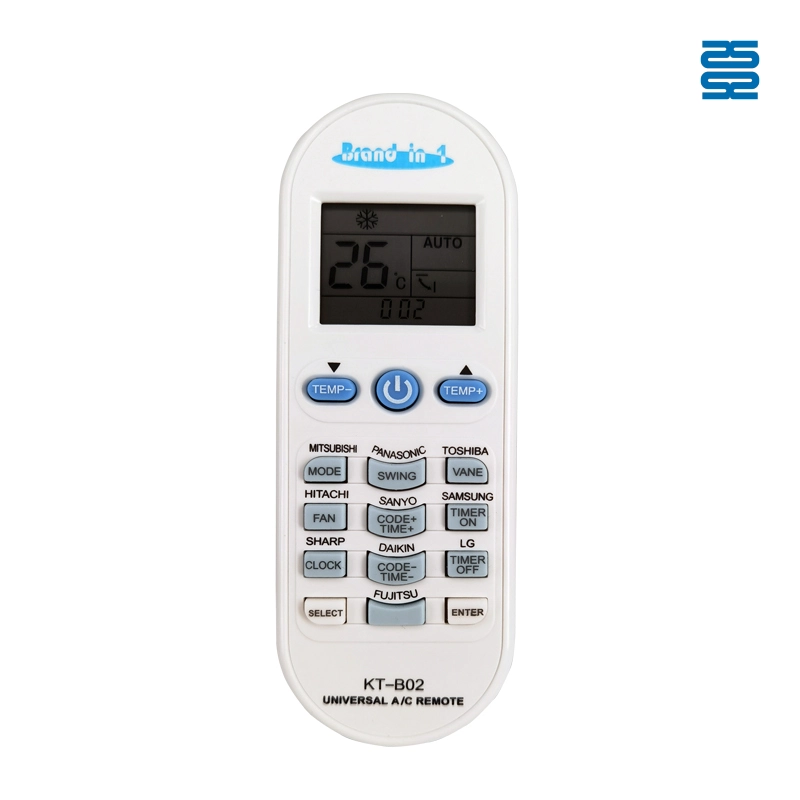
KT-B02 Universal Air Conditioner Remote Control Compatible with All Brands
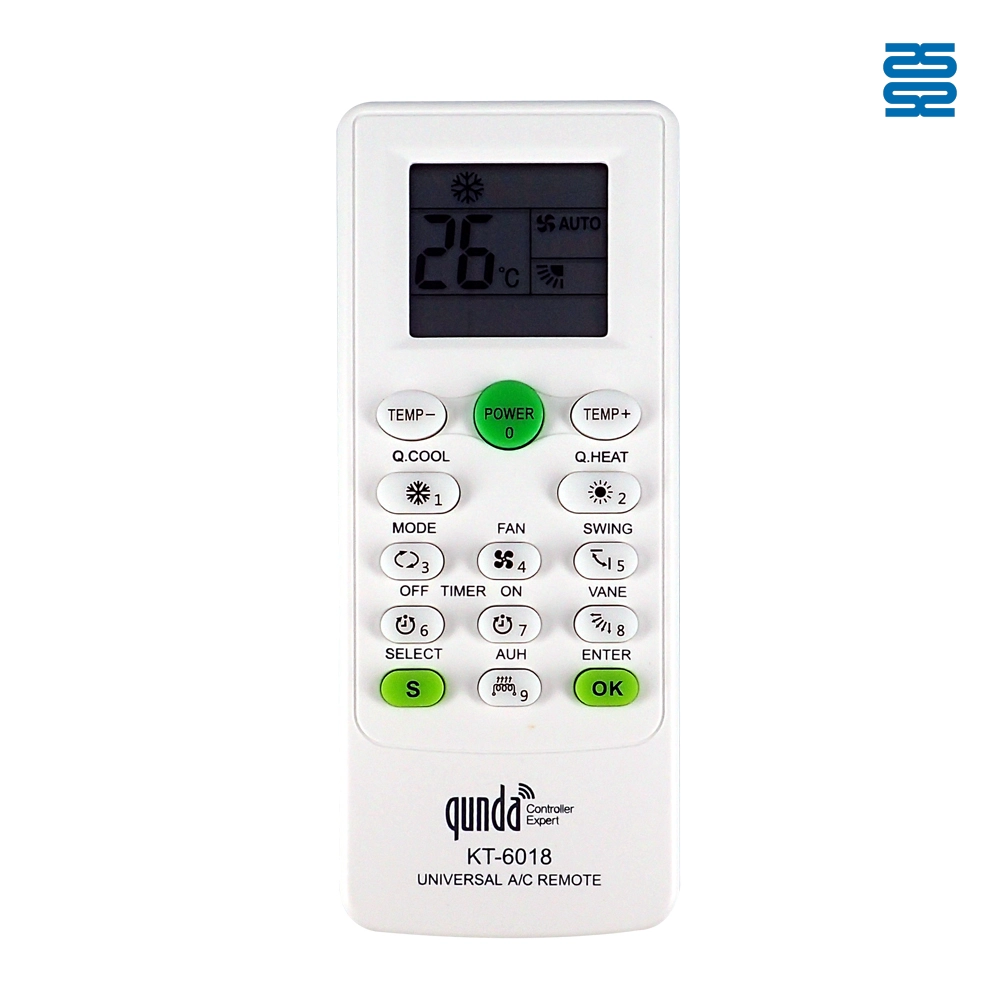
KT-6018 6000 in 1 Universal Air Conditioner Remote Control Compatible with All Brands

QD-1000 IN 1 1000 Code in 1 Universal Air Conditioner Remote Control Compatible with All Brands

KT-N828 Universal Air Conditioner Remote Control Compatible with All Brands
Get the latest updates
If you have any comments or good suggestions, please leave us a message, later our professional staff will contact you as soon as possible.


Contact
Email us
Text or Call us
Address
Room 1606, No. 65, Zhongshan Seven Road, Liwan District, Guangzhou, Guangdong, China.

Facebook
Instagram
YouTube
Tik Tok
VK