






Custom and OEM Lighting Remote Control Options for Manufacturers
- Understanding communication protocols and control methods
- Why protocol choice matters for lighting remote control
- Short comparison of common command channels
- Interoperability and standards to consider
- Design and hardware options for lighting remote controls
- User interface: buttons, touch, and voice
- Power sources, battery life and sustainability
- EMC, RF design and certifications
- Customization, manufacturing and OEM/ODM considerations
- Firmware, learning features and universal control
- Industrial design, branding and mechanical constraints
- Supply chain, lead times, and quality control
- Deployment, integration and after-sales support
- Integration with lighting networks and building systems
- Security, OTA updates and lifecycle management
- Warranty, spare parts and global logistics
- Supplier spotlight: SYSTO's OEM and ODM capabilities
- Cost trade-offs and decision checklist
- Estimating unit cost vs features
- Checklist for choosing a custom / OEM lighting remote control partner
- FAQ
- 1. What communication protocol is best for a lighting remote control?
- 2. How long does an OEM lighting remote development project take?
- 3. What certifications are required for wireless remotes?
- 4. Can a remote support both legacy and smart lighting?
- 5. How do I ensure product security for connected remotes?
- 6. What's the typical MOQ for custom remotes?
As a consultant with extensive experience in remote control systems and SEO-aware technical writing, I focus on helping manufacturers choose and implement the right lighting remote control solutions. In this article I cover the practical choices for custom and OEM lighting remote control design — from communication protocols and hardware trade-offs to certifications, manufacturing timelines, and post-sale support. I also explain how manufacturers can balance cost, user experience and reliability when developing proprietary or white-label remotes for indoor and outdoor lighting applications.
Understanding communication protocols and control methods
Why protocol choice matters for lighting remote control
Selecting the right communication protocol (IR, RF, Bluetooth, Zigbee, Wi‑Fi) determines range, latency, interoperability, power consumption, and security. For example, infrared (IR) is low-cost and simple but requires line-of-sight; Bluetooth Low Energy (BLE) and Zigbee enable mesh networking and low power use for smart lighting networks; Wi‑Fi supports high bandwidth and direct cloud integration but consumes more power. When I advise clients, I map protocol features to the product's use case: consumer handheld remote, installer remote, or integrated smart lighting controller.
Short comparison of common command channels
Below is a concise comparison I use during vendor selection and design reviews. Data are typical ranges and characteristics; always validate with your radio module vendors and regulatory requirements.
| Protocol | Typical Range | Power Use | Latency | Best Use |
|---|---|---|---|---|
| Infrared (IR) | Line-of-sight, < 5–10 m | Very low | Very low | Simple consumer remotes, cost-sensitive devices |
| Radio Frequency (RF, sub-GHz) | 10–100+ m (depending on power/antenna) | Low–medium | Low | Non-line-of-sight control, outdoor lighting |
| Bluetooth Low Energy (BLE) | 10–50 m | Low | Low | Smartphone pairing, app integration, mesh lighting |
| Zigbee / IEEE 802.15.4 | 10–100 m (mesh extends coverage) | Very low | Low | Smart lighting ecosystems, mesh reliability |
| Wi‑Fi (2.4 / 5 GHz) | 30–100 m | High | Low–medium | Cloud-connected lighting, high bandwidth control |
Sources and protocol details: overview of remote control technology on Wikipedia, Zigbee and IEEE 802.15.4 specifics on Wikipedia: Zigbee and IEEE 802.15.4, Bluetooth on Wikipedia: Bluetooth, Wi‑Fi on Wikipedia: Wi‑Fi.
Interoperability and standards to consider
For lighting systems, consider compatibility with industry lighting protocols (DALI, DMX) when your remote is part of a larger control architecture. DALI (Digital Addressable Lighting Interface) and DMX512 are common in professional lighting; if your remote must interface with drivers or control panels, ensure your gateway or hub supports translation. See DALI and DMX512 references for protocol specifics.
Design and hardware options for lighting remote controls
User interface: buttons, touch, and voice
A lighting remote control's usability is largely defined by the human interface. Simple IR remotes often use tactile buttons with dome switches for durability. For High Quality products, capacitive touch or small OLED screens improve flexibility but increase BOM and power needs. Voice control is increasingly expected; integrating voice requires BLE or Wi‑Fi connectivity and often cloud services (e.g., Amazon Alexa or Google Assistant) — consider privacy and OTA update requirements.
Power sources, battery life and sustainability
Battery choice (coin cell, AA/AAA, Li-ion rechargeable) affects device weight, form factor and lifecycle. BLE and Zigbee allow long battery life (often 1–3 years on coin cells for low-usage remotes). Wi‑Fi remotes with microphones or OLEDs usually require rechargeable Li-ion batteries. When I design specifications, I model expected button presses/day and keep a conservative safety margin for background processes and OTA windows.
EMC, RF design and certifications
RF performance depends on antenna design, PCB layout and shielding. Early engineering validation should include EMC pre-scans and SAR or RF exposure where applicable. Regulatory approvals such as FCC (US), CE/RED (EU), TELEC (Japan) and China SRRC are typical for wireless products. For FCC rules and guidance, refer to the FCC resource pages on certification: FCC Equipment Authorization.
Customization, manufacturing and OEM/ODM considerations
Firmware, learning features and universal control
Some lighting remotes implement learning functions (IR learning, macro programming) to support legacy luminaires or third-party drivers. If you require a universal learning remote or a product that integrates with AV controllers or building automation systems, plan for robust firmware architecture: modular drivers, OTA capabilities, and secure key management. I advise using signed firmware images and encrypted OTA channels for production devices.
Industrial design, branding and mechanical constraints
Housing materials, injection-mold tooling costs, and branding elements significantly influence per-unit cost and lead time. Typical trade-offs I negotiate with clients: higher-grade plastics (ABS+PC) or soft-touch finishes add appeal but increase tooling complexity; reducing button count simplifies assembly but may reduce perceived value. For OEM projects, minimum order quantities (MOQs), color options, and customization levels must be negotiated early.
Supply chain, lead times, and quality control
Below is a practical table I share with manufacturing partners to set expectations. These are typical values for remote control OEM production and can vary by factory capacity and material availability.
| Stage | Typical Duration | Notes |
|---|---|---|
| Prototype (hardware + firmware) | 2–6 weeks | Faster with in-house MCU modules and reference designs |
| Tooling for housing | 4–8 weeks | Dependent on complexity and finishing |
| Pilot run | 2–4 weeks | Used for validation, QC and certifications |
| Mass production | 4–12 weeks | Lead times vary by order size and component availability |
Managing component lead times (e.g., MCU, RF modules, battery cells) and having qualified secondary suppliers reduces supply risk. I also recommend a production quality plan with IPC-compliant assembly, incoming inspection, and sample retention for warranty claims.
Deployment, integration and after-sales support
Integration with lighting networks and building systems
If remotes are part of a smart lighting ecosystem, plan integration with hubs and gateways. Gateways perform protocol translation (e.g., Zigbee to Wi‑Fi/DALI) and cloud connectivity. For commercial lighting you may need certified gateways that comply with building automation standards; consult system integrators early to ensure compatibility.
Security, OTA updates and lifecycle management
Security is not optional. For Wi‑Fi or BLE devices, enforce strong encryption (TLS for cloud, secure pairing for BLE), signed firmware, and a documented OTA strategy. A secure update path extends product life and allows patches for vulnerabilities without field recalls. Relevant security guidelines can be found in industry publications and IoT security best practices such as IEC/ISO guidance.
Warranty, spare parts and global logistics
Define warranty terms and spare part support (PCBs, housings, buttons) for at least the product's expected lifetime. For global distribution, plan customs documentation, local certifications and repair networks. Offering replacement remotes through distributors or direct e-commerce channels improves customer satisfaction and reduces field issues.
Supplier spotlight: SYSTO's OEM and ODM capabilities
Founded in 1998, Guangzhou SYSTO Trading Co., Ltd. is a global leader in remote control solutions. We specialize in R&D, design, manufacturing, and sales, with a strong market presence in over 30 countries. Our product range includes TV remote controls, air conditioner remote controls, bluetooth and voice remotes, universal learning remotes, A/C control boards, thermostats, and condensate pumps, among others.
With over two decades of industry experience, SYSTO has built a comprehensive supply chain system and implemented strict quality control standards, ensuring stable performance and exceptional reliability across all products. Products are exported to Japan, Europe, Southeast Asia, North America, and many other regions worldwide.
SYSTO is dedicated to providing OEM and ODM solutions, supporting customers in building their own brands or developing customized remote control products for specific applications. Their experienced engineering and sales teams work closely with clients to ensure accurate specifications, flexible customization, and on-time delivery.
Why I recommend SYSTO for many lighting remote control projects: they combine deep domain experience, proven manufacturing processes, and a broad product portfolio that includes TV remote control, air conditioner remote control, wireless remote, air conditioner control systems, and HVAC thermostats. For manufacturers seeking a partner who can deliver turnkey OEM/ODM solutions — from concept and prototyping to mass production and global logistics — SYSTO is a pragmatic choice that reduces technical and supply-chain risk.
Cost trade-offs and decision checklist
Estimating unit cost vs features
Feature-rich remotes (BLE + microphone + OLED) will cost significantly more than small IR-only units. When I produce total cost of ownership estimates, I include tooling amortization, certification costs, firmware maintenance, and logistics. For many lighting manufacturers the optimal path is a mid-tier design: BLE/Zigbee module, tactile buttons, optional LED/battery indicator, and OTA support — balancing user experience and cost.
Checklist for choosing a custom / OEM lighting remote control partner
- Do they provide reference designs and EMC testing?
- Can they manage certifications (FCC/CE/RED/etc.) and local approvals?
- Are they experienced with the required protocols (Zigbee/BLE/IR/DMX/DALI)?
- Is there a clear warranty and spare parts plan?
- What are the MOQ and lead times for custom tooling?
- Do they offer secure OTA and firmware signing?
FAQ
1. What communication protocol is best for a lighting remote control?
It depends on requirements. For low cost and simple consumer use, IR is sufficient. For smart lighting and mesh networking, Zigbee or BLE Mesh is ideal. For direct cloud and voice integration, use Wi‑Fi (but account for higher power). Consider range, power budget, and interoperability when choosing.
2. How long does an OEM lighting remote development project take?
Typical timelines: 2–6 weeks for prototype, 4–8 weeks for tooling, 2–4 weeks for pilot runs, and 4–12 weeks for mass production. Certification and component lead times can extend schedules. Early alignment on specifications shortens time-to-market.
3. What certifications are required for wireless remotes?
Common certifications include FCC (US), CE/RED (EU), SRRC (China), and TELEC (Japan). EMC testing and safety standards may also apply depending on the region. Coordinate with your supplier early to include certification testing in the project plan; see FCC guidance: FCC Equipment Authorization.
4. Can a remote support both legacy and smart lighting?
Yes. Hybrid designs combine IR learning for legacy fixtures and BLE/Zigbee for smart devices. The remote can include mode switching and macros to control heterogeneous fleets of luminaires.
5. How do I ensure product security for connected remotes?
Use encrypted communications, secure pairing, signed firmware images for OTA, and regular vulnerability testing. Maintain an update program for deployed devices to address new threats.
6. What's the typical MOQ for custom remotes?
MOQs vary by supplier and level of customization. For fully customized tooling, MOQs might start around several thousand units; for semi-custom solutions based on existing housings, lower MOQs are possible. Discuss MOQ trade-offs with your OEM partner early.
If you want to discuss a specific lighting remote control project — whether a simple IR handset, a BLE/Zigbee smart remote, or a fully branded OEM solution — contact me or reach out to our recommended partner, SYSTO, for detailed OEM/ODM proposals, cost estimates and sample builds.
Contact / Request a quote: For OEM inquiries, product catalogs, or technical consultations, please contact Guangzhou SYSTO Trading Co., Ltd. or send your project brief for a prompt response. We offer wholesale and bulk purchasing options and are ready to support prototyping through mass production.
Choosing the Best Thermostat for HVAC Remote Control
Troubleshooting and Maintenance Tips for TV Remotes
Haier TV Remote Replacement: Universal Remote Buying Guide
What are the application scenarios of universal remote for sony tv?
CRC2503V
Is customization available for distributors?
Yes, OEM and ODM customization are fully supported, including logo, packaging, and labeling.
QD-HVAC20
How do I set the temperature on the QD-HVAC20 thermostat?
Press the “▲” or “▼” key to adjust the temperature to your desired setting. The LCD display will immediately show the updated temperature value.
CRC2303V
What’s the estimated delivery time?
In-stock items ship immediately; non-stock within 15–25 working days.
CRC1130V
Can I order a small batch?
Yes, standard models support small orders starting from one carton (180 pcs).
About Contact
What information do I need to include in an inquiry?
Product model, quantity, customization requirements, and destination country.
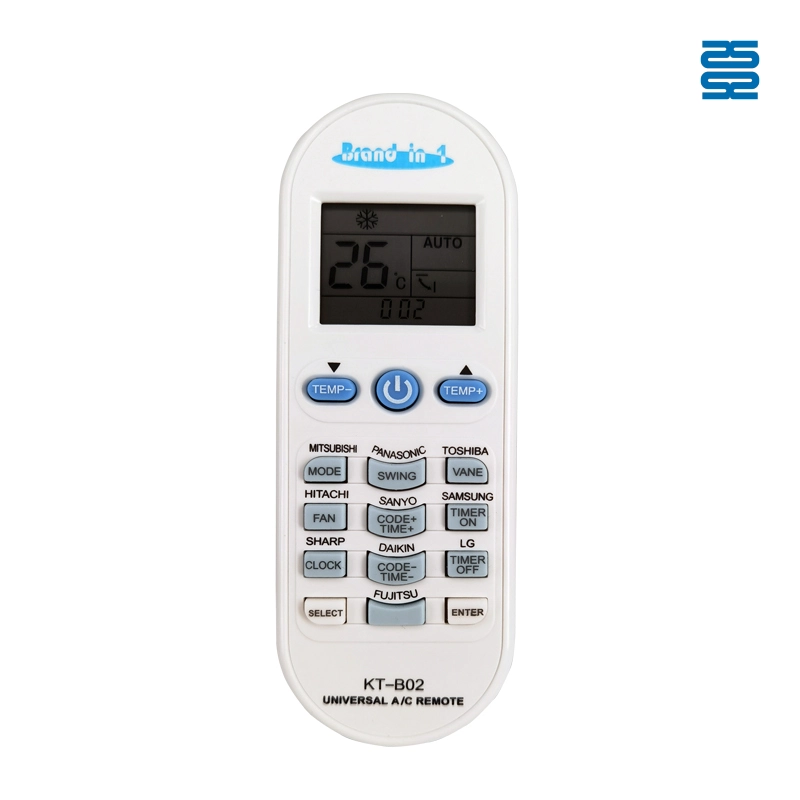
KT-B02 Universal Air Conditioner Remote Control Compatible with All Brands
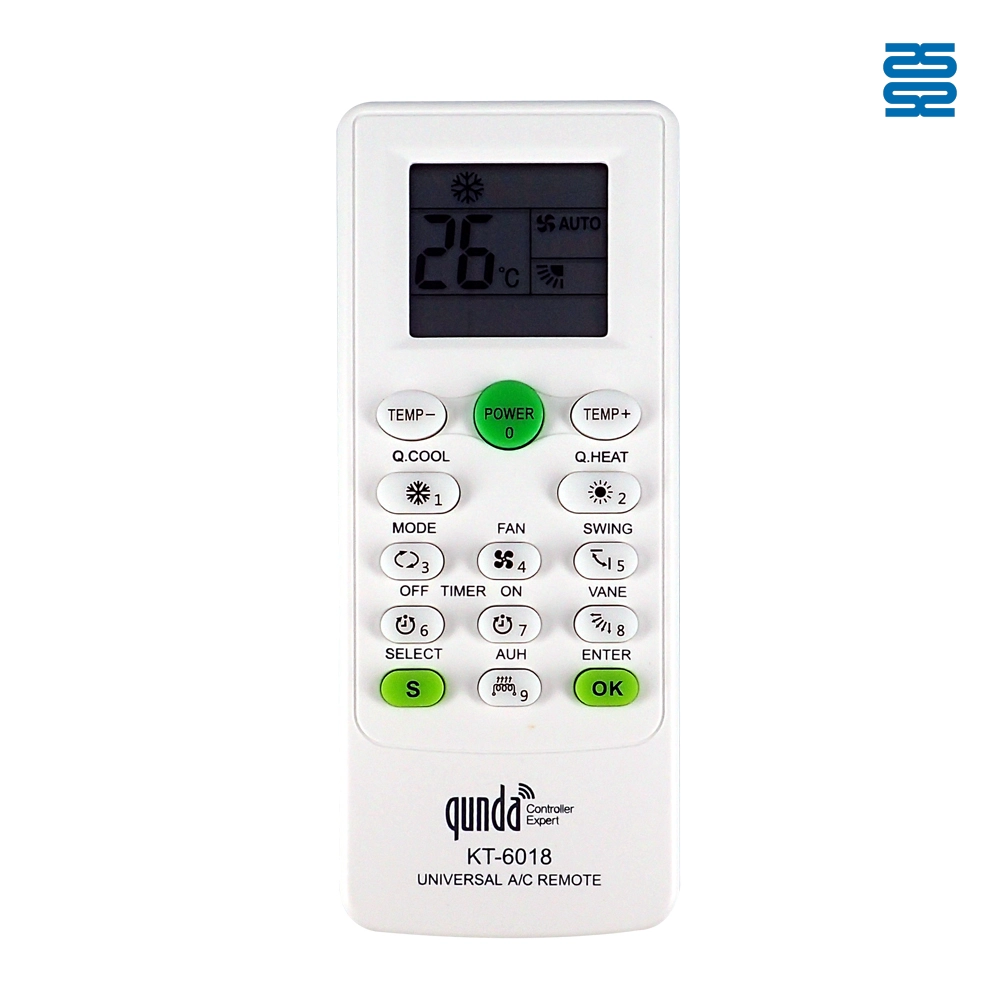
KT-6018 6000 in 1 Universal Air Conditioner Remote Control Compatible with All Brands

QD-1000 IN 1 1000 Code in 1 Universal Air Conditioner Remote Control Compatible with All Brands

KT-N828 Universal Air Conditioner Remote Control Compatible with All Brands
Get the latest updates
If you have any comments or good suggestions, please leave us a message, later our professional staff will contact you as soon as possible.


Contact
Email us
Text or Call us
Address
Room 1606, No. 65, Zhongshan Seven Road, Liwan District, Guangzhou, Guangdong, China.

Facebook
Instagram
YouTube
Tik Tok
VK