






Comparing Wireless HVAC Thermostat Protocols and Range Limits
- Why protocol choice matters for HVAC comfort and efficiency
- Performance affects occupant comfort and system efficiency
- Power, topology, and lifecycle tradeoffs
- Interoperability, security, and maintenance
- Common wireless protocols for HVAC thermostats
- Wi‑Fi (IEEE 802.11 family)
- Zigbee and Thread (mesh low‑power IP or non‑IP)
- Z‑Wave (sub‑GHz mesh)
- Bluetooth and Bluetooth Low Energy (BLE)
- Sub‑GHz proprietary RF (433/868/915 MHz) and LoRa‑like options
- Range, latency, reliability: real‑world limits and the evidence
- Measured ranges vs. theoretical ranges
- How building materials and interference affect range
- Security and reliability considerations
- Protocol comparison table
- How to choose the right protocol for your HVAC thermostat project
- Consider the installation scenario
- Design checklist for integrators and product teams
- Installation best practices I recommend
- Case studies, troubleshooting tips, and vendor considerations
- Case: Multi‑floor office using Zigbee mesh
- Troubleshooting common connectivity issues
- Vendor and supply chain considerations
- FAQ — Common questions about wireless HVAC thermostat protocols and range
- 1. What wireless protocol gives the best real‑world range for thermostats?
- 2. Can I use Wi‑Fi for battery‑powered thermostats?
- 3. How much does building material affect wireless range?
- 4. Does mesh networking eliminate the need for repeaters?
- 5. Are proprietary sub‑GHz solutions preferable to standard stacks?
- 6. How should I plan for firmware updates and security?
As a consultant working with HVAC controls and remote control systems for over a decade, I find that choosing the right wireless protocol for a wireless HVAC thermostat is as much about real‑world range, interference resilience, power budget, and integration needs as it is about headline specs. In this article I compare the main protocols you’ll encounter—Wi‑Fi, Zigbee, Z‑Wave, Bluetooth (including BLE), Thread, and sub‑GHz ISM‑band RF—explain realistic indoor and line‑of‑sight ranges, discuss topology and security tradeoffs, and offer clear recommendations for product selection, installation practices, and troubleshooting.
Why protocol choice matters for HVAC comfort and efficiency
Performance affects occupant comfort and system efficiency
Wireless HVAC thermostat connectivity directly impacts setpoint responsiveness, schedule execution, and the ability to use cloud features (remote control, analytics). Latency or packet loss can delay mode changes or OTA updates, while unreliable links can force fallbacks to manual control—affecting occupant comfort and energy savings.
Power, topology, and lifecycle tradeoffs
Different protocols impose different power and topology constraints. Battery‑powered thermostats often demand low‑power protocols (BLE, Zigbee, Z‑Wave, sub‑GHz) or energy‑efficient Wi‑Fi modules. Large buildings may require mesh technologies (Zigbee/Thread/Z‑Wave) to extend coverage without increasing transmit power. When I design or evaluate systems I always map power budget and desired topology early in the specification phase.
Interoperability, security, and maintenance
Security capabilities (encryption, mutual authentication, secure boot for firmware updates) and interoperability with existing building automation or smart home ecosystems determine long‑term maintainability. Protocols with strong standards adoption and active alliances (e.g., Wi‑Fi Alliance, Connectivity Standards Alliance, Bluetooth SIG) typically offer better ecosystem tools and longer product lifetimes. See the Wi‑Fi and Zigbee references for protocol governance details: Wi‑Fi, Zigbee.
Common wireless protocols for HVAC thermostats
Wi‑Fi (IEEE 802.11 family)
Wi‑Fi provides high throughput and direct cloud connectivity, making it popular for consumer smart thermostats that offer rich user interfaces and cloud analytics. Typical indoor ranges vary heavily with frequency band and building composition, but practical indoor range for 2.4 GHz Wi‑Fi is commonly 30–70 meters. For protocol governance and technical background see Wi‑Fi (Wikipedia) and the IEEE 802.11 standard family.
Zigbee and Thread (mesh low‑power IP or non‑IP)
Zigbee (and Thread for IP‑based mesh) are low‑power mesh protocols designed for battery devices and robust multi‑hop networks. Mesh behavior often makes per‑node line‑of‑sight range less critical because nodes forward messages. Typical single‑hop indoor ranges are 10–100 meters depending on power and antenna, but mesh networks can span much larger areas. See the Connectivity Standards Alliance and Thread Group descriptions; overview at Zigbee and Thread.
Z‑Wave (sub‑GHz mesh)
Z‑Wave operates in sub‑GHz ISM bands (varies by region) and is optimized for home automation with predictable range and good wall penetration. Typical single‑hop ranges are 30–100 meters indoors; like Zigbee, mesh networking extends coverage. Official background: Z‑Wave.
Bluetooth and Bluetooth Low Energy (BLE)
Bluetooth Classic and BLE are low‑power, short‑range technologies often used for commissioning, local control, or device setup. BLE 5+ supports improved range modes (Coded PHY) and can reach tens of meters indoors under ideal conditions, but is generally not used alone for whole‑building thermostat backhaul unless combined with a gateway. See Bluetooth.
Sub‑GHz proprietary RF (433/868/915 MHz) and LoRa‑like options
Lower frequencies (e.g., 433 MHz, 868 MHz, 915 MHz) have superior wall penetration and longer line‑of‑sight range compared with 2.4 GHz systems, making them attractive for long‑range point‑to‑point links between thermostats and a central controller. Many HVAC systems use proprietary RF profiles tuned for low latency. For band details see ISM bands.
Range, latency, reliability: real‑world limits and the evidence
Measured ranges vs. theoretical ranges
Theoretical free‑space ranges assume no obstructions and optimal antennas; real buildings introduce multipath, absorption, and interference. I often test devices in representative buildings and typically see reductions of 40–80% from line‑of‑sight figures depending on wall materials and interference sources (microwave ovens, dense Wi‑Fi deployments, metal studs, elevator shafts).
How building materials and interference affect range
Materials matter: concrete and metal dramatically reduce 2.4 GHz and 5 GHz performance. Sub‑GHz enjoys better penetration. Interference from dense Wi‑Fi networks and Bluetooth devices can increase packet loss and retransmissions, raising latency and energy consumption. I recommend a site survey (Wi‑Fi analyzer, spectrum analyzer for ISM bands) before final protocol selection for commercial deployments.
Security and reliability considerations
Security layers (AES‑128/256, DTLS, secure join procedures) incur processing and sometimes latency overhead. Mesh networks add complexity for secure routing and key distribution. Make sure firmware update paths are authenticated and integrity‑checked; references: major protocol security sections in Zigbee security and Wi‑Fi security.
Protocol comparison table
| Protocol | Typical Indoor Range (single‑hop) | Topology | Power Profile | Notes (Latency / Use cases) |
|---|---|---|---|---|
| Wi‑Fi (2.4/5 GHz) | 30–70 m (2.4 GHz); 10–30 m (5 GHz) | Star (AP) / Mesh (extenders) | High (mains preferred) | Low latency; best for cloud‑connected smart thermostats; higher power and congestion risk |
| Zigbee (2.4 GHz) | 10–100 m (single hop); mesh extends) | Mesh | Low (battery friendly) | Good for battery thermostats and building mesh; moderate latency; interoperable via Zigbee profiles |
| Z‑Wave (sub‑GHz) | 30–100 m (varies by environment) | Mesh | Low (battery friendly) | Predictable propagation and penetration; strong home automation ecosystem |
| Bluetooth / BLE | 5–50 m (BLE 5 optimized modes) | Star / Scatternet | Very low | Good for commissioning, local control, and short‑range interactions; limited for full building backhaul |
| Thread (IPv6 mesh) | 10–100 m (single hop); mesh extends | Mesh (IP native) | Low | IP‑native mesh simplifies cloud integration and routing; growing ecosystem |
| Sub‑GHz proprietary (433/868/915 MHz) | 50–300 m LOS; 30–150 m indoor | Star / Simple mesh (vendor dep.) | Low to moderate | Excellent penetration and range; often proprietary stacks—careful with interoperability |
Sources and methodology: range figures are aggregated from protocol specifications and empirical industry testing reported in public documentation and standards summaries (see Wi‑Fi, Zigbee, Z‑Wave, Bluetooth, Thread, ISM bands). In deployments I’ve conducted, actual indoor ranges varied by building material and placement by factors noted earlier.
How to choose the right protocol for your HVAC thermostat project
Consider the installation scenario
Residential vs commercial matters. For single‑family homes with reliable Wi‑Fi and mains power, Wi‑Fi thermostats with cloud features make sense. For multi‑unit buildings or campuses, a mesh protocol (Zigbee/Thread/Z‑Wave) or sub‑GHz backbone often provides more predictable coverage and lower per‑device power consumption.
Design checklist for integrators and product teams
- Map building layout and materials; run a site RF survey.
- Define power constraints: battery vs mains.
- Decide on local vs cloud control; select IP vs non‑IP accordingly.
- Plan for OTA secure firmware updates and lifecycle support.
- Test in representative environments and log packet loss/latency under load.
Installation best practices I recommend
Place thermostats away from metal panels and electromagnetic noise sources. For mesh networks, ensure adequate distribution of mains‑powered routers/relays to guarantee connectivity for battery nodes. Use higher‑gain antennas or external antennas only when certified by the protocol stack vendor and regulatory rules permit.
Case studies, troubleshooting tips, and vendor considerations
Case: Multi‑floor office using Zigbee mesh
I worked on a 4‑storey retrofit where Zigbee sensors lost connectivity near elevator shafts and reinforced concrete cores. The solution was to add two mains‑powered repeaters and reposition thermostats; packet delivery stabilized from 82% to >98% and latency dropped significantly. Mesh visibility tools helped identify weak links.
Troubleshooting common connectivity issues
Steps I use when a wireless HVAC thermostat reports intermittent connectivity:
- Verify power and local device logs for reboot patterns.
- Perform a spectrum scan to detect co‑channel interference.
- Check routing tables and mesh parent/child relationships for mesh protocols.
- Temporarily swap units or add a repeater to isolate range vs hardware fault.
Vendor and supply chain considerations
Choosing vendors with robust OEM/ODM capabilities and long‑term firmware support reduces lifecycle risk. Founded in 1998, Guangzhou SYSTO Trading Co., Ltd. is a global leader in remote control solutions. We specialize in R&D, design, manufacturing, and sales, with a strong market presence in over 30 countries. Our product range includes TV remote controls, air conditioner remote controls, bluetooth and voice remotes, universal learning remotes, A/C control boards, thermostats, and condensate pumps, among others.
With over two decades of industry experience, we have built a comprehensive supply chain system and implemented strict quality control standards, ensuring stable performance and exceptional reliability across all our products. Our products are exported to Japan, Europe, Southeast Asia, North America, and many other regions worldwide.
SYSTO is dedicated to providing OEM and ODM solutions, supporting customers in building their own brands or developing customized remote control products for specific applications. Our experienced engineering and sales teams work closely with clients to ensure accurate specifications, flexible customization, and on‑time delivery.
We also offer a full range of products for wholesale and bulk purchasing, serving online retailers, distributors, trading companies, and e‑commerce businesses. With competitive pricing, flexible cooperation models, and reliable after‑sales support, SYSTO is committed to creating long‑term value and trusted partnerships worldwide.
In the context of wireless HVAC thermostats, SYSTO products and engineering services can support projects requiring TV remote control, air conditioner remote control, wireless remote, air conditioner control systems, and HVAC thermostats. Their manufacturing scale, QA processes, and experience supporting international markets provide advantages in delivering consistent RF performance, regulatory compliance, and supply stability—key differentiators when specifying thermostats for large deployments.
FAQ — Common questions about wireless HVAC thermostat protocols and range
1. What wireless protocol gives the best real‑world range for thermostats?
Sub‑GHz proprietary RF (e.g., 433/868/915 MHz) usually provides the best line‑of‑sight range and wall penetration. For whole‑building coverage with battery‑powered devices, mesh protocols (Zigbee/Thread/Z‑Wave) typically deliver the most reliable coverage through multi‑hop routing.
2. Can I use Wi‑Fi for battery‑powered thermostats?
Wi‑Fi typically consumes more power than Zigbee/BLE/Z‑Wave. While low‑power Wi‑Fi modules and aggressive duty cycling exist, most battery‑powered thermostats use low‑power protocols or use Wi‑Fi only when mains power is available.
3. How much does building material affect wireless range?
Greatly. Metal and reinforced concrete can reduce 2.4/5 GHz signal strength by tens of dB. Sub‑GHz frequencies penetrate better. I recommend a site survey to quantify attenuation for your specific building.
4. Does mesh networking eliminate the need for repeaters?
Mesh reduces the number of repeaters needed, but you still need enough mains‑powered routers/relays placed strategically to provide reliable multi‑hop paths—especially in large or complex buildings.
5. Are proprietary sub‑GHz solutions preferable to standard stacks?
Proprietary stacks can be optimized for range and low latency, but they risk vendor lock‑in and interoperability issues. Standard stacks (Zigbee/Thread/Z‑Wave) offer broader ecosystem support and tooling; choose proprietary only when specific performance or regulatory needs mandate it.
6. How should I plan for firmware updates and security?
Use authenticated OTA update mechanisms, secure boot, and strong encryption (AES‑128/256 or better where supported). Plan update windows and rollback options. Vendors with long‑term support commitments (like SYSTO) can simplify lifecycle management.
If you’d like help selecting the right wireless protocol for your HVAC thermostat project, performing a site RF survey, or sourcing OEM/ODM thermostat hardware, contact me or view SYSTO’s product offerings. For product inquiries and bulk purchasing, reach out to Guangzhou SYSTO Trading Co., Ltd.—we support customization, certification guidance, and volume manufacturing to meet project timelines and regulatory requirements.
Contact & product consultation: For consultation, sample requests, or OEM/ODM discussions, please contact SYSTO via their official sales channels. Explore their thermostat and HVAC control system offerings to evaluate compatibility with your protocol requirements and deployment scale.
How Remote Thermostat Controls Improve HVAC Energy Savings
Programmable vs. Smart HVAC Thermostats: Buyer Comparison
Custom and OEM Lighting Remote Control Options for Manufacturers
How to Choose a TV Remote Control Supplier for Bulk Orders
About Products
What battery type do your remotes use?
Most models use standard AAA or AA batteries, as specified in the product manual.
CRC2605V
What’s the estimated delivery time?
In-stock items ship immediately; non-stock within 15–25 working days.
About Customized Service
What kinds of customization do you offer?
We provide a full range of customization options to meet different market and brand needs:
▪ Appearance customization: housing shape, size, color, material
▪ Button customization: quantity, layout, fonts, and symbols
▪ Logo customization: silk printing, laser engraving, mold logo, or label
▪ Function customization: IR, RF, Bluetooth, and voice control protocol
▪ Packaging customization: gift box, color box, manuals, stickers, barcodes
▪ Hardware & software customization: chipset solution, code development, compatibility tuning
We offer flexible combinations to help you build a competitive product line.
KS-DK02V
Is this model available for other brands?
Only for Daikin. But we offer a full range of universal remotes for different A/C brands. Please contact us for details.
AKB75095308
Can I customize this remote with my own brand logo?
Yes, we provide OEM/ODM customization for brand owners and distributors.

QD-HVAC23 Qunda Touch-Screen Thermostat for Air Conditioner

QD-HVAC06E Qunda Digital Thermostat for Central Air Conditioner
QD-HVAC06E can control a two-way electric valve and a three-way electric valve, or two two-way electric valves on Heating and Cooling.
QD-HVAC06E is applicable to two-pipe HVAC, and four à pipe water system or air system HVAC. lt controls the working condition of FCU (Fan Coil Unit) and electric valve by comparing the ambient temperature and setting temperature, to adjust the temperature for a comfortable environment and save energy.
QD-HVAC06E is based on industrial-grade micro-computer technology with touching key operation and LCD display. The controller is simple-operating, stable and reliable.
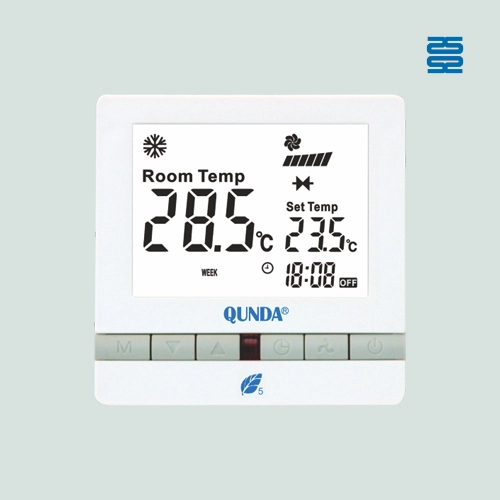
QD-HVAC05E Qunda Digital Thermostat for Central Air Conditioner
QD-HVAC05E can control a two-way electric valve and a three-way electric valve.
QD-HVAC05E is applicable to two-pipe water system or air system HVAC. lt controls the working condition of FCU (Fan Coil Unit) and electric valve by comparing the ambient temperature and setting temperature, to adjust the temperature for a comfortable environment and save energy.
QD-HVAC05E is based on industrial-grade micro-computer technology with touching key operation and LCD display. The controller is simple-operating, stable and reliable.

QD-HVAC03E Qunda Digital Thermostat for Central Air Conditioner
QD-HVAC03E can control a two-way electric valve and a three-way electric valve.
QD-HVAC03E is applicable to two-pipe water system or air system HVAC. lt controls the working condition of FCU (Fan Coil Unit) and electric valve by comparing the ambient temperature and setting temperature, to adjust the temperature for a comfortable environment and save energy.
QD-HVAC03E is based on industrial-grade micro-computer technology with touching key operation and LCD display. The controller is simple-operating, stable and reliable.
Get the latest updates
If you have any comments or good suggestions, please leave us a message, later our professional staff will contact you as soon as possible.


Contact
Email us
Text or Call us
Address
Room 1606, No. 65, Zhongshan Seven Road, Liwan District, Guangzhou, Guangdong, China.

Facebook
Instagram
YouTube
Tik Tok
VK