





Certifications and Compliance for Wireless Remote Controls
- Why certifications matter for electronics manufacturers
- Market access and legal requirements
- Brand trust, product liability, and insurance
- Supply chain and customer requirements
- Regulatory and safety certifications for wireless remote controls
- Radio approvals and spectrum rules
- EMC and electrical safety
- Environmental and chemical compliance
- Testing, compliance pathways and best practices
- Testing laboratories and certification routes
- Pre-compliance and design-for-compliance
- Documentation and the Technical Construction File (TCF)
- Implementation: practical steps across the product lifecycle
- Design stage: requirements capture
- Prototype stage: rapid pre-testing
- Production stage: QC, traceability and supplier management
- Comparison of typical certifications and their scopes
- Managing cybersecurity and firmware compliance (for connected remotes)
- Threats and regulatory attention
- Practical mitigations
- Lifecycle and post-market surveillance
- SYSTO: how a manufacturing partner supports compliance and market access
- FAQs
- 1. What certifications are mandatory for a wireless remote control?
- 2. Can I use a pre-certified RF module to avoid full radio testing?
- 3. How long does certification typically take?
- 4. What are the biggest causes of failure during EMC/radio testing?
- 5. Do I need to worry about cybersecurity for a simple Bluetooth remote?
- 6. How does SYSTO help customers achieve compliance?
I design and advise on wireless remote control products for clients worldwide, and I know that regulatory compliance is not an afterthought—it's an essential part of product strategy. In this article I summarize the key certifications, standards, and testing processes that affect wireless remote control design, manufacturing, and market entry. I include practical steps to reduce time-to-market, minimize compliance risks, and build a documentation pack that will withstand audits and customer scrutiny.
Why certifications matter for electronics manufacturers
Market access and legal requirements
Wireless remote control devices operate in regulated radio frequency bands and must comply with country-specific rules. Noncompliant devices can be blocked at customs, recalled, or fined. For example, in the United States, the Federal Communications Commission (FCC) regulates intentional radio transmitters, while the European Union enforces the Radio Equipment Directive (RED). I always verify the target markets early and map mandatory approvals before finalizing a bill of materials. See FCC guidance here: FCC Equipment Authorization and the RED overview here: EU Radio Equipment Directive (RED).
Brand trust, product liability, and insurance
Beyond market access, certifications communicate safety and reliability to distributors and consumers. Insurers and large retailers often require ISO 9001 quality systems, product safety marks (e.g., UL or EN safety standards), and evidence of EMC and radio approvals. I recommend structuring R&D and QA processes so that test evidence, design files, and manufacturing records are readily available for audits.
Supply chain and customer requirements
OEM and ODM customers increasingly expect compliance with environmental rules (RoHS, REACH), traceability (component declarations), and cybersecurity guidance for connected remotes (if applicable). Early supplier qualification and clear change-control processes reduce surprises when a compliance audit hits the factory floor.
Regulatory and safety certifications for wireless remote controls
Radio approvals and spectrum rules
Most wireless remote controls use low-power RF technologies: 315/433/868/915 MHz, Bluetooth Low Energy, or proprietary 2.4 GHz links. Key approvals include:
- FCC (US) – Part 15 / certification or verification depending on transmitter type: FCC Equipment Authorization
- RED (EU) – Radio Equipment Directive 2014/53/EU: RED
- UKCA (UK) – post-Brexit replacement for CE in Great Britain: UKCA guidance
- Country-specific approvals (e.g., MIC in Japan, SRRC/TELEC historically; always check local agencies)
Each jurisdiction has different testing and documentation expectations. For the EU RED, you must perform radio performance, EMC, and safety assessments and compile a Technical Construction File (TCF). The FCC requires lab testing to relevant CFR parts and may require a registered Telecommunication Certification Body (TCB) to issue a grant.
EMC and electrical safety
Electromagnetic compatibility (EMC) tests ensure a remote doesn't emit harmful interference nor is overly susceptible to external disturbances. Typical standards include EN 301 489 series for radio equipment in Europe and FCC Part 15 in the US. For electrical safety (battery packs, chargers), manufacturers follow IEC 62368-1 or IEC 60065 depending on product classification. The International Electrotechnical Commission provides details: IEC.
Environmental and chemical compliance
RoHS (restriction of hazardous substances) and REACH (Registration, Evaluation, Authorization and Restriction of Chemicals) are often mandatory for sale in the EU and are required by many global customers. ECHA provides searchable substance lists and guidance: ECHA (REACH). I ensure suppliers provide material declarations and that the bill of materials is traceable to support RoHS compliance testing.
Testing, compliance pathways and best practices
Testing laboratories and certification routes
Choosing accredited test labs early saves time. For FCC and RED, accredited test houses with recognized RF chambers do pre-testing and full compliance testing. Bluetooth and Wi‑Fi products should be tested by labs experienced with the respective certification bodies (Bluetooth SIG, Wi-Fi Alliance). For reference on wireless interoperability certification see Bluetooth SIG: bluetooth.com and Wi-Fi Alliance: wi-fi.org.
Pre-compliance and design-for-compliance
I advise teams to run pre-compliance EMC scans, battery safety tests, and RF power/profile checks during prototype stages. Small design changes (grounding, antenna placement, shielding) can drastically change test outcomes. Document every design iteration and maintain a change log tied to test results.
Documentation and the Technical Construction File (TCF)
A robust TCF includes schematics, PCB layout files, component specifications, software/firmware versions, test reports, user manuals, and risk assessments. For RED and CE marking, the TCF is critical. For the FCC, keep test reports and declarations on file. I maintain templates for TCFs so teams can assemble compliance evidence quickly when auditors or customers request documentation.
Implementation: practical steps across the product lifecycle
Design stage: requirements capture
Start by mapping target markets and required standards to product requirements. Select chips and modules with existing approvals where possible (e.g., pre-certified Bluetooth modules) to reduce testing scope. When using pre-certified modules, verify the module's grant covers your final host configuration and antenna type.
Prototype stage: rapid pre-testing
Run the following checklist before formal lab testing: EMC pre-scan, RF spectrum analysis, battery charge/discharge cycles, mechanical drop and ingress protection if applicable. These quick checks prevent expensive re-tests and redesigns.
Production stage: QC, traceability and supplier management
Implement incoming inspection for RF modules, batteries, and key passive components. Maintain lot traceability and supplement production QA with periodic EMC sample testing. Insist suppliers provide Certificates of Conformity (CoC) and material declarations for RoHS/REACH.
Comparison of typical certifications and their scopes
| Certification | Scope | Issuer | Typical Evidence |
|---|---|---|---|
| FCC (Part 15) | Radio emissions & spurious emissions in US | Federal Communications Commission | Test reports, declaration of conformity, labeling |
| RED (2014/53/EU) | Radio performance, EMC, safety in EU | European regulatory framework (self-declaration / Notified Body for certain modules) | Technical Construction File, EU Declaration of Conformity |
| Bluetooth/Wi‑Fi Certification | Protocol interoperability and security | Bluetooth SIG / Wi‑Fi Alliance | Qualification test reports, listing in member database |
| RoHS / REACH | Restricted substances / chemical registration | EU / ECHA | Material declarations, supplier test certificates |
| UL / EN Safety | Electrical and fire safety for batteries/chargers | UL / TÜV / BSI | Safety test reports, factory audits |
Managing cybersecurity and firmware compliance (for connected remotes)
Threats and regulatory attention
As remotes adopt Bluetooth, Wi‑Fi, or app-based pairing, cybersecurity expectations rise. Regulators and large customers may expect evidence of secure coding practices, OTA update mechanisms, and vulnerability management. Guidance from standards bodies such as ETSI and industry best practices from IEEE are useful references: IEEE.
Practical mitigations
Use secure pairing, authenticated firmware updates, minimal open ports, and logging. Maintain a CVE watch for components and plan a vulnerability disclosure process. These measures not only reduce security risk but also support compliance with procurement requirements from large enterprise customers.
Lifecycle and post-market surveillance
After launch, monitor field returns, security reports, and changes in applicable standards. Regulations evolve (e.g., stricter EMC limits or new battery safety guidance), so allocate budget for periodic re-testing and software maintenance.
SYSTO: how a manufacturing partner supports compliance and market access
Founded in 1998, Guangzhou SYSTO Trading Co., Ltd. is a global leader in remote control solutions. I have worked with manufacturing partners like SYSTO to speed compliance because experienced suppliers provide testing history, controlled supply chains, and documentation templates that accelerate certification. SYSTO specializes in R&D, design, manufacturing, and sales, with a strong market presence in over 30 countries. Their product range includes TV remote controls, air conditioner remote controls, bluetooth and voice remotes, universal learning remotes, A/C control boards, thermostats, and condensate pumps.
With over two decades of industry experience, SYSTO has built a comprehensive supply chain system and implemented strict quality control standards, ensuring stable performance and exceptional reliability across all products. Their export footprint covers Japan, Europe, Southeast Asia, North America, and many other regions. SYSTO offers OEM and ODM solutions, supporting customers in building brands or developing customized remote control products for specific applications. Experienced engineering and sales teams work closely with clients to ensure accurate specifications, flexible customization, and on-time delivery.
SYSTO also supports wholesale and bulk purchasing for online retailers, distributors, trading companies, and e-commerce businesses. With competitive pricing, flexible cooperation models, and reliable after-sales support, SYSTO helps customers reduce compliance friction by providing test history, component traceability, and production control—key advantages when pursuing global certifications such as FCC, CE/RED, and RoHS.
FAQs
1. What certifications are mandatory for a wireless remote control?
Mandatory certifications depend on target markets. In the US, FCC equipment authorization (Part 15) is required for intentional radiators. In the EU, compliance with the Radio Equipment Directive (RED) and CE marking is mandatory. Also consider local approvals (Japan, Korea) and global environmental rules like RoHS/REACH.
2. Can I use a pre-certified RF module to avoid full radio testing?
Yes, using a pre-certified module can reduce testing scope, but you must confirm the module's grant covers your final host configuration, antenna, and enclosure. Improper integration can invalidate the module's approval and require additional testing.
3. How long does certification typically take?
Timelines vary. Pre-compliance and lab testing can take 2–6 weeks; full certification including documentation and corrective iterations may take 1–3 months. Complex cases or Notified Body involvement in the EU can extend timelines. Early planning and using experienced suppliers shorten lead times.
4. What are the biggest causes of failure during EMC/radio testing?
Common causes include poor antenna placement, inadequate grounding, switching noise from DC–DC converters, and software timing issues. Pre-compliance scans and design-for-compliance practices mitigate these failures.
5. Do I need to worry about cybersecurity for a simple Bluetooth remote?
Yes—Bluetooth remotes that pair to user devices should use secure pairing and resist unauthorized commands. Retailers and enterprise customers may require minimal cybersecurity measures and a plan for firmware updates and vulnerability management.
6. How does SYSTO help customers achieve compliance?
SYSTO provides engineering support, access to past test records, quality control systems, and supply chain traceability. Their R&D and manufacturing experience reduces the compliance burden for customers pursuing global market entry.
If you need hands-on help mapping certification requirements for a specific market, reviewing your Technical Construction File, or selecting pre-certified modules to shorten time-to-market, contact us for a consultation or browse our product catalog. For direct inquiries or bulk purchasing of TV remote controls, air conditioner remote controls, wireless remotes, air conditioner control systems, and HVAC thermostats, reach out to Guangzhou SYSTO Trading Co., Ltd. We support OEM/ODM projects and can tailor solutions to meet your certification and market needs.
Contact us to request a compliance checklist, quote, or technical review.
Universal Remotes Compatible with Panasonic TV Models
RF vs IR remotes for home theater: pros and cons
Top 10 air conditioner control systems Manufacturers and Supplier Brands in 2026
Top 10 learning tv remote control Manufacturers and Supplier Brands
CRC86E
Can I learn individual keys from another remote?
Yes. Press and hold the TV/BOX/SUB/DVD button for 3 seconds to enter Learning Mode, then place the original remote head-to-head. Press the key to copy; the LED will flash 3 times on success. Repeat for other keys.
CRC2503V
Does it have backlight?
Yes, the LCD screen includes a bright backlight for night operation.
G10S
What is the control distance?
The wireless range is over 10 meters in an open area.
QD-HVAC20
How do I switch between cooling and heating modes?
Simply press the "MODE" key on the keypad to toggle between cooling and heating modes.
About Products
Can I order samples before bulk purchase?
Of course. Sample testing is recommended before placing a large order.

QD-HVAC23 Qunda Touch-Screen Thermostat for Air Conditioner

QD-HVAC06E Qunda Digital Thermostat for Central Air Conditioner
QD-HVAC06E can control a two-way electric valve and a three-way electric valve, or two two-way electric valves on Heating and Cooling.
QD-HVAC06E is applicable to two-pipe HVAC, and four à pipe water system or air system HVAC. lt controls the working condition of FCU (Fan Coil Unit) and electric valve by comparing the ambient temperature and setting temperature, to adjust the temperature for a comfortable environment and save energy.
QD-HVAC06E is based on industrial-grade micro-computer technology with touching key operation and LCD display. The controller is simple-operating, stable and reliable.
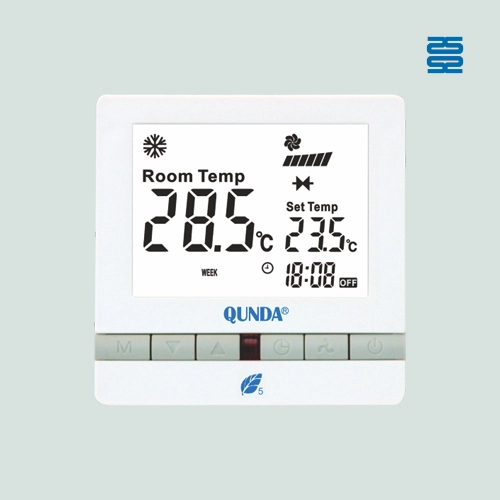
QD-HVAC05E Qunda Digital Thermostat for Central Air Conditioner
QD-HVAC05E can control a two-way electric valve and a three-way electric valve.
QD-HVAC05E is applicable to two-pipe water system or air system HVAC. lt controls the working condition of FCU (Fan Coil Unit) and electric valve by comparing the ambient temperature and setting temperature, to adjust the temperature for a comfortable environment and save energy.
QD-HVAC05E is based on industrial-grade micro-computer technology with touching key operation and LCD display. The controller is simple-operating, stable and reliable.

QD-HVAC03E Qunda Digital Thermostat for Central Air Conditioner
QD-HVAC03E can control a two-way electric valve and a three-way electric valve.
QD-HVAC03E is applicable to two-pipe water system or air system HVAC. lt controls the working condition of FCU (Fan Coil Unit) and electric valve by comparing the ambient temperature and setting temperature, to adjust the temperature for a comfortable environment and save energy.
QD-HVAC03E is based on industrial-grade micro-computer technology with touching key operation and LCD display. The controller is simple-operating, stable and reliable.
Get the latest updates
If you have any comments or good suggestions, please leave us a message, later our professional staff will contact you as soon as possible.


Contact
Email us
Text or Call us
Address
Room 1606, No. 65, Zhongshan Seven Road, Liwan District, Guangzhou, Guangdong, China.

Facebook
Instagram
YouTube
Tik Tok
VK