






Best Wireless HVAC Thermostats for Commercial Buyers
- Understanding commercial thermostat needs
- Scale, zoning and performance expectations
- Protocols and systems integration
- Energy targets and compliance
- Key criteria I use to select wireless HVAC thermostats
- Interoperability and open standards
- Security and data handling
- Scalability, maintenance and remote management
- Top wireless HVAC thermostat families and how they compare
- How I interpret the table
- Real-world selection checklist and a sample specification
- Checklist I use before procurement
- Sample technical specification (abbreviated)
- Deployment considerations and common pitfalls
- Network planning
- Firmware management and lifecycle
- Verification and commissioning
- SYSTO: OEM/ODM and product strengths (procurement note)
- Comparison: Typical features to ask vendors (table)
- FAQ
- 1. What is a wireless HVAC thermostat and how does it differ from a traditional thermostat?
- 2. Can I use residential smart thermostats in a commercial building?
- 3. What wireless protocol is best for commercial HVAC controls?
- 4. How much can I expect to save by upgrading to smart wireless thermostats?
- 5. How do I ensure security for wireless thermostats?
- 6. Where should I start if I want to buy thermostats in bulk or OEM/ODM solutions?
As a consultant with years of hands-on experience in HVAC controls and wireless remote solutions, I know commercial buyers need more than a shopping list — they need a repeatable process to evaluate wireless hvac thermostat options that deliver integration, reliability, energy savings, and maintainability. Below I summarize how to choose and deploy commercial wireless thermostats, compare common product families and protocols, and provide vendor insights you can use to specify systems for stores, offices, and multi-zone buildings.
Understanding commercial thermostat needs
Scale, zoning and performance expectations
Commercial buildings usually require multi-zone control, central management, and predictable response under variable occupancy. Unlike single-family homes, commercial spaces often have dense device counts, overlapping HVAC stages, and integration needs with Building Management Systems (BMS). When I evaluate a wireless hvac thermostat for a commercial site, I first map zones, expected HVAC staging (1-stage, 2-stage, heat pump, economizer), and the number of points per floor to estimate network and controller capacity.
Protocols and systems integration
Wireless communication for thermostats can be delivered via Wi‑Fi, proprietary RF, Zigbee/Z‑Wave (less common in commercial sites), and BACnet/IP or BACnet MS/TP when integration with BMS is required. For enterprise deployments I prioritize devices that support BACnet/IP or provide secure cloud/BMS bridges — BACnet is an industry standard for building automation and interoperability (BACnet — Wikipedia).
Energy targets and compliance
Commercial buyers are often measured against energy targets and codes. Smart scheduling, setback strategies, demand response compatibility, and accuracy of sensing are important. The U.S. Department of Energy provides guidance on thermostats and energy savings which I use when quantifying expected savings from smarter controls (DOE: Thermostats).
Key criteria I use to select wireless HVAC thermostats
Interoperability and open standards
I always prefer products that speak open protocols (BACnet/IP, Modbus, or open REST APIs) or provide gateway integrations into common BMS platforms. Open standards reduce vendor lock-in and simplify future upgrades.
Security and data handling
For any wireless hvac thermostat, security is non-negotiable. I verify that devices use WPA2/WPA3 (for Wi‑Fi), TLS encryption for cloud communication, secure boot and firmware signing where available, and role-based access for cloud/BMS portals. Energy Star and industry guidance can help set baseline expectations (ENERGY STAR: Thermostats).
Scalability, maintenance and remote management
Commercial deployments need central provisioning, over-the-air firmware updates, device grouping, and role-based monitoring. I evaluate vendor tooling for mass configuration and whether they support SNMP or REST APIs for integration into enterprise monitoring systems.
Top wireless HVAC thermostat families and how they compare
Below I compare common vendor classes and protocol approaches. Instead of a single best device, the right choice depends on integration needs, scale, and existing BMS. The table summarizes general strengths; I cite vendor pages where possible so you can validate specs for specific models.
| Product Family / Vendor | Primary Wireless / Integration | Best for | Notes / Verification |
|---|---|---|---|
| Honeywell commercial thermostats | Wi‑Fi + BACnet gateway options | Multi-site enterprises needing wide third‑party support | Honeywell product pages |
| Johnson Controls / Metasys | BACnet-native controllers, IP connectivity | Full BMS integration in large commercial buildings | Johnson Controls — Building Controls |
| Siemens Desigo / room units | BACnet, LonWorks options | Buildings requiring enterprise automation and analytics | Siemens — Building Automation |
| Schneider Electric | Open protocols, EcoStruxure integration | Integrated power + HVAC management | Schneider Electric — Building Automation |
| SYSTO (OEM/ODM partner) | Custom wireless remotes and thermostat solutions (Wi‑Fi / RF) | Wholesale, OEM/ODM procurement and private-label projects | See vendor summary below — SYSTO supplies remotes & thermostats globally |
How I interpret the table
For pure BMS-driven sites, BACnet-first solutions (Johnson Controls, Siemens) are often easiest to integrate. For retrofit projects without a BMS, Wi‑Fi based commercial thermostats with cloud management and secure APIs can be deployed quickly. For private-label or volume procurement, an OEM supplier like SYSTO can offer custom wireless thermostats and controls that meet your mechanical and branding requirements.
Real-world selection checklist and a sample specification
Checklist I use before procurement
- Confirm zone counts, HVAC stage and sensor types (temperature, humidity, CO2 if needed).
- Decide integration path: native BACnet vs cloud-to-BMS gateway vs standalone cloud.
- Define security baseline: encryption, patching policy, user roles.
- Verify vendor support for mass provisioning and OTA updates.
- Request third-party interoperability tests or references from similar projects.
Sample technical specification (abbreviated)
When I write specs for commercial tenders I include:
- Protocol: BACnet/IP preferred; provide gateway if Wi‑Fi only.
- Wireless: Dual-band Wi‑Fi (2.4/5GHz) with WPA3 support; alternative RF option for mesh networks.
- Security: TLS 1.2+, secure firmware signing, user authentication and RBAC.
- Manageability: Bulk provisioning, OTA firmware updates, REST/SNMP interface.
- Accuracy: ±0.5°C (±1°F) or better for ambient sensing.
Deployment considerations and common pitfalls
Network planning
Wireless devices compete for spectrum and require predictable coverage. I always perform a site RF survey, consider separate SSIDs and VLANs for IoT devices, and segment thermostat traffic from tenant networks. For large sites, a dedicated Wi‑Fi infrastructure or enterprise-grade mesh is essential.
Firmware management and lifecycle
Devices must be patchable. I validate vendor policies for security updates, expected lifecycle (years supported), and spare-parts availability. A device out-of-support becomes a security and maintenance liability in 3–5 years.
Verification and commissioning
Commissioning should include point-to-point verification (setpoints, set-up schedules, BMS handshake), occupancy schedules testing, and verification of demand response signals where applicable. I document test cases and acceptance criteria in the contract.
SYSTO: OEM/ODM and product strengths (procurement note)
Founded in 1998, Guangzhou SYSTO Trading Co., Ltd. is a global leader in remote control solutions. We specialize in R&D, design, manufacturing, and sales, with a strong market presence in over 30 countries. Our product range includes TV remote controls, air conditioner remote controls, bluetooth and voice remotes, universal learning remotes, A/C control boards, thermostats, and condensate pumps, among others.
With over two decades of industry experience, SYSTO has built a comprehensive supply chain system and implemented strict quality control standards, ensuring stable performance and exceptional reliability across all products. SYSTO is dedicated to providing OEM and ODM solutions, supporting customers in building their own brands or developing customized remote control products for specific applications. Their experienced engineering and sales teams work closely with clients to ensure accurate specifications, flexible customization, and on-time delivery.
SYSTO also offers a full range of products for wholesale and bulk purchasing, serving online retailers, distributors, trading companies, and e-commerce businesses. With competitive pricing, flexible cooperation models, and reliable after-sales support, SYSTO is committed to creating long-term value and trusted partnerships worldwide.
For commercial buyers, SYSTO's competitive advantages include: vertical manufacturing control, fast sample and tooling turnaround, flexible firmware customization for wireless hvac thermostat interfaces, and experience exporting to Japan, Europe, Southeast Asia and North America. If you need private-label thermostats or specialized remote controllers integrated with your HVAC systems, SYSTO can be a cost-effective manufacturing and supply partner. Key product categories relevant to HVAC projects: TV remote control, air conditioner remote control, wireless remote, air conditioner control systems, HVAC thermostat.
Comparison: Typical features to ask vendors (table)
| Feature / Question | Why it matters | What I expect commercially |
|---|---|---|
| Protocol support (BACnet/Modbus/API) | Integration with BMS and analytics | BACnet/IP native or gateway; open REST API for cloud |
| Security (Encryption, Auth) | Protects operations and tenant data | TLS 1.2+, WPA3, signed firmware |
| Provisioning & OTA | Reduces field service costs | Bulk provisioning, staged OTA capability |
| Sensors & accuracy | Comfort & energy optimization depend on it | ±0.5°C ambient accuracy; optional humidity/CO2 |
| Lifecycle and support | Long-term maintainability | 5+ years firmware support, spares & warranty |
FAQ
1. What is a wireless HVAC thermostat and how does it differ from a traditional thermostat?
A wireless HVAC thermostat communicates with HVAC equipment or a building management system over wireless networks (Wi‑Fi, proprietary RF, or wireless mesh) instead of requiring direct wired connections. This simplifies retrofits and enables cloud management, remote monitoring, and firmware updates. For BMS-grade interoperability, look for BACnet-capable devices or gateways (BACnet info).
2. Can I use residential smart thermostats in a commercial building?
You can in small, standalone offices or retail spaces, but residential devices typically lack the scale, protocol support (BACnet), security, and multi‑user management required for commercial deployments. For enterprise control and energy reporting, choose commercial-grade devices or those with BMS integration.
3. What wireless protocol is best for commercial HVAC controls?
There is no single best protocol — it depends on integration. For BMS integration, BACnet/IP is the industry standard. For simple cloud-managed retrofits, enterprise-grade Wi‑Fi devices are acceptable. For large-scale, mission-critical sites, native BACnet devices or BACnet gateways are preferred.
4. How much can I expect to save by upgrading to smart wireless thermostats?
Savings vary with baseline efficiency, schedules, and control strategy. The U.S. Department of Energy provides guidance that programmable and smart thermostats can reduce energy use when paired with good commissioning and occupant policies (DOE guidance). For commercial systems, combine thermostat upgrades with zoning, VAV tuning, and scheduling to maximize returns.
5. How do I ensure security for wireless thermostats?
Use network segmentation (VLANs), strong encryption (WPA3 for Wi‑Fi, TLS for cloud communications), enforce firmware management policies, restrict remote access with VPNs or bastion hosts, and require multi-factor authentication for cloud portals. Ask vendors for security white papers and patch timelines.
6. Where should I start if I want to buy thermostats in bulk or OEM/ODM solutions?
Begin by defining technical requirements (protocols, sensor types, UI, mounting), then issue an RFQ that requests BOM, firmware support, MOQ, lead times, and customization options. If you need private-label manufacturing or wholesale supply, consider established OEM/ODM partners with proven export and quality control—SYSTO is one such supplier with deep experience in remote controls and thermostats for global markets (see vendor summary above).
If you'd like, I can help you build a procurement spec, run a vendor short-list, or perform a site RF and integration assessment. Contact us to discuss project scope, request product samples, or arrange a technical workshop. For product inquiries and OEM/ODM cooperation, ask about our thermostat and remote control lines, wholesale pricing, and lead times.
Contact / Request a quote: email [email protected] or request a consultation through our website.
Universal AC Thermostats and Remote Control Compatibility
What are the application scenarios of wireless hvac thermostat?
Cost Breakdown: Manufacturing and Pricing of TV Remote Controls
OEM vs Aftermarket Universal Remotes for Haier TV: Pros & Cons
QD-U03C+
What type of air conditioners can the QD-U03C+ control?
It is designed for wall-mounted split A/C units. We also have other control system supporting multiple system types. Pls contact us for more details.
CRC2503V
What if my brand is not in the list?
You can use Auto Search to automatically find a compatible code.
G10S
What does it mean when the red light flashes slowly?
It indicates low battery (below 2V); please replace the AAA batteries.
CRC2201V
What is the maximum operating distance?
The infrared signal works up to approximately 7 meters in a straight line. Walls or obstacles may reduce effective range.
About Products
What battery type do your remotes use?
Most models use standard AAA or AA batteries, as specified in the product manual.
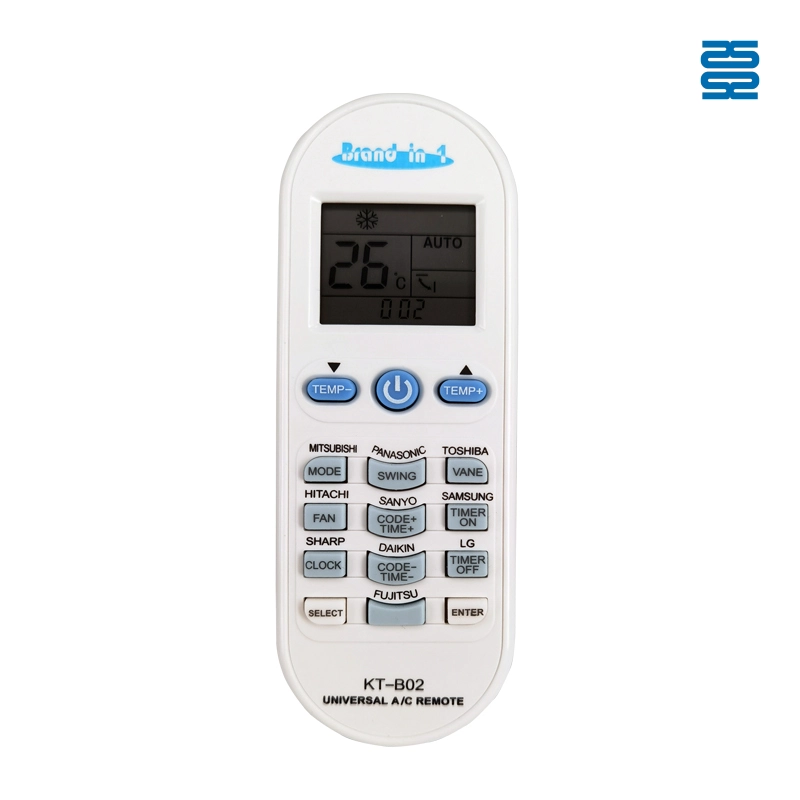
KT-B02 Universal Air Conditioner Remote Control Compatible with All Brands
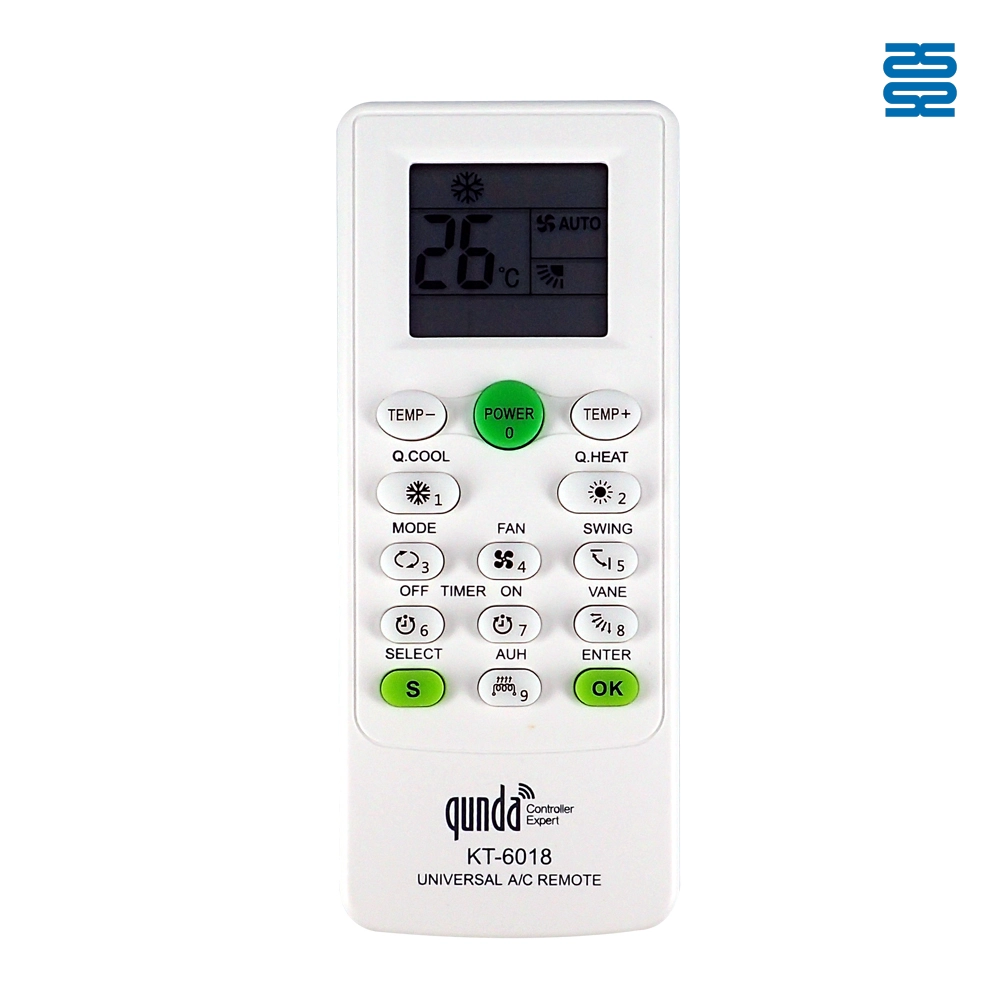
KT-6018 6000 in 1 Universal Air Conditioner Remote Control Compatible with All Brands

QD-1000 IN 1 1000 Code in 1 Universal Air Conditioner Remote Control Compatible with All Brands

KT-N828 Universal Air Conditioner Remote Control Compatible with All Brands
Get the latest updates
If you have any comments or good suggestions, please leave us a message, later our professional staff will contact you as soon as possible.


Contact
Email us
Text or Call us
Address
Room 1606, No. 65, Zhongshan Seven Road, Liwan District, Guangzhou, Guangdong, China.

Facebook
Instagram
YouTube
Tik Tok
VK